What Is Cloud Cost Optimization? Guide – Cloud Cost…
March 3, 2026|9:44 AM
Unlock Your Digital Potential
Whether it’s IT operations, cloud migration, or AI-driven innovation – let’s explore how we can support your success.
Home /
Work /
Blogs /
What Is Cloud Cost Optimization? Guide – Cloud Cost…
In today’s dynamic digital landscape, cloud computing has become an indispensable backbone for businesses of all sizes. While it offers unparalleled agility, scalability, and innovation, uncontrolled cloud spending can quickly erode its perceived benefits. This guide delves deeply into what is cloud cost optimization?, providing a comprehensive understanding of this critical practice.
Effectively managing your cloud resources and expenses is not just about cutting costs; it’s about maximizing value. Cloud cost optimization ensures that your organization gets the most out of its cloud investment, aligning spending with business objectives. It’s a strategic process that demands continuous attention and refinement.
Understanding what is cloud cost optimization?
Cloud cost optimization refers to the process of reducing your overall cloud spending by identifying mismanaged resources, eliminating waste, and matching resource allocation to actual demand. At its core, it’s about achieving maximum value from your cloud investment while maintaining or improving performance. This concept involves a deep dive into your cloud spending definition across various services and accounts.
It’s a proactive and ongoing effort, not a one-time project. Organizations that truly understand what is cloud cost optimization? embrace it as an integral part of their cloud strategy. This continuous analysis ensures that resources are utilized efficiently, avoiding unnecessary expenditures.
Cost efficiency explained in the cloud context means getting the best performance and reliability for the lowest possible cost. This doesn’t necessarily mean using the cheapest services but rather the most appropriately priced services for your specific workloads and performance requirements. Effective optimization can unlock significant savings and free up budget for further innovation.
The Indispensable Role of Cloud Cost Optimization
The shift to cloud computing often brings the promise of lower infrastructure costs and greater flexibility. However, without diligent management, these benefits can be overshadowed by escalating bills, leading many to ask, `why optimize cloud expenses`? The answer lies in sustainable growth and competitive advantage. Proactive optimization transforms cloud spending from a potential burden into a strategic asset.
One of the primary drivers for this practice is the sheer complexity of cloud billing models. With numerous services, pricing tiers, and regional differences, `understanding cloud finance` can be daunting for even experienced IT teams. Optimization provides the clarity needed to make informed financial decisions.
The `economic benefits of cloud` are fully realized only when costs are actively managed. This includes not just direct savings but also improved operational efficiency and faster time to market due to better resource allocation. Without optimization, companies risk overprovisioning, underutilizing, and ultimately wasting valuable budget.
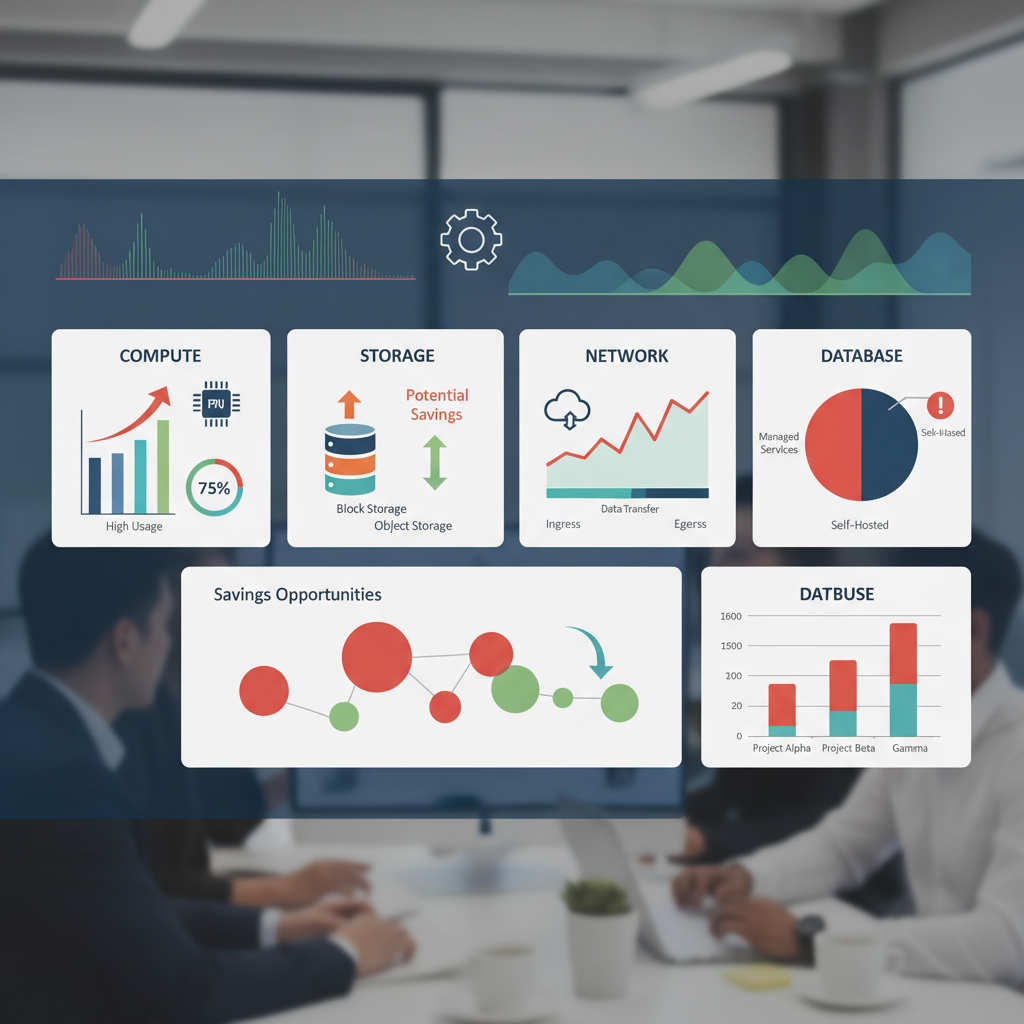
A dashboard showing various cloud service costs (compute, storage, network, database) broken down by category, with a clear indication of areas with high spending and potential savings.
✓ Free consultation ✓ No commitment required ✓ Trusted by experts
Key Pillars of Effective Cloud Cost Optimization
Achieving true cloud cost efficiency requires a multi-faceted approach, focusing on several critical areas. These pillars form the foundation for any successful cloud cost optimization strategy, helping organizations continuously refine their spending. Each pillar addresses a distinct aspect of cloud resource management, ensuring comprehensive coverage.
`Cloud resource optimization basics` involve a deep understanding of how your applications consume resources and identifying opportunities for improvement. This foundational knowledge empowers teams to make data-driven decisions. Without this understanding, optimization efforts can be speculative and ineffective, leading to suboptimal outcomes.
Right-sizing Instances and Services
Right-sizing is perhaps the most fundamental aspect of cloud cost optimization. It involves ensuring that your compute instances, storage volumes, and other services are perfectly matched to the workload requirements. Many organizations provision larger resources than necessary, simply to be safe, leading to significant overspending.
Analyzing usage metrics helps identify underutilized resources that can be scaled down or even terminated. This process often uncovers instances running at low CPU or memory utilization for extended periods. Regularly review your resource usage patterns to identify instances that can be scaled down or reconfigured.
Leveraging Reserved Instances and Savings Plans
Cloud providers offer various commitment-based discounts, such as Reserved Instances (RIs) or Savings Plans. These allow you to commit to a certain level of usage (e.g., for one or three years) in exchange for substantial discounts compared to on-demand pricing. This strategy is particularly effective for stable, predictable workloads.
Strategic purchasing of RIs or Savings Plans requires careful forecasting of future resource needs. It’s crucial to understand your baseline usage before making long-term commitments. Analyze your historical usage data to determine appropriate commitments for Reserved Instances or Savings Plans.
Utilizing Spot Instances
Spot Instances offer significantly reduced pricing for spare cloud capacity. While they can be interrupted by the cloud provider with short notice, they are ideal for fault-tolerant, flexible workloads like batch processing, analytics, or testing environments. They represent a powerful tool for specific use cases.
Integrating Spot Instances into your architecture requires careful planning and the ability to handle interruptions gracefully. Many modern cloud applications are designed with this resiliency in mind. They provide a cost-effective option when workload elasticity is paramount.
Implementing Auto-scaling and Serverless Architectures
Auto-scaling dynamically adjusts the number of compute resources based on demand, ensuring you only pay for what you use when you need it. This prevents overprovisioning during low traffic periods and ensures adequate capacity during peak times. It’s a highly efficient way to manage fluctuating workloads.
Serverless architectures, like AWS Lambda or Azure Functions, take this a step further by abstracting away servers entirely. You pay only for the actual computation time your code runs, often measured in milliseconds. These services can dramatically reduce operational overhead and costs for event-driven applications.
Optimizing Storage and Data Transfer Costs
Storage costs can accumulate rapidly, especially with large volumes of data. Regularly review your storage usage, identifying and deleting old or unused data. Tiering data to appropriate storage classes (e.g., cold storage for archival data) can also lead to substantial savings.
Data transfer costs, particularly egress (data moving out of the cloud provider’s network), can be significant. Optimize your network architecture, use content delivery networks (CDNs), and minimize unnecessary data movement between regions or the internet. Understanding these transfer patterns is key.
Practical Strategies and `what is cloud cost optimization? tips`
Implementing cloud cost optimization effectively requires a structured approach and continuous effort. It’s not just about applying individual tactics but integrating them into a comprehensive strategy. Here, we explore `what is cloud cost optimization? tips` that yield tangible results.
A robust optimization strategy relies on visibility, governance, and automation. Without clear insights into spending, it’s difficult to identify areas for improvement. Establishing strong governance policies ensures that resources are provisioned and used responsibly across the organization.
Implementing FinOps Practices
FinOps is an evolving operational framework that brings financial accountability to the variable spending model of the cloud. It promotes collaboration between finance, technology, and business teams to make data-driven decisions on cloud spending. Adopting FinOps principles is crucial for advanced cloud financial management.
This approach emphasizes understanding the business value of cloud services and making trade-offs between speed, cost, and quality. It transforms cloud cost management from a back-office function into a strategic business enabler. FinOps helps bridge the gap between technical teams and financial objectives.
Tagging and Resource Identification
Proper tagging of cloud resources is fundamental for granular cost allocation and visibility. By tagging resources with information like project, department, owner, or environment, you can accurately attribute costs and identify spending patterns. This is an essential step for `understanding cloud finance` at a detailed level.
Consistent tagging policies enable better reporting, chargebacks, and identification of untagged or orphaned resources. Implement a consistent tagging strategy across all your cloud environments from the outset. Automation can help enforce these policies, ensuring compliance and data integrity.
Cost Monitoring and Alerting
Implementing robust cost monitoring tools is vital for tracking spending in real-time and identifying anomalies. Cloud providers offer native tools, and third-party solutions provide enhanced features like predictive analytics and customized dashboards. These tools give you the necessary insights.
Setting up alerts for budget thresholds or sudden spikes in spending helps prevent budget overruns and allows for quick corrective action. Regular review of cost reports is essential to stay on top of your cloud expenditure. Proactive monitoring prevents unpleasant surprises at the end of the billing cycle.
Automation for Efficiency
Automating cost optimization tasks is a game-changer. This can include scheduled shutdowns for non-production environments, automatic right-sizing based on historical usage, or lifecycle policies for storage. Automation reduces manual effort and ensures consistent application of optimization rules.
Many cloud providers offer services for infrastructure-as-code (IaC), allowing you to define and manage your cloud resources using code. This approach promotes consistency, repeatability, and makes it easier to enforce cost-aware provisioning practices. Automation is key to scaling optimization efforts.
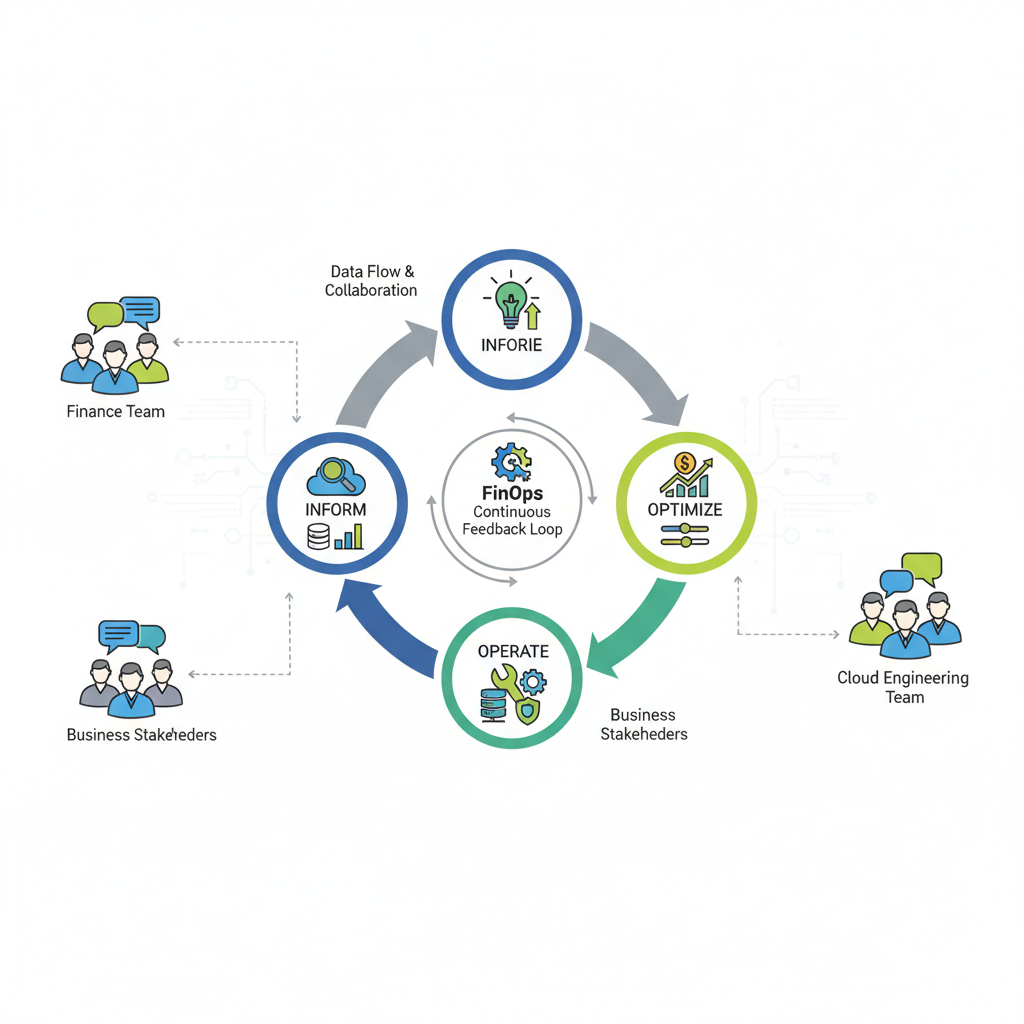
A flowchart illustrating the continuous feedback loop of FinOps, showing stages like “Inform,” “Optimize,” and “Operate,” with arrows indicating data flow and collaboration between different teams.
`what is cloud cost optimization? guide`: Step-by-Step Implementation
Embarking on a journey to optimize cloud costs might seem daunting, but a structured approach can make it manageable and highly effective. This `what is cloud cost optimization? guide` outlines a step-by-step process for implementing and sustaining an optimization strategy. Following these steps helps ensure a comprehensive and impactful program.
Successfully implementing a cloud cost optimization program requires commitment from leadership and active participation from all relevant teams. It’s a cultural shift as much as a technical one, promoting a cost-aware mindset throughout the organization. This collaborative effort drives long-term success.
1. Gain Visibility into Current Spending
The first step is to understand exactly where your money is going. Utilize your cloud provider’s billing tools, cost explorer dashboards, and third-party cost management platforms. Analyze spending by service, region, account, and — most importantly — by business unit or project (if proper tagging is in place).
Identify your biggest cost centers and areas with high potential for waste. This initial assessment provides the baseline for all future optimization efforts. Before making any changes, accurately map your current cloud expenditures.
2. Identify and Prioritize Optimization Opportunities
Once you have visibility, identify specific areas for improvement. This could include underutilized instances, unattached storage volumes, overly expensive data transfer patterns, or services that could benefit from commitment discounts. Prioritize opportunities based on potential savings and ease of implementation.
Focus on quick wins first to build momentum and demonstrate value. These early successes can secure buy-in for more complex, long-term initiatives. Document these findings and create a clear action plan.
3. Implement Optimization Strategies
Execute the identified optimization strategies. This involves technical changes like right-sizing VMs, setting up auto-scaling groups, configuring storage lifecycle policies, or purchasing RIs/Savings Plans. It might also involve process changes, such as implementing a tagging policy.
The `best what is cloud cost optimization?` strategies often involve a combination of these tactics. Don’t be afraid to experiment and iterate, constantly evaluating the impact of your changes. Ensure proper testing is conducted before deploying widespread changes.
4. Monitor, Report, and Iterate
Cloud cost optimization is an ongoing cycle. Continuously monitor your spending, review the impact of your implemented changes, and generate regular reports for stakeholders. The cloud environment is dynamic, so your optimization strategy must also evolve.
Use the insights gained from monitoring to identify new opportunities and refine existing strategies. This continuous feedback loop ensures that your cloud spending remains aligned with business value. Regular reviews are critical for sustained success.
Advanced `what is cloud cost optimization? examples`
Beyond the basic strategies, advanced optimization involves a deeper look into architecture and operational practices. These `what is cloud cost optimization? examples` showcase how organizations can push the boundaries of cost efficiency. They require a more mature cloud posture and often involve significant architectural redesign.
These examples demonstrate that optimization is not a static goal but a continuous journey of improvement. It involves questioning existing assumptions and constantly seeking more efficient ways to operate in the cloud. Proactive engagement with these strategies can yield substantial long-term benefits.
Architectural Re-design for Cost Efficiency
Sometimes, the most significant savings come from re-architecting applications to be cloud-native and cost-aware. This might involve breaking down monolithic applications into microservices, leveraging serverless computing for specific functions, or adopting managed database services. These changes can reduce operational overhead and improve scalability.
Designing for resilience and fault tolerance also contributes to cost efficiency by preventing costly downtime and resource recovery efforts. A well-designed cloud architecture inherently promotes better resource utilization. Consider the total cost of ownership, not just raw infrastructure.
Reserved Instance and Savings Plan Portfolios
For larger organizations, managing a portfolio of Reserved Instances and Savings Plans becomes an art. This involves continuously analyzing usage patterns, expiration dates, and market conditions to maximize coverage and minimize waste. Tools and automation can significantly aid in this complex task.
Consider a blended approach, combining different types of commitments to match varying workload predictability. The goal is to achieve the highest possible discount rate while maintaining flexibility for evolving business needs. This requires sophisticated financial planning and forecasting.
Multi-Cloud Cost Management
Organizations operating in a multi-cloud environment face additional challenges in consolidating cost data and applying consistent optimization strategies. Implementing a centralized cost management platform becomes essential to gain a holistic view of spending across all providers. This approach helps in achieving `best what is cloud cost optimization?` across diverse cloud footprints.
Developing cross-cloud governance and policy enforcement is crucial for maintaining cost control and operational efficiency. It ensures that best practices are applied uniformly, regardless of the underlying cloud provider. Multi-cloud necessitates a unified strategy.
✓ Free consultation ✓ No commitment required ✓ Trusted by experts
Conclusion
Understanding `what is cloud cost optimization?` is no longer optional but a critical component of successful cloud adoption. It’s a continuous journey of monitoring, analysis, and strategic action that drives maximum value from your cloud investments. By embracing the principles outlined in this guide, organizations can transform their cloud spending into a strategic advantage, fostering innovation and sustainable growth.
From right-sizing and commitment plans to FinOps practices and architectural redesign, the path to cloud cost optimization is multifaceted. Proactive engagement and a culture of cost awareness across technical and financial teams are paramount for sustained success. Start your optimization journey today to unlock the full potential of your cloud environment.
Johan Carlsson is a cloud architecture specialist and frequent speaker focused on scalable workloads, AI/ML, and IoT innovation. At Opsio, he helps organizations harness cutting-edge technology, automation, and purpose-built services to drive efficiency and achieve sustainable growth. Johan is known for enabling enterprises to gain a competitive advantage by transforming complex technical challenges into powerful, future-ready cloud solutions.