

Vulnerabilities in Cloud Computing: Expert Q&A

January 13, 2026|6:45 PM
Unlock Your Digital Potential
Whether it’s IT operations, cloud migration, or AI-driven innovation – let’s explore how we can support your success.
January 13, 2026|6:45 PM
Whether it’s IT operations, cloud migration, or AI-driven innovation – let’s explore how we can support your success.
Is your organization ready for the evolving threat landscape in cloud environments? Or are you exposing your critical business assets to cyber attacks without knowing it?
Cloud security challenges can be overwhelming, with high stakes. In 2023, there was a 75% increase in cloud environment intrusions. Also, there was a 110% spike in cloud-conscious threat actors.
The financial damage is significant. Companies face an average of $4.8 million in recovery costs after breaches. Even worse, 82% of data breaches now involve cloud-stored information. And 70% of organizations run their workloads on public cloud platforms.
We’ve made this Q&A resource to tackle your top Cloud Security Risks concerns. Our method combines technical know-how with practical business wisdom. It helps you grasp how threats affect your operations and profits.
Through our partnership, we help you make smart security investments and operational choices. This lowers your risk while keeping your cloud adoption agile.
Cloud computing has changed how businesses work. But, it also brings new security risks. It’s key for leaders to understand these risks and manage them well.
Clouds offer great chances for growth and efficiency. Yet, they also bring unique security challenges. These challenges are different from those faced by traditional on-premises systems.
As we help businesses move to the cloud, we focus on the basics. This knowledge helps in making smart security choices. It’s crucial for protecting assets while using cloud services.
Cloud computing means using internet services for computing needs. It includes servers, storage, and more. This model changes how IT resources are used and secured.
The cloud has three main service models. Each has its own benefits and risks. SaaS, PaaS, and IaaS offer different levels of control and security needs.
Deployment strategies also affect security. Public clouds are cost-effective but need careful management. Private clouds offer more control but require more security knowledge. Hybrid clouds mix both, offering flexibility but adding complexity.
| Cloud Service Model | Provider Responsibility | Customer Responsibility | Primary Security Focus |
|---|---|---|---|
| Software-as-a-Service (SaaS) | Application, data, runtime, middleware, OS, virtualization, servers, storage, networking | User access, data governance, endpoint security | Identity management and data protection |
| Platform-as-a-Service (PaaS) | Runtime, middleware, OS, virtualization, servers, storage, networking | Application code, data security, user access | Application security and API protection |
| Infrastructure-as-a-Service (IaaS) | Virtualization, servers, storage, networking | OS, middleware, runtime, applications, data | Configuration management and network security |
| Hybrid Cloud | Varies by component deployment | Integration security, data flow management | Cross-environment consistency and visibility |
Security in cloud computing is vital. Businesses put their most valuable assets in the cloud. Strong security practices are essential for success.
Companies moving to the cloud often underestimate the security needed. Cloud storage vulnerabilities have caused billions in losses and damaged reputations. Misconfigured access controls are a big risk.
Customer trust, compliance, and competitive edge depend on security. Cloud infrastructure vulnerabilities can be anywhere. Weak spots can let attackers in, steal data, or disrupt operations.
The shared responsibility model is key in cloud security. Providers secure the infrastructure, but customers must protect their data and applications. Even with top-notch provider security, cloud storage vulnerabilities can still occur due to customer mistakes.
We advise our clients to make security a part of every cloud strategy. Inadequate security can lead to financial losses, damage to customer trust, and legal issues. A single vulnerability can cause widespread damage in cloud environments.
Cloud computing has many vulnerabilities, some more serious than others with opsio. We’ve analyzed cloud environments to help businesses focus on security. This way, they can protect themselves better.
Each type of vulnerability needs its own solution. Attackers keep finding new ways to exploit cloud weaknesses. The most common issues are unauthorized data access and mistakes in how cloud services are set up.
Data breaches are a big worry in cloud computing. They happen when unauthorized people get to sensitive information. This can be through many ways, like software bugs or stolen passwords.
When a breach happens, it can cost a lot. There are legal fees, fines, and the loss of customer trust. Data Breach Prevention is key to keeping cloud data safe. It involves both technology and teaching employees about security.
Attackers use smart ways to get to cloud data. They might use SQL injection or stolen passwords. To stop breaches, it’s important to watch for threats and act fast.
The damage from a breach depends on what data is lost. Things like health records or payment info are very valuable to hackers. To protect these, cloud services need strong security. This includes encryption and strict access controls.
Misconfigured cloud storage is a big problem. It’s often caused by rushing to set up services or not knowing how to secure them properly. The National Security Agency says it’s a major weakness.
These mistakes can let hackers in. They might happen because teams are in a hurry or don’t know the best security practices. Human error is the main cause. That’s why tools that check settings are so important.
There are many ways cloud storage can be misconfigured. For example, leaving ports open or not encrypting data properly. These mistakes make it easy for hackers to find and exploit weaknesses.
In December 2021, Twitter’s API was hacked. This was because of API Security Threats. It shows even big companies can make mistakes that let hackers in.
APIs are a big risk because they’re used a lot in cloud systems. They often lack good security checks. This makes them a target for hackers. We’ve seen cases where APIs let hackers into databases or change how apps work.
API security is a big deal because APIs are everywhere in cloud systems. Hackers use them to inject bad code or steal data. Every API endpoint needs to be checked and updated regularly.
| Vulnerability Type | Common Attack Vector | Primary Impact | Prevention Strategy |
|---|---|---|---|
| Data Breaches | Stolen credentials, exploited software flaws, social engineering | Financial loss, regulatory fines, reputation damage, legal liability | Multi-factor authentication, encryption, access monitoring, Data Breach Prevention programs |
| Misconfigured Storage | Public bucket access, excessive permissions, disabled encryption | Unauthorized data access, compliance violations, data exposure | Configuration audits, automated validation, least privilege access, security baselines |
| Insecure APIs | Injection attacks, broken authentication, parameter manipulation | Backend compromise, data extraction, service disruption | API gateways, input validation, rate limiting, authentication tokens |
| Open Network Ports | Port scanning, service exploitation, unauthorized connections | Network infiltration, lateral movement, resource compromise | Network segmentation, firewall rules, port monitoring, access restrictions |
Knowing about vulnerabilities is just the start. Businesses need to find weaknesses before hackers do. They also need to manage their cloud settings well and check their security often.
It’s also important to build a security-aware culture. Teams should see security as a key part of their work, not just a technical issue. When security is part of the development process, businesses can innovate fast while staying safe.
Modern cloud environments face many security threats. These threats can harm availability, confidentiality, and operational continuity. Understanding these risks helps us protect your business systems against evolving threats.
Cloud security is complex and needs a broad approach. We’ve seen that focusing on common risks through proactive monitoring and access controls is key. This ensures your systems stay secure.
Unauthorized access is a major risk in cloud environments. It happens when unauthorized people or systems get into resources without permission. Cloud Authentication Weaknesses make it easy for attackers to get in and steal data.
Weak authentication is a big problem. Poor password policies and lack of multi-factor authentication make systems vulnerable. This allows attackers to easily gain access to sensitive areas.
Poor access management is another big issue. When users have too many permissions, it’s a big risk. If these accounts get compromised, the damage can be huge.
Attackers use many ways to exploit weak authentication. These include phishing, credential stuffing, brute-force attacks, keylogging malware, and cross-site scripting exploits.
Insufficient session management makes things worse. It leaves authentication tokens open to hijacking. Poor identity verification lets attackers impersonate users and bypass security.
Insider threats are hard to deal with because they come from within. They involve employees or partners with access and knowledge of your systems. It’s hard to tell if they’re doing something wrong.
Insider threats can be malicious or careless. Malicious insiders might steal data or sabotage systems for personal reasons. Negligent insiders might cause problems through mistakes or lack of knowledge.
Not managing access properly makes things worse. We’ve seen cases where former employees still have access. This is a big risk for attackers to exploit.
Several things make your organization more vulnerable to insider threats. These include not monitoring user activities, not separating duties, poor hiring practices, not training employees well, and not having good incident response plans.
Distributed Denial of Service (DDoS) attacks are a big risk for availability. They overwhelm your systems with traffic, making them unavailable to users. These attacks can cause a lot of problems, including lost revenue and damage to your reputation.
DDoS attacks use botnets to flood your systems. They can cause a lot of disruption. It’s important to have good defenses against these attacks.
We’ve seen three main types of DDoS attacks. Network-layer attacks flood your systems with traffic. Application-layer attacks exhaust server resources. Protocol exploitation attacks use weaknesses in protocols to amplify attacks.
Multi-Tenancy Issues add complexity to cloud security. In public clouds, multiple organizations share the same infrastructure. This can lead to security problems that affect everyone.
The shared model introduces unique risks. Attackers can use side-channel attacks to get information from other workloads. Resource exhaustion by one tenant can affect others.
We help clients choose the right cloud model for their needs. This helps address Multi-Tenancy Issues and protect against shared infrastructure risks.
Cloud vulnerabilities can cause big problems for companies. They affect financial reports, customer trust, and follow rules. Looking at the big picture, we see how these issues hurt a company’s health and standing in the market. The damage goes deep, lasting long after the problem is fixed.
Security issues in the cloud can hurt a business in many ways. They lead to financial losses, lose customer trust, and face strict rules. We help our clients understand and prepare for these risks before they cause big problems.
Cloud vulnerabilities can cost a lot of money. IBM research shows that cloud data breaches cost companies an average of $4.8 million to recover from. This is just the start of the costs, as companies often overlook hidden expenses.
The first costs include fixing the problem, figuring out what happened, and making systems safe again. Legal fees go up fast, as companies deal with rules and possible lawsuits. Fines from breaking rules add to the expense, hitting companies hard.
Companies also lose money when they can’t work because of security issues. They have to spend extra money to keep their systems safe. Insurance costs go up, too, as companies are seen as riskier after a breach.
The biggest long-term cost is when customers leave because of a breach. We’ve seen companies lose months of profit, stall important plans, and keep spending on security.
| Impact Category | Immediate Costs | Long-Term Costs | Recovery Timeline |
|---|---|---|---|
| Incident Response | Forensic analysis, system remediation, emergency security upgrades | Enhanced monitoring systems, ongoing security investments | 3-6 months |
| Legal & Regulatory | Legal fees, regulatory fines, notification expenses | Compliance audits, consent decrees, increased oversight | 12-24 months |
| Business Operations | Lost productivity, emergency staffing, overtime expenses | Revenue loss, customer churn, contract terminations | 18-36 months |
| Insurance & Risk | Deductible payments, crisis management services | Premium increases, coverage restrictions, higher retention | 24-48 months |
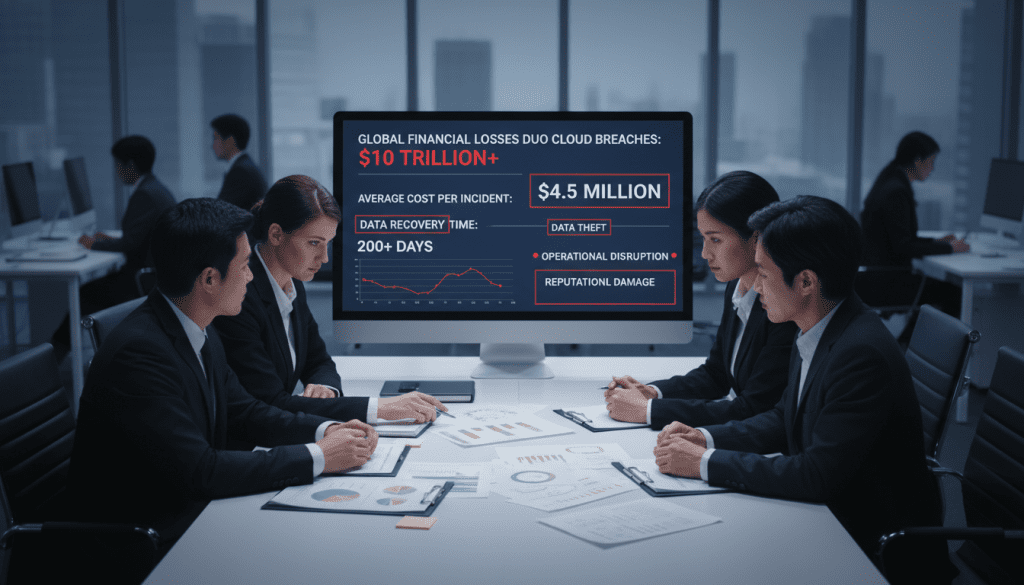
Compliance Challenges add to the financial hit, as breaches can lead to big fines. We tell our clients that these fines can be millions of dollars. Breaches also mean more audits and rules, needing more staff and money.
The Thales Global Cloud Security Study found that human error caused 44% of cloud data breaches. This shows why spending on security is key, not just a technical issue. It’s about making the whole company safer.
Reputation damage is a big problem after a breach. It can take years to get back trust from customers and partners. In some industries, being seen as secure is key to success.
When a breach is known, customers might leave. They might not want to deal with a company that can’t keep their data safe. Prospective customers often avoid companies with recent breaches, even after they fix the problem.
We help companies recover from reputation damage. It’s hard and expensive, affecting many areas of the business. It’s hard to get back the trust of employees, investors, and partners.
Partnerships and alliances can be affected, too. Companies might not want to work with you if you’ve had a breach. It makes it harder to get the best talent and keep investors happy.
Reputation damage and Compliance Challenges can make things worse. More people know about the breach, hurting your reputation even more. It’s hard to get back in the market.
Competitors might use your breach against you. They can look better and take your customers. Getting back to where you were can cost more than fixing the breach.
Social media makes it hard to recover. People can share their negative experiences online. We help our clients deal with these issues and show they’re safer.
Effective cloud security is not accidental. It needs careful planning and ongoing effort to protect your data and systems. We’ve developed strategies to help you reduce cloud risks while keeping your operations efficient. These strategies focus on preventing security incidents before they happen, which is more cost-effective and less disruptive.
The key to successful cloud protection is understanding the shared responsibility model. This model shows which security tasks belong to your cloud provider and which are your responsibility. We help clients ensure no security gaps exist between provider and customer obligations.
Regular security audits are crucial for mitigating vulnerabilities. These thorough examinations of your cloud infrastructure find weaknesses before attackers can. We recommend both scheduled audits and continuous automated scanning to keep your security strong.
Comprehensive audits should deeply examine your entire cloud environment every quarterly or semi-annual basis. These detailed reviews give insights into your security setup and compliance. Continuous automated scanning catches misconfigurations, unauthorized changes, and new vulnerabilities in real-time.
Specialized cloud security posture management (CSPM) tools automatically find issues across multiple cloud environments. Organizations should use third-party tools to scan infrastructure and spot misconfigurations. These automated solutions offer constant vigilance that manual reviews can’t match.
We advise organizations to always set data storage to private by default. This simple practice prevents accidental exposure of sensitive information. Established Infrastructure as Code (IaC) file review processes catch configuration errors before deployment reaches production environments.
Using encryption techniques is a key technical control for protecting data confidentiality. Even when other security controls fail, proper encryption ensures that unauthorized parties cannot access sensitive information. We strongly advocate for implementing encryption at multiple layers throughout your cloud infrastructure.
Organizations must encrypt data in three critical states. Data at rest includes information stored in databases, file systems, and backup systems. Data in transit covers information moving between systems, users, and cloud services. Data in use protects information being actively processed by applications.
Current encryption standards include AES-256 for symmetric encryption and RSA-2048 or higher for asymmetric encryption. Proper key management practices protect encryption keys with the same rigor as the data they secure. Without secure key management, even the strongest encryption becomes vulnerable to compromise.
| Encryption Layer | Protection Scope | Recommended Standard | Key Benefit |
|---|---|---|---|
| Data at Rest | Stored databases, files, backups | AES-256 | Protects against physical theft and unauthorized access |
| Data in Transit | Network communications, API calls | TLS 1.3 | Prevents interception and eavesdropping |
| Data in Use | Active processing and computation | Homomorphic encryption | Enables secure processing in untrusted environments |
We guide clients to always use encrypted protocols for all communications. HTTPS instead of HTTP protects web traffic. SFTP replaces FTP for file transfers. The latest versions of TLS (Transport Layer Security) secure all data transmission pathways.
Database connections, API calls, and any other communication channels require encryption implementation. This comprehensive approach eliminates potential exposure points that could allow sensitive information interception. Using the latest SSL/TLS versions ensures protection against known protocol vulnerabilities.
Virtualization security is crucial in cloud environments where abstraction layers create unique challenges. Virtual machines, containers, and serverless functions require specific security considerations that traditional infrastructure doesn’t face. We help organizations address these specialized requirements systematically.
Securing hypervisors that manage virtual machines is critical. These powerful systems control resource allocation and isolation between virtual environments. Proper isolation prevents cross-contamination where one compromised virtual machine could affect others on the same physical hardware.
Container security demands attention to multiple factors. Hardening container images eliminates unnecessary components and vulnerabilities before deployment. Scanning containers for known vulnerabilities should occur before any production release. Runtime protection monitors container behavior for suspicious activities that might indicate compromise.
We help organizations implement defense-in-depth strategies that combine multiple complementary security controls. This layered approach ensures that if one control fails, others remain in place to protect your assets. Single points of failure become virtually impossible when properly implemented.
Perimeter security with properly configured firewalls provides the first line of defense. Network segmentation limits lateral movement if attackers breach outer defenses. Identity and access management (IAM) with strong authentication controls who can access what resources.
Multi-factor authentication (MFA) for all users and privileged accounts adds crucial verification layers. Zero trust architectures verify every access request regardless of source location. This approach assumes no implicit trust, even for requests originating inside your network perimeter.
Continuous monitoring provides real-time visibility into security events and potential threats. Log management systems collect and analyze activity across your entire infrastructure. This comprehensive view enables rapid detection and response to suspicious activities.
Regular penetration testing simulates real-world attacks to validate security control effectiveness. These controlled exercises identify gaps before actual attackers can exploit them. We recommend conducting penetration tests at least annually, and after any significant infrastructure changes.
Keeping your cloud secure is more than just setting up defenses. It’s about doing regular checks to find and fix weak spots in your setup. These checks are key for any business wanting to keep their cloud safe from cloud security risks. They help spot and fix problems before hackers can find them.
Clouds change fast, and old security methods can’t keep up. New updates and changes in the cloud create new risks. We help businesses stay ahead by checking their security all the time, not just once in a while.
“Lack of visibility makes it difficult to take action on threats since finding vulnerabilities is like looking for a needle in a haystack.”
Our main goal is to check your cloud setup for any security gaps. We work with you to find things like misconfigured resources and unpatched software. This way, we make sure no weak spot is missed.
Using CNAPP (Cloud-Native Application Protection Platform) tools helps a lot. They make it easier to watch for and fix security problems in the cloud. These tools work with different cloud services and help keep everything secure.
Spotting vulnerabilities is key to keeping your cloud safe. We use many ways to check for weaknesses. This includes looking at your code, running tests, and checking your setup before it’s used.
Using all these methods together gives you a full picture of your cloud’s security. Penetration testing and code reviews also help by showing how easy it is to exploit found weaknesses.
Staying on top of your cloud’s security is more than just checking once in a while. It’s about always knowing what’s going on. This is crucial because cloud environments change fast, and you need to keep up.
We help you set up a system that watches for changes and catches threats as they happen. This way, you can act fast to stop problems before they get worse. It’s all about being ready to respond quickly to any security issue.
Our monitoring system sends alerts when something important needs your attention. It works with SIEM systems to help your team respond to threats together. This makes sure you can act fast and keep your cloud safe.
The real value of checking your cloud for risks is not just finding them. It’s about fixing the most important ones first. We help you decide which risks to tackle right away and which can wait. This makes sure you’re using your resources wisely.
| Risk Factor | Assessment Criteria | Business Impact |
|---|---|---|
| Vulnerability Severity | CVSS score, exploit availability, attack complexity | Determines potential damage from successful exploitation |
| System Exposure | Internet-facing resources, network accessibility, service criticality | Indicates likelihood of discovery by attackers |
| Data Sensitivity | Classification level, regulatory requirements, business value | Defines potential consequences of data compromise |
| Exploitability | Required privileges, user interaction, technical complexity | Reflects ease with which attackers can leverage vulnerability |
By looking at these factors, we help you focus on the biggest cloud security risks first. This way, you can make your security efforts count and keep your business safe.
Organizations in cloud environments face many rules that need careful handling. These rules change fast, with new ones popping up and old ones getting bigger. We help clients turn these rules into chances to build stronger security and keep customer trust.
First, figuring out which rules apply is key. There are many rules for different parts of cloud operations. This means you need a good plan to cover everything without wasting time.
Cloud computing has rules from many places and industries. These rules ask for specific security steps and paperwork. We guide clients to understand which rules fit their business and operations.
The General Data Protection Regulation (GDPR) is a big deal for data protection worldwide. It covers any data of EU residents, no matter where the company is. GDPR requires strong data protection, like privacy-by-design and data subject rights.
Breaking GDPR rules can cost up to 4% of global sales or €20 million, whichever is more. This shows how important it is to follow compliance rules well.
The Health Insurance Portability and Accountability Act (HIPAA) is for healthcare in the US. It needs strong security for health info, like access controls and encryption. HIPAA has gotten tougher, with big fines for not following rules.
Other important rules include:
These rules often ask for the same things, making it easier to follow them all at once. We help clients find common ground to meet many rules with one effort.
Aligning cloud security with rules needs a plan that mixes rules into daily security work. We see compliance as part of security, not separate. This means both tech steps and rules to follow over time.
Modern Cloud-Native Application Protection Platform (CNAPP) solutions help manage rules in complex cloud setups. They check against over 30 frameworks, like CIS and NIST, and spot problems fast.
Getting and keeping compliance involves several steps we do with clients:
Checking compliance should be ongoing, not just once a year. This way, problems are caught early, and fixes can happen fast. We set up alerts for when things go off track.
Linking security controls to rules makes it clear which steps meet which rules. Often, one control can meet many rules at once. For example, strong encryption meets GDPR, HIPAA, and PCI DSS.
Governance frameworks make sure security and rules are part of business decisions. We help clients set up committees, define roles, and create plans for handling compliance issues.
Good documentation shows you’re following rules and care about security. It includes policies, risk plans, audit logs, and training records. This helps with audits and protects against legal trouble.
We tell clients that dealing with compliance rules is a chance to make their cloud safer and more trustworthy. Seeing compliance as part of business strategy can give you an edge. It turns compliance into a value that builds trust, helps partnerships, and opens new markets.
We’ve developed key security practices that mix technical steps with a strong organizational culture. This is because nearly half of all cloud breaches come from human mistakes. Our experience shows that just using technology isn’t enough, as 44% of breaches are caused by people.
Effective cloud security needs both advanced tools and well-trained people working together. We guide clients in creating detailed strategies to protect against cloud threats. This includes training, access control, constant monitoring, and quick response to incidents.
Training employees is a smart investment in security. Even the best technology can fail if users don’t know how to use it safely. We create training programs that teach all employees about security basics, threats, and how to handle sensitive data.
Good training covers basic security awareness for everyone. Topics include password safety, phishing, and how to report security issues. We use engaging methods to help employees remember and apply what they learn.

DevOps teams and managers need special training because they have more access. They need to know about cloud security, including how to configure services and manage identities. Training should cover secure cloud setup, infrastructure security, secrets management, and identity access management.
Teaching employees to spot phishing emails is crucial. Phishing is a common way attackers get into cloud systems. Training should help employees recognize phishing attempts and know how to report them.
Access controls are key to cloud security. They ensure users and services only have the access they need. We help organizations set up identity and access management systems that protect against threats.
The principle of least privilege is essential. Users should only have the access they need, not too much. We help clients analyze access needs, use role-based access control, and regularly review permissions.
Multi-factor authentication should be mandatory for all users accessing cloud resources. This adds an extra layer of security. We recommend using risk-based MFA that changes based on location, device, and user behavior.
Access control goes beyond setup to include ongoing management. Regularly reviewing user access and privileges is important. Revoking access for former employees prevents unauthorized access through old accounts.
Other access control steps include just-in-time access, logging all access, and regular access certification. These practices ensure access is always appropriate and prevent unauthorized access.
New technologies and cloud platforms have created new vulnerabilities. Security experts must stay alert and adapt to these changes. We help our clients stay ahead of threats designed to exploit cloud environments.
Cloud computing’s benefits, like scalability and rapid deployment, also attract attackers. A single breach can cause widespread damage. It’s crucial for organizations to understand these threats to maintain security.
Ransomware has become a major threat, targeting cloud environments. Attackers use double-extortion, encrypting data and stealing it for leverage. This forces organizations to pay large ransoms to restore access and prevent data leaks.
Cloud environments are attractive to attackers because of centralized data storage. A single breach can affect many systems at once. This maximizes damage and ransom demands.
The 2021 Colonial Pipeline attack showed the impact of cloud security risks. Hackers used a weak VPN to gain access and deploy ransomware. This attack led to fuel shortages, price spikes, and a $4.4 million ransom payment.
Today’s ransomware operators use advanced tactics to evade detection:
These tactics require comprehensive defense strategies. Organizations must assume breaches and focus on quick detection and response.
IoT vulnerabilities in cloud systems expand the attack surface. Organizations connect IoT devices to cloud platforms for data and control. These devices often lack basic security, making them easy targets for attackers.
The combination of IoT and cloud creates unique security challenges. IoT devices often receive little security updates, leaving them vulnerable for years.
IoT deployments in cloud environments face several critical vulnerabilities:
Compromised IoT devices can form massive botnets. These can launch devastating DDoS attacks, overwhelming cloud infrastructure and disrupting services.
Advanced Persistent Threats pose a growing concern. Sophisticated adversaries conduct long-term campaigns to infiltrate cloud environments. They use custom malware and zero-day exploits to evade detection and conduct slow data exfiltration.
The integration of artificial intelligence into cloud services introduces new vulnerabilities. AI systems can be attacked through adversarial inputs and model theft. As AI becomes common in cloud services, new security strategies are needed to protect AI workloads.
Organizations must remain vigilant and adapt to emerging threats. The cloud security landscape is constantly evolving. Staying ahead of attacks requires continuous monitoring, regular assessments, and proactive defense mechanisms.
Organizations need to prepare for the future of cloud security today. Understanding trends and technologies is key. Making strategic investments now will protect against evolving threats.
The CrowdStrike 2026 Global Threat Report shows the urgency. Cloud environment intrusions increased by 75%. Threat actors targeting cloud environments grew by 110%. This highlights the need for security strategies to stay ahead.
Cloud computing will grow, integrating artificial intelligence. This creates new challenges and opportunities. We help clients find lasting value in innovations.
Several trends are changing cloud security. These trends address weaknesses in traditional models. They represent fundamental shifts, not just small improvements.
Zero trust architectures are replacing old security models. They verify every access request, not just from the network. This is crucial in today’s cloud environments.
Security Service Edge (SSE) and Secure Access Service Edge (SASE) are gaining traction. They combine networking and security in cloud solutions. This simplifies management and improves security posture.
Security is not a destination but an ongoing journey that requires continuous adaptation to new threats and technologies.
DevSecOps practices are changing how we build and deploy applications. They integrate security from the start. This approach is more effective than patching later.
Confidential computing technologies protect data in use. They use hardware-based trusted execution environments. This ensures sensitive information remains encrypted and isolated.
Supply chain security has become a major focus. High-profile attacks have shown the importance of software bills of materials (SBOM) and vendor security assessments. Technologies that verify software integrity are also crucial.
New technologies are giving organizations powerful tools to defend against threats. These advances improve detection, response, and prevention capabilities.
Cloud-Native Application Protection Platform (CNAPP) solutions provide comprehensive visibility across multi-cloud environments. They combine agentless and agent-based scanning. We recommend CNAPP solutions for their ability to consolidate security tools.
| Technology | Primary Function | Key Benefit | Implementation Approach |
|---|---|---|---|
| CNAPP Platforms | Unified multi-cloud protection | Comprehensive visibility with agentless and agent-based scanning | Consolidates security tools into single platform |
| XDR Systems | Cross-environment threat correlation | Complete attack visibility across endpoints, networks, and cloud | Integrates security events from multiple sources |
| SOAR Solutions | Automated incident response | Handles routine tasks and reduces alert fatigue | Automated workflows with human escalation for complex issues |
| Behavioral Analytics | Anomaly detection | Identifies subtle indicators human analysts might miss | Machine learning baselines with deviation alerting |
Automated threat detection and response use machine learning. Behavior-based detection establishes baselines and alerts on deviations. Automated remediation can respond to threats without human intervention.
Extended Detection and Response (XDR) capabilities correlate security events across environments. This comprehensive view enables faster incident response. We implement XDR solutions to help security teams overcome fragmentation.
Security Orchestration, Automation, and Response (SOAR) platforms manage alerts and incidents. They handle routine tasks and escalate only critical issues. This allows security teams to focus on the most important threats.
Emerging technologies include quantum-resistant cryptography and decentralized identity systems. Privacy-enhancing technologies enable secure data analysis and collaboration. These innovations will shape the future of cloud security.
We guide clients toward security architectures and technologies that will remain effective. This ensures today’s investments continue to deliver value tomorrow and beyond.
Studying real security breaches shows us patterns that change how we prevent data breaches. Real incidents teach us lessons that theory can’t. They show how attackers find weaknesses and the consequences for organizations. Looking at these cases helps leaders see why proactive security is key.
The SolarWinds supply chain attack of 2020 showed how sophisticated threats can hit thousands of customers at once. Hackers added malicious code to updates from trusted vendors. This hit many government agencies and big companies, showing that just having defenses isn’t enough.
From SolarWinds, we learned a few important things. We need to check trusted software and use network segmentation. Also, logging helps find signs of trouble, and we need to rethink our security models for attacks through trusted channels.
The Colonial Pipeline ransomware attack in 2021 showed how old systems without basic security are easy targets. Attackers used weak VPNs to spread ransomware, shutting down systems. This caused fuel shortages, panic buying, and high prices in the southeast.
Legacy systems need to be updated or isolated fast. We must use multi-factor authentication everywhere. And we need to have incident response plans ready to go.
The MOVEit Transfer vulnerability exploited in 2023 hit hundreds of companies worldwide, including the University of Rochester and British Airways. A zero-day SQL injection flaw in file transfer software caused big damage. Since there was no warning, quick responses were crucial.
The most dangerous vulnerabilities are those in trusted, widely-used software that we rely on every day without questioning its security.
MOVEit taught us to keep full inventories of software and patch internet-facing systems first. Defense-in-depth strategies help avoid total compromise. And we must be ready to respond fast since zero-days give no warning.
The 2022 Opus data breach was caused by poor API security, letting unauthorized access to personal info. This showed APIs need strong security, including authentication and logging. Many overlook API security, seeing these interfaces as less critical than user apps.
The LastPass security incident of 2022 showed even secure password managers can be breached. Attackers got access to backup data and customer vaults. This taught us to encrypt sensitive data, even in backups and dev environments. Being open with customers when incidents happen helps keep trust.
The December 2021 Twitter API breach exposed data of 5.4 million users, with some info sold on the dark web. This breach showed how API flaws can lead to big data leaks. It stressed the need for API security, data minimization, and quick incident response to protect users.
Every major security incident shows why preventing data breaches is crucial. The damage goes beyond just fixing the problem, affecting operations and long-term success. Understanding these impacts helps justify the need for security investments.
Financial impacts include costs for response, forensics, and fines that can be millions. Long-term, there are lost business, increased security spending, and higher insurance costs. These costs often far exceed the initial response costs.
Operational disruption happens during recovery and when adding new security measures. This leads to lost productivity, delayed projects, and resources taken away from growth. Some breaches require rebuilding systems, causing months of challenges that hurt revenue and competitiveness.
| Impact Category | Immediate Effects | Long-Term Consequences | Mitigation Priority |
|---|---|---|---|
| Financial | Incident response costs, forensics, immediate fines | Lost business, increased insurance, ongoing compliance costs | High |
| Operational | System shutdowns, productivity loss, resource diversion | Delayed initiatives, reduced innovation capacity | Critical |
| Reputational | Customer trust erosion, negative media coverage | Brand damage, customer acquisition challenges | Critical |
| Legal | Regulatory investigations, initial lawsuits | Class action settlements, ongoing litigation | High |
Reputational damage hurts customer trust, employee morale, and investor confidence. It’s hard to measure but very damaging. Companies lose their edge and some customer relationships never recover. Brand value drops, making marketing and getting new customers harder and more expensive.
Legal issues include lawsuits, regulatory actions, and class action settlements. These create ongoing financial and operational burdens. Legal exposure extends far beyond the initial incident, making planning uncertain.
Strategic impacts include delayed plans, lost competitive edge, and sometimes, leadership changes or business failures. Companies hit by big breaches often see boardroom changes, leadership turnover, and major strategic shifts. Some never regain their market position, while others face acquisition or closure.
These patterns show why preventing data breaches is a top priority. Successful companies see security as a way to enable business, not just a cost. Proactive security protects data, the company’s future, and growth in a dangerous world.
Fixing cloud storage vulnerabilities needs teamwork from everyone in tech. No single group can solve these problems alone. We must work together, including businesses, cloud providers, and the security community.
Knowing who does what in cloud security is key. We help clients understand their roles and the cloud provider’s. Providers handle the basics like data centers and network security. But, customers must protect their data and set up security settings.
Before moving to the cloud, check your provider’s security. Look for certifications like SOC 2 and ISO 27001. Also, check their security history and what tools they offer. Make sure you have a clear plan for any security issues.
Joining groups that share security info is a good idea. These groups share threats, set standards, and offer tools. Open-source projects and research communities help spot and fix cloud issues early.
Working with governments and private companies makes security better. It brings together intelligence, innovation, and research. This way, we keep security up to date with your business and the threats it faces.
Many cloud vulnerabilities exist, with misconfigured cloud storage being a big one. The National Security Agency says it’s a major weakness. This includes things like too much access, no encryption, and open ports.
Data breaches are another big problem. They happen when unauthorized people get to sensitive info. This can be through many ways, like stolen passwords or social engineering.
API security threats are also a big deal. Clouds use APIs a lot, but they often lack proper security. This makes them a target for hackers.
Cloud authentication weaknesses are also a big issue. Things like weak passwords and bad session management are common. Plus, multi-tenancy issues in public clouds can let one organization’s problems affect others.
Cloud breaches can cost a lot. IBM says they average .8 million to fix. This includes things like incident response, legal fees, and fines.
The real cost goes beyond that. It includes lost productivity, emergency security spending, and higher insurance costs. A big breach can also hurt a company’s reputation and lead to lost customers.
The shared responsibility model is key in cloud security. It says who is responsible for what security. This is important because confusion can lead to security gaps.
Cloud providers handle security “of” the cloud. This includes things like data center security and network protection. Customers are responsible for security “in” the cloud. This includes things like data protection and access management.
To prevent cloud storage vulnerabilities, you need good configuration management. Use tools like Cloud Security Posture Management (CSPM) to monitor and fix misconfigurations.
Set up secure configuration baselines and use infrastructure-as-code scanning. This helps catch problems before they cause harm. Also, make sure storage resources have the right access permissions.
Regular security audits are important. They help ensure only authorized people can access data. They also check encryption and logging.
Multi-factor authentication (MFA) is crucial for cloud security. It adds an extra layer of protection beyond passwords. This makes it harder for hackers to get in, even if they have passwords.
MFA is very important for privileged accounts. These accounts have a lot of power and can be a big risk. Use risk-based MFA that changes based on the situation.
MFA is very effective against automated attacks. These are common ways hackers try to get into systems. It’s important to find a balance between security and user experience.
Vulnerability assessments should be more than just occasional scans. They should be continuous, like the cloud itself. This is because cloud environments change a lot.
Do comprehensive assessments at least every quarter. More often if you’re in a regulated industry or handle sensitive data. These assessments should include scanning, configuration checks, penetration testing, and code reviews.
Continuous monitoring is also key. It gives real-time security visibility. This helps catch problems fast and respond quickly.
There are many compliance regulations for cloud security. Each one has its own rules and requirements. These include GDPR, HIPAA, PCI DSS, and more.
GDPR is important for any organization that handles EU data. It has strict rules and can result in big fines. HIPAA is for healthcare organizations and their partners. PCI DSS is for anyone who handles credit card info.
Other regulations include Sarbanes-Oxley, CCPA, and FISMA. Each one adds complexity. But, you can meet them all with the right security program.
Human error is a big problem in cloud security. A study found that 44% of breaches were caused by human mistakes. This includes things like poor training and security culture.
Human error can lead to many problems. This includes misconfiguring cloud resources and falling for phishing attacks. It’s important to train employees well.
There are many new threats in cloud computing. Ransomware is a big one. It’s become more sophisticated and targets cloud environments.
IoT vulnerabilities are also a concern. These devices often lack basic security. Advanced Persistent Threats (APTs) are another threat. They are long-term attacks that can go undetected for months.
AI in cloud services also creates new vulnerabilities. It can be attacked in many ways. This requires new security strategies.
A Cloud-Native Application Protection Platform (CNAPP) is a new kind of security tool. It combines many security functions into one platform. This gives you a complete view of your cloud security.
It includes things like Cloud Security Posture Management (CSPM) and Cloud Workload Protection Platform (CWPP). It also includes Cloud Infrastructure Entitlement Management (CIEM) and threat detection. This helps you find and fix security problems quickly.
Insider threats are different from external threats. They come from within your organization. They have legitimate access and know your systems well.
Insider threats can be malicious or negligent. They can steal data or make security mistakes. It’s hard to detect them because they seem normal.
It’s important to have good security training and monitoring. This helps catch insider threats early.
The Colonial Pipeline attack was a big wake-up call. It showed how vulnerable legacy systems can be. Hackers used a weak VPN to get in and then demanded a ransom.
This attack highlighted the need for better security. This includes using multi-factor authentication and isolating old systems. It also showed the importance of having a good incident response plan.
API security is very important in cloud environments. Clouds use APIs a lot for communication and integration. But, APIs can be vulnerable to attacks.
The Twitter API breach was a recent example. It showed how important API security is. It’s important to use strong authentication and encryption for APIs.
Remote work requires good security measures. This includes using multi-factor authentication and zero trust network access. It’s also important to have good endpoint security.
Use cloud access security brokers (CASBs) and data loss prevention (DLP) technologies. These help protect data and ensure compliance. It’s also important to train employees on security best practices.
Encryption is a key way to protect data in the cloud. It makes data unreadable to unauthorized people. This is important because other security measures can fail.
Use strong encryption algorithms and proper key management. Regularly rotate encryption keys and ensure they are properly configured. This helps protect data throughout its lifecycle.




Experience power, efficiency, and rapid scaling with Cloud Platforms!