In today’s digital landscape, cybersecurity investments are no longer optional—they’re essential. Yet many organizations struggle to quantify the return on these investments, making it difficult to secure budget approval and prioritize security initiatives. A robust cybersecurity cost-benefit analysis provides the framework needed to make informed decisions, justify spending to stakeholders, and ensure your security budget delivers maximum value. This guide will walk you through the process of evaluating cybersecurity investments through a financial lens, helping you build a compelling business case for protecting your most valuable digital assets.
Understanding the True Costs of Cybersecurity
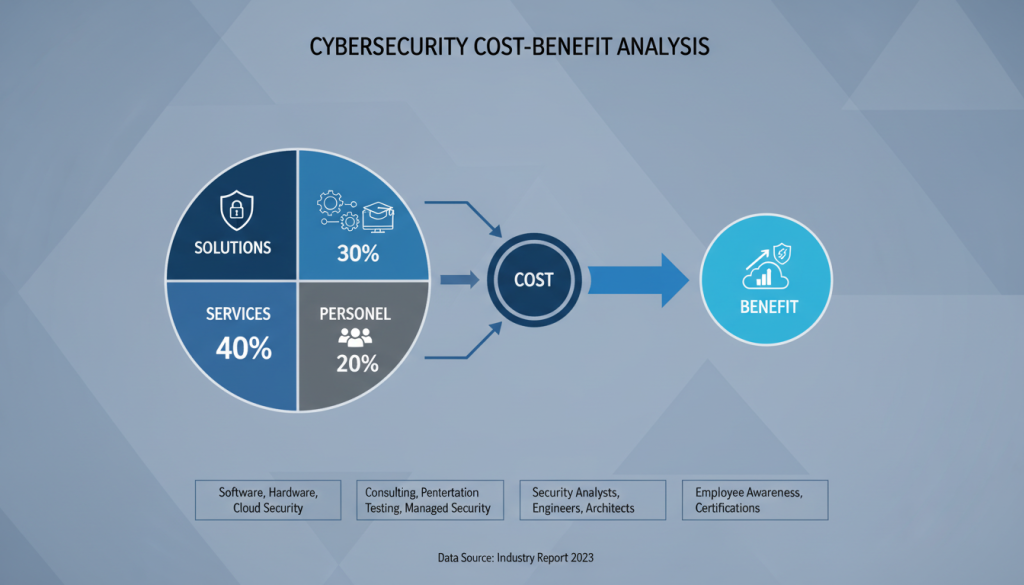
Breakdown of typical cybersecurity investment categories and their relative costs
Cybersecurity spending encompasses multiple components that must be considered in any comprehensive cost-benefit analysis. Understanding these costs is the first step toward evaluating the effectiveness of your security investments.
Direct Cybersecurity Costs
Security Solutions
The technological backbone of your security posture includes firewalls, antivirus software, endpoint protection, intrusion detection systems, and data encryption tools. These solutions typically require both upfront investment and ongoing licensing fees. For enterprise-grade solutions, costs can range from $450 to $2,500 for firewall configurations and $3 to $10 per user monthly for endpoint protection.
Security Services
Many organizations supplement their internal capabilities with external expertise, including managed security service providers (MSSPs), security assessments, penetration testing, and incident response retainers. These services provide specialized skills without the overhead of full-time staff but can represent significant ongoing expenses ranging from $1,500 to $6,000 for vulnerability assessments.
Personnel
The human element of cybersecurity includes security analysts, network administrators, compliance officers, and security leadership. According to industry data, security analysts command salaries averaging $90,283 annually, while network administrators typically earn around $63,244 per year. These costs extend beyond base salaries to include benefits, training, and retention expenses.
Training and Awareness
Effective security requires ongoing education for both technical staff and general employees. Professional certifications like CISSP ($699) and CEH ($1,199) represent significant investments in staff development, while organization-wide security awareness programs can cost $15-40 per employee annually but are essential for reducing human-factor risks.
Indirect Cybersecurity Costs
Beyond the obvious direct expenses, cybersecurity investments incur several indirect costs that must be factored into any comprehensive analysis:
- Productivity impacts from security procedures and authentication requirements
- Integration complexity when implementing new security controls
- Opportunity costs when IT resources focus on security rather than business initiatives
- Administrative overhead for compliance documentation and reporting
The Financial Impact of Cyber Attacks
To perform an effective cost-benefit analysis of cybersecurity investments, you must understand what you’re protecting against. The financial consequences of cyber attacks extend far beyond immediate remediation costs and can impact organizations for years after an incident.
Direct Financial Losses
Immediate costs include incident response, forensic investigation, data recovery, and system restoration. For ransomware attacks, organizations may face ransom demands averaging $570,000 in 2021. Organizations experiencing cyber attacks report losing between $50,000 and $99,999 in direct revenue on average.
Operational Disruption
Business downtime represents one of the most significant costs of cyber incidents. With average downtime lasting 21 days following a ransomware attack, organizations face substantial productivity losses, missed opportunities, and inability to serve customers—all translating to revenue impact.
Legal and Regulatory Consequences
Data breaches often trigger regulatory investigations, potential fines, and litigation. Legal costs alone can range from $50,000 to $148 million, with a median of $1.6 million. Under regulations like GDPR, organizations can face penalties up to €20 million or 4% of global annual revenue.
The Long-Term Cost of Reputational Damage
Perhaps the most difficult impact to quantify is reputational damage. Studies indicate that reputational costs from abnormal customer turnover and loss of goodwill average around $1.57 million per incident. This damage can persist long after systems are restored, affecting customer acquisition, retention, and even valuation for public companies.
“The true cost of a cyber attack extends far beyond the immediate incident response. Organizations must consider the full spectrum of financial impacts when evaluating security investments.”
– Cybersecurity Cost-Benefit Analysis Framework
Building a Cybersecurity Cost-Benefit Analysis Framework
A structured approach to cybersecurity cost-benefit analysis enables organizations to make data-driven decisions about security investments. This framework provides a repeatable methodology for evaluating the financial implications of security controls.
Step 1: Risk Assessment and Quantification
Begin by identifying your organization’s critical assets, potential threats, and existing vulnerabilities. For each scenario, estimate two key variables:
- Annual Rate of Occurrence (ARO) – The probability of a specific threat occurring within a year
- Single Loss Expectancy (SLE) – The monetary impact of a single occurrence of the threat
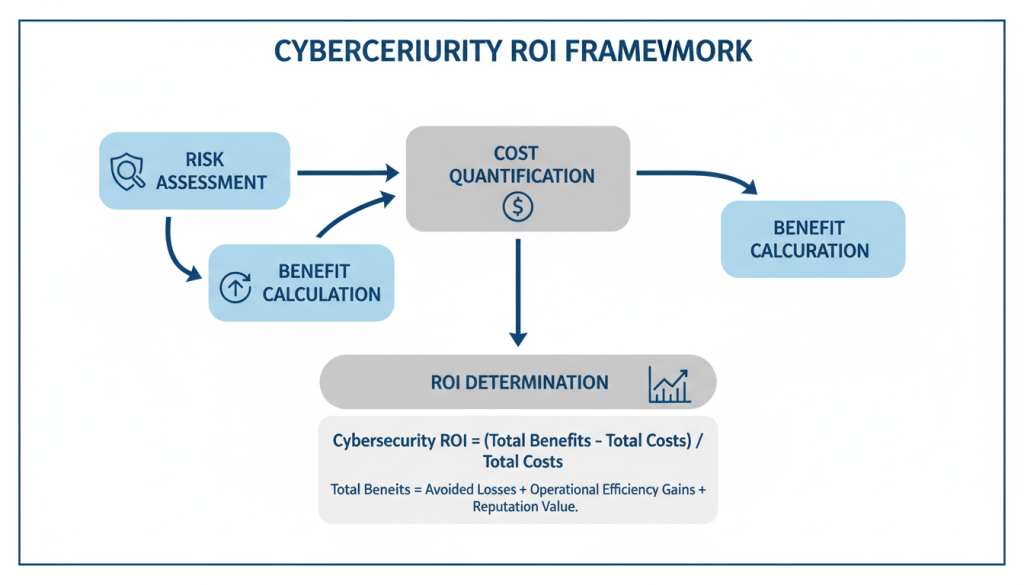
Multiply these values to calculate the Annualized Loss Expectancy (ALE): ALE = SLE × ARO
Step 2: Control Effectiveness Evaluation
For each security control under consideration, evaluate its effectiveness in reducing either the probability (ARO) or impact (SLE) of identified threats. This reduction represents the expected benefit of the control in terms of loss avoidance.
Example: If a ransomware attack has an ARO of 0.2 (20% chance annually) and an SLE of $500,000, the ALE is $100,000. If implementing advanced endpoint protection reduces the ARO to 0.05 (5% chance), the new ALE becomes $25,000, representing a $75,000 annual benefit in risk reduction.
Step 3: Cost Analysis of Security Controls
Calculate the Total Cost of Ownership (TCO) for each security control, including:
- Initial acquisition and implementation costs
- Ongoing maintenance, licensing, and support expenses
- Personnel costs for operation and management
- Training and awareness requirements
- Integration and compatibility expenses
Step 4: ROI Calculation and Comparison
With benefits (reduced ALE) and costs (TCO) quantified, calculate the Return on Investment for each security control:
Cybersecurity ROI = (Expected Loss Reduction – Annualized Cost) / Annualized Cost
Where Expected Loss Reduction = ALE before – ALE after
This formula provides a standardized metric for comparing different security investments and prioritizing those with the highest return relative to cost.
Struggling to Quantify Your Cybersecurity ROI?
Our Cybersecurity Investment Calculator helps you apply this framework to your specific environment, providing customized insights into your most valuable security investments.
Download the Calculator
Challenges in Quantifying Cybersecurity Costs and Benefits
While a structured framework provides clarity, several challenges complicate cybersecurity cost-benefit analysis. Understanding these challenges helps organizations develop more realistic assessments and avoid common pitfalls.
What Can Be Quantified
- Direct incident response costs
- System downtime and productivity losses
- Regulatory fines and penalties
- Security tool licensing and maintenance
- Staff salaries and training expenses
What’s Difficult to Quantify
- Reputational damage and lost customer trust
- Intellectual property theft implications
- Future business opportunities lost
- Competitive advantage erosion
- Executive time spent managing incidents
Addressing Uncertainty in Risk Estimates
The probabilistic nature of cyber threats introduces significant uncertainty into cost-benefit calculations. Organizations can address this challenge through:
- Scenario analysis – Evaluating multiple threat scenarios with varying probabilities and impacts
- Sensitivity testing – Adjusting key variables to determine how changes affect the overall analysis
- Range estimates – Using low/medium/high estimates rather than precise figures
- Historical data – Leveraging industry benchmarks and internal incident history to refine estimates
“You can’t manage what you can’t measure—but you also can’t pretend uncertain estimates are precise.”
Cost-Effective Cybersecurity Strategies
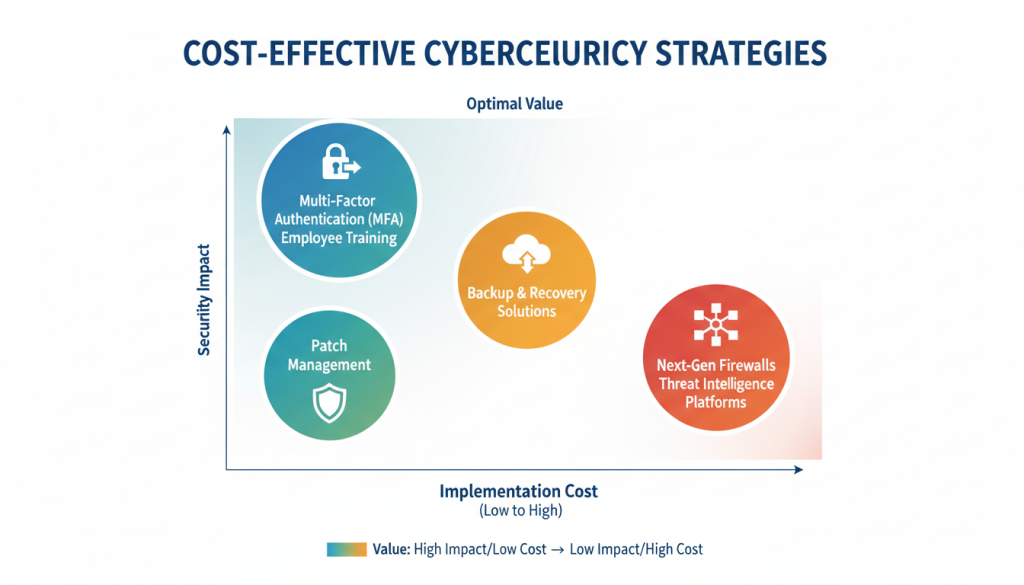
Not all security investments deliver equal value. Organizations with limited resources should prioritize controls that provide the highest security benefit relative to cost. These cost-effective strategies form the foundation of a robust security program while maximizing return on investment.
High-Impact, Low-Cost Security Controls
Multi-Factor Authentication (MFA)
Implementing MFA can prevent up to 99.9% of account compromise attacks, according to Microsoft research. With relatively low implementation costs ($3-6 per user monthly) and minimal user friction with modern solutions, MFA represents one of the highest-value security investments available.
Security Awareness Training
With human error involved in over 85% of breaches, targeted security awareness programs deliver exceptional ROI. Modern phishing simulation and training platforms cost $15-40 per user annually while significantly reducing successful social engineering attacks.
Patch Management
Timely patching prevents exploitation of known vulnerabilities that attackers frequently target. While requiring process discipline more than financial investment, effective patch management can be implemented with minimal additional tools while dramatically reducing the attack surface.
Optimizing Security Investments Through Outsourcing
For many organizations, particularly those with limited internal security expertise, strategic outsourcing can improve security posture while controlling costs:
- Managed Security Service Providers (MSSPs) – Provide 24/7 monitoring and response capabilities without the overhead of building an internal security operations center
- Virtual CISO Services – Deliver executive security leadership on a fractional basis, reducing the cost of strategic guidance
- Cloud Security Solutions – Leverage economies of scale from cloud providers who can implement enterprise-grade security more efficiently than most individual organizations
The Gordon-Loeb Model for Optimal Investment
The Gordon-Loeb economic model provides a mathematical framework for determining optimal cybersecurity investment levels. The model suggests that organizations should generally invest less than 37% of the expected loss from a cybersecurity breach. This guideline helps prevent overinvestment in security controls with diminishing returns.
Cybersecurity Investment Efficiency
4.2
Optimal investment range
Multi-Factor Authentication
4.8
Security Awareness Training
4.5
Managed Detection & Response
4.1
The Financial Impact of Compliance Requirements
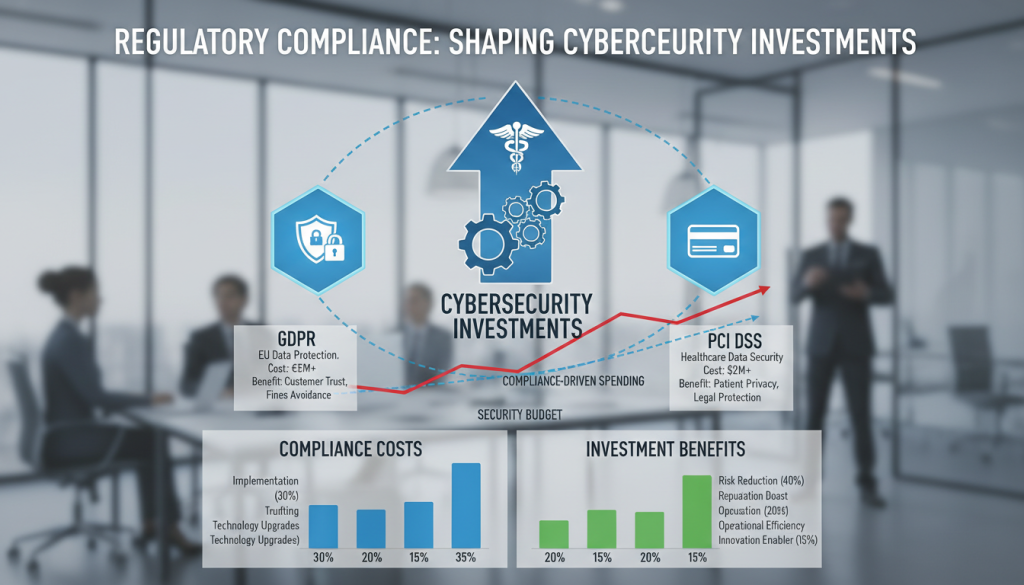
Regulatory requirements significantly influence cybersecurity investments, introducing both mandatory costs and potential strategic benefits. Understanding these impacts is essential for a comprehensive cost-benefit analysis.
Compliance as a Cost Driver
Regulatory frameworks like GDPR, HIPAA, PCI DSS, and industry-specific requirements mandate specific security controls and processes. These compliance obligations introduce several cost categories:
| Compliance Cost Category |
Description |
Typical Investment Range |
| Assessment & Gap Analysis |
Initial evaluation of compliance status and required remediation |
$10,000 – $50,000 |
| Control Implementation |
Technical and procedural controls required by regulations |
$50,000 – $500,000+ |
| Documentation & Policies |
Development and maintenance of required documentation |
$15,000 – $75,000 |
| Audit & Certification |
Third-party validation of compliance status |
$20,000 – $100,000 annually |
| Ongoing Monitoring |
Continuous compliance verification and reporting |
$25,000 – $150,000 annually |
Leveraging Compliance for Strategic Advantage
While compliance requirements introduce costs, they can also deliver strategic benefits that should be factored into cost-benefit analysis:
- Risk Reduction – Many compliance controls directly reduce security risks, delivering dual benefits
- Competitive Differentiation – Demonstrable compliance can provide market advantage, particularly in regulated industries
- Reduced Insurance Premiums – Cyber insurance providers often offer better terms for compliant organizations
- Structured Approach – Compliance frameworks provide a structured methodology for security programs
Important: Non-compliance can result in significant financial penalties. Under GDPR, organizations can face fines up to €20 million or 4% of global annual revenue, whichever is higher. These potential penalties must be factored into the cost-benefit analysis as risk-based costs.
Making the Business Case for Cybersecurity Investments
Translating technical security requirements into business language is essential for securing executive support and budget approval. A compelling business case connects security investments to business outcomes and financial metrics that resonate with decision-makers.
Elements of an Effective Business Case
Structure your cybersecurity investment proposal to address key stakeholder concerns:
- Executive Summary – Concise overview of proposed investments, expected benefits, and financial justification
- Risk Assessment – Clear articulation of threats, vulnerabilities, and potential business impacts
- Investment Options – Tiered approach with basic, recommended, and comprehensive security packages
- Financial Analysis – ROI calculations, payback period, and comparison of investment versus potential loss
- Implementation Roadmap – Phased approach with clear milestones and success metrics
- Monitoring Framework – How outcomes will be measured and reported to demonstrate value
Addressing Common Executive Concerns
“How do we know these investments will actually reduce our risk?”
Address this by quantifying risk reduction through metrics like reduced attack surface, improved detection capabilities, and decreased mean time to respond. Reference industry benchmarks and case studies demonstrating effectiveness of proposed controls.
“What’s the payback period for these security investments?”
Calculate and present clear payback periods based on risk reduction. For example: “Implementing MFA at $50,000 annually reduces our ALE by $250,000, providing a 5x return and payback period of approximately 10 weeks.”
“How will we measure the effectiveness of these security controls?”
Present a monitoring framework with specific KPIs such as security incidents prevented, mean time to detect/respond, patch compliance rates, and user awareness metrics. Commit to regular reporting on these metrics to demonstrate ongoing value.
Continuous Evaluation and Adjustment
Emphasize that cybersecurity cost-benefit analysis is not a one-time exercise but an ongoing process:
- Regularly reassess threats and vulnerabilities as the landscape evolves
- Track and report on security metrics to validate investment effectiveness
- Adjust security controls based on performance data and emerging threats
- Conduct annual reviews of the security program’s ROI and strategic alignment
Conclusion: Balancing Security Investment with Business Value
Effective cybersecurity cost-benefit analysis transforms security from a technical necessity into a strategic business enabler. By quantifying both the costs of security controls and the financial benefits of risk reduction, organizations can make informed decisions that optimize resource allocation while protecting critical assets.
The most successful security programs balance investment with risk appetite, focusing first on high-impact, low-cost controls that deliver exceptional ROI. By applying the frameworks and methodologies outlined in this guide, security leaders can build compelling business cases that secure executive support and demonstrate ongoing value.
Remember that cybersecurity is not about eliminating all risk—an impossible goal—but rather about making strategic investments that reduce risk to acceptable levels while enabling business objectives. A disciplined, data-driven approach to cybersecurity cost-benefit analysis provides the foundation for this balanced security strategy.
Ready to Optimize Your Cybersecurity Investments?
Download our Cybersecurity ROI Calculator and Investment Framework to apply these principles to your organization. Our tool helps you quantify security risks, evaluate control effectiveness, and build compelling business cases for your most critical security investments.
Download the Framework