



What are the top 5 cloud service providers?
Choosing the right cloud platform is crucial for your company’s success in today’s digital world. It’s a key factor in staying competitive.
Choosing cloud computing market leaders is not easy. You need to think about what your business needs. The cloud market has a few big players, each with their own strengths.
Amazon Web Services (AWS) is the biggest, with 29% of the market. Microsoft Azure has 22%, and Google Cloud Platform has 12%. These three control almost two-thirds of the cloud market as of Q1 2026.
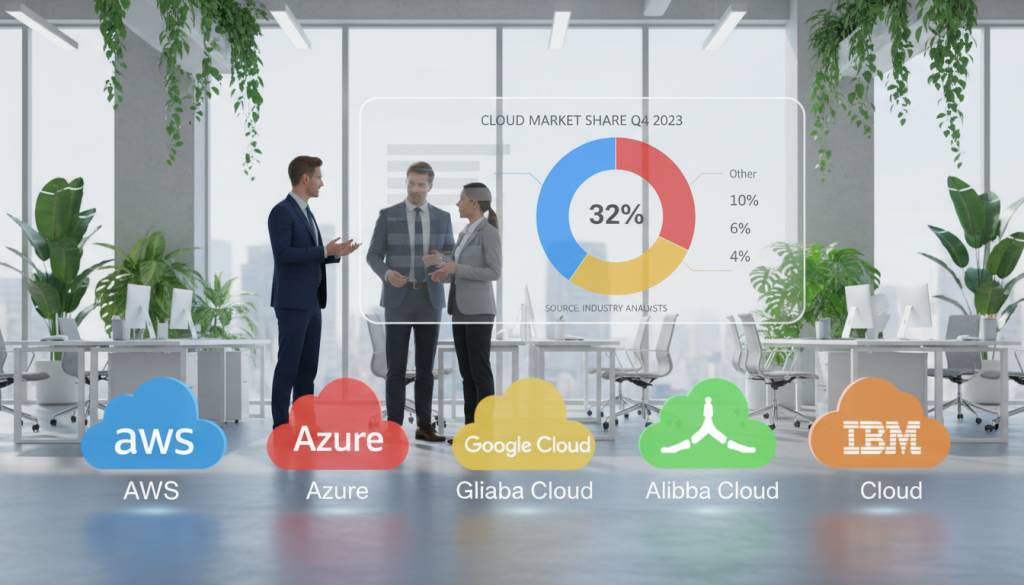
IBM Cloud and Oracle Cloud are also top providers. They offer special features for companies with specific needs or old systems.
In this guide, we’ll look at each provider’s strengths, costs, and best uses. Our knowledge helps you find the right solution for your business. This way, you can save money and work better.
Key Takeaways
- AWS leads with 29% market share, offering the most comprehensive service portfolio and global infrastructure
- Microsoft Azure commands 22% of the market, excelling in hybrid cloud and enterprise integration scenarios
- Google Cloud Platform holds 12% market share, specializing in data analytics and machine learning capabilities
- IBM Cloud and Oracle Cloud round out the top five, providing industry-specific solutions and database expertise
- The top three providers collectively control 63% of the global cloud infrastructure market
- Selecting the right cloud partner directly impacts scalability, cost optimization, and competitive positioning
Introduction to Cloud Computing
Before we dive into cloud giants, it’s key to understand cloud computing basics. This knowledge helps you choose the right technology partners and solutions. Cloud computing has changed how companies manage IT, moving from big investments to flexible models that grow with businesses.
Choosing the right technology is crucial for digital transformation. Knowing the basics helps leaders pick the right tech for their goals. This knowledge is the foundation for successful cloud adoption.
Definition and Benefits of Cloud Services
Cloud computing offers technology resources over the internet, like servers and storage, on a pay-as-you-go basis. Providers manage massive data center networks worldwide. This includes servers, storage, and cooling systems for top performance.
Instead of buying hardware, companies rent computing power. This saves money on outdated equipment. It gives businesses access to enterprise-grade infrastructure without the hassle of maintenance.
Enterprise cloud solutions bring many benefits. They improve efficiency and help businesses stay ahead:
- Low capital outlay: No big upfront costs, just variable expenses based on use
- Faster time-to-market: Deploy apps and services quickly, speeding up innovation
- Enhanced agility: Scale resources fast without long waits or limits
- Managed services: Get help with security and maintenance, freeing up resources for core activities
- Disaster recovery: Keep data safe with automated backups across many locations, ensuring business continuity
These benefits let companies focus on growth. They don’t need big IT teams for infrastructure. Instead, they can innovate and serve customers better.
Types of Cloud Computing Models
Cloud providers offer four main models, each for different needs and capabilities. Knowing these models helps choose the right level of control and management.
Infrastructure-as-a-Service (IaaS) gives virtual resources like servers and storage. Companies control their environment without owning hardware. This is great for flexibility without the cost of hardware.
Platform-as-a-Service (PaaS) provides environments for building apps. Developers can focus on their work without worrying about infrastructure. Providers handle all the technical stuff.
Software-as-a-Service (SaaS) offers apps over the internet, no local installation needed. Users get access to powerful apps without IT help. Providers handle updates and security.
Serverless Computing removes the need for server management. Developers deploy code without worrying about servers. The cloud handles resources, charging only for use. This boosts development efficiency and saves money.
Companies can pick from public, private, hybrid, or multi-cloud models. Each has its own benefits for security, control, and cost. Public clouds are cost-effective and scalable. Private clouds offer more control. Hybrid clouds mix public and private for flexibility. Multi-cloud strategies avoid vendor lock-in and improve performance.
Importance of Cloud Service Providers
Cloud providers are indispensable in today’s digital world. They offer complex infrastructure that’s too expensive for most companies to manage. Providers give businesses access to top technology they couldn’t afford otherwise.
Choosing a provider is more than just getting infrastructure. Providers invest in security, innovation, and expertise. They have thousands of engineers working on performance, security, and new services.
Working with providers frees businesses from managing data centers and keeping systems up to date. This lets companies focus on what they do best. Small startups get the same tech as big companies, making things more competitive.
Cloud solutions help businesses compete globally without huge investments. Providers have data centers worldwide for fast access. This supports business growth in new markets without the need for physical presence.
Choosing the right provider is a strategic decision. It affects efficiency, competition, and innovation. The next sections will look at specific providers, helping you find the best fit for your business.
Amazon Web Services (AWS)
Amazon Web Services (AWS) changed the tech world by making top-notch infrastructure available to all. It started in 2006 and is now the top player in cloud computing. AWS uses its experience from Amazon’s big retail operations to offer great scalability and reliability.
When we look at AWS vs Azure vs Google Cloud, AWS stands out. It has about 32% of the cloud market and serves millions of customers. AWS supports many ways to use the cloud, giving businesses the freedom to choose what works best for them.
Comprehensive Service Portfolio
AWS is one of the best IaaS providers because of its wide range of services. It has over 200 cloud services covering all tech areas. AWS’s core services, like EC2, S3, and RDS, show its strength in Infrastructure as a Service.
EC2 lets you quickly start virtual servers, saving on hardware costs. S3 is top-notch for storing data, keeping it safe and easy to access. It grows with your needs without needing big changes.
RDS makes managing databases easier by handling setup and backups. It supports many database types, letting businesses use what they know best.
Beyond these basics, AWS offers special solutions in many areas:
- Artificial Intelligence and Machine Learning: SageMaker, Rekognition, and Comprehend
- Analytics and Big Data: Redshift, EMR, and Athena
- Internet of Things: IoT Core, IoT Analytics, and IoT Greengrass
- Security and Identity: IAM, KMS, and CloudTrail
- Application Development: Lambda, API Gateway, and Elastic Beanstalk
Distinctive Platform Advantages
AWS has many unique features. It has the biggest cloud network, with over 100 Availability Zones across 31 regions. This lets businesses deploy apps close to users, improving performance and meeting data rules.
Each AWS Region has many Availability Zones, each with its own power and network. This setup makes apps more reliable and available, even when data centers fail.
AWS’s mature ecosystem is another big plus. It has thousands of tech partners and solutions built for AWS. This makes it easier for businesses to get started and grow.
AWS is also very serious about security and following rules. It meets many compliance standards, helping businesses in strict industries move to the cloud safely.
AWS keeps innovating, adding new services and features fast. It releases thousands of new things every year, giving customers access to the latest tech without waiting.
Flexible Economic Models
AWS pricing is designed to match what you use, avoiding waste. This changes IT costs, making them flexible and scalable with your business.
The main pricing model is pay-as-you-go. You only pay for what you use, without long-term contracts. This makes it easy to start and stop services as needed.
For steady workloads, AWS offers big savings through Reserved Instances and Savings Plans. These options let businesses save a lot by committing to usage levels.
| Pricing Model | Discount Range | Commitment Required | Best For |
|---|---|---|---|
| On-Demand | Standard rates | None | Variable workloads, testing, short-term projects |
| Reserved Instances | Up to 75% savings | 1 or 3 years | Steady-state applications with predictable usage |
| Savings Plans | Up to 72% savings | 1 or 3 years | Flexible compute usage across services |
| Spot Instances | Up to 90% savings | None (interruptible) | Fault-tolerant, flexible workloads |
Reserved Instances offer big discounts for long-term commitments. They’re great for things like databases and web servers that always run.
Savings Plans give similar discounts but are more flexible. You commit to a dollar amount per hour, not specific instances. This works well for changing needs.
Spot Instances let you bid on unused capacity for up to 90% off. They’re good for workloads that can handle interruptions, like data analysis.
AWS’s pricing makes it accessible to all, from startups to big companies. Its flexibility and strong features make it the top choice among best IaaS providers.
Microsoft Azure
Microsoft Azure is changing the game in cloud computing for businesses. It helps companies update their IT while keeping things familiar with Microsoft. Since 2010, Azure has grown fast, now taking about 22% of the global cloud market.
Azure is great for businesses looking to mix old and new tech. It works well with Microsoft tools and offers the latest in cloud tech. This makes it a top choice for digital transformation.
Azure’s global setup is huge, with 126 Availability Zones across 60 regions. This means more places to host data than any other provider. It helps meet data rules and improve app performance worldwide.
Azure focuses on keeping things running smoothly, no matter where you are. It’s built for big business needs, ensuring apps keep working even when things go wrong.
Comprehensive Service Portfolio
Azure offers over 200 cloud services. These services help with everything from running apps to automating business processes. It even supports new tech like edge computing and serverless apps.
Azure has many tools for different needs. For example, Azure Virtual Machines give scalable computing for Windows and Linux. Azure Blob Storage is for storing lots of data cheaply.
Azure also has tools for advanced tech like AI and IoT. Azure Cognitive Services has pre-made AI models for tasks like vision and speech. Azure IoT Hub helps connect devices securely, and Azure Stream Analytics processes data in real-time.
The cloud is about how you do computing, not where you do computing.
Distinguishing Platform Capabilities
Azure stands out in cloud comparisons with its unique features. Azure Arc is a big deal, letting Azure manage data centers and clouds everywhere. This makes it easy to keep everything in line, no matter where it is.
Azure works well with Microsoft tools, making it great for companies already using Microsoft. Azure Active Directory makes it easy to manage identities across many apps. This makes logging in and managing access simpler and more secure.
Azure is also top-notch for companies in regulated fields. It has lots of compliance certifications, showing it’s serious about security and following rules. This gives companies peace of mind when they’re working under strict rules.
| Azure Capability | Business Value | Target Scenarios | Integration Benefits |
|---|---|---|---|
| Azure Arc | Unified hybrid management | Multi-cloud governance, edge computing | Consistent policies across environments |
| Azure Active Directory | Centralized identity platform | Enterprise SSO, conditional access | Seamless Office 365 integration |
| Azure DevOps | Integrated development lifecycle | CI/CD pipelines, agile planning | GitHub and Visual Studio connectivity |
| Power Platform | Low-code business automation | Process automation, app development | Native Azure service connectivity |
Azure has a strong toolchain for developers, covering the whole app lifecycle. Azure DevOps helps with everything from coding to deployment. It works well with GitHub and Visual Studio, making development faster and easier.
Strategic Implementation Scenarios
Azure is great for moving old apps to the cloud, especially for .NET apps. It offers many ways to migrate, from simple moves to full rebuilds. This lets companies move fast but also plan for the future.
For companies using both cloud and on-premises tech, Azure is a big help. Azure Stack lets companies run Azure services locally, keeping things consistent. This is good for data security and apps that need fast access.
Companies using Microsoft tools find Azure’s cloud services very useful. Power BI and Power Automate make it easy to analyze data and automate business processes. This turns Microsoft tools into powerful digital workplaces.
Azure is also great for developers building new apps. It has tools for many programming languages and frameworks. This makes it easy to work on apps without worrying about security or compliance.
Azure’s pricing is flexible, with options for paying as you go or committing to long-term use. The Azure Hybrid Benefit program helps companies save money by using their existing Microsoft licenses. This makes Azure a smart choice for companies looking to innovate while staying stable and compliant.
Google Cloud Platform (GCP)
Google Cloud Platform stands out among cloud giants. It uses Google’s innovations for enterprise solutions. GCP is known for its unique advantages, thanks to Google’s scale in consumer services. With a 12% market share, it offers over 100 specialized services, focusing on innovation in artificial intelligence, machine learning, and data analytics.
Organizations already using Google services find great value in GCP. Businesses seeking cutting-edge data processing and AI development appreciate GCP’s leadership.
Overview of GCP Services
Google Cloud Platform has a wide range of cloud services. It focuses on quality and specialized capabilities. The platform provides foundational infrastructure services and advanced data processing tools.

The core infrastructure services include Google Compute Engine and Google Cloud Storage. GCP also offers specialized services in container management and data analytics. Google Kubernetes Engine (GKE) provides enterprise-grade container orchestration.
GCP’s advanced services include:
- BigQuery: Serverless data warehousing for petabytes of data in seconds
- Cloud AI and Machine Learning Platform: Pre-trained models and custom ML development environments
- Cloud Dataflow: Unified stream and batch data processing for real-time analytics
- Cloud Dataproc: Managed Apache Spark and Apache Hadoop service for big data processing
- Cloud Pub/Sub: Messaging service for building event-driven systems and streaming analytics pipelines
- TensorFlow Integration: Native support for Google’s open-source machine learning framework
- Anthos: Multi-cloud and hybrid cloud application platform
GCP offers flexible pricing through pay-as-you-go models and committed use discounts. Smaller companies and startups appreciate GCP’s transparent pricing and automatic sustained use discounts.
Key Features of Google Cloud
Google Cloud Platform’s unique capabilities come from Google’s internal technological development. It offers competitive advantages for specific use cases and organizational needs. These differentiators reflect Google’s engineering culture and its focus on solving problems at unprecedented scale.
Superior data analytics performance is GCP’s most compelling advantage. BigQuery processes queries across petabytes of data with response times measured in seconds. This enables real-time business intelligence that was previously impossible without massive infrastructure investments.
GCP’s artificial intelligence and machine learning leadership provides accessible AI capabilities to organizations across the technical expertise spectrum. Pre-trained APIs for vision recognition, natural language processing, translation, and speech recognition deliver sophisticated functionality without requiring specialized data science knowledge. For organizations with ML expertise, TensorFlow integration and custom model development platforms provide research-grade capabilities.
| Feature Category | Capability | Business Advantage | Target Use Case |
|---|---|---|---|
| Data Analytics | BigQuery serverless warehousing | Analyze petabytes in seconds without infrastructure | Real-time business intelligence and data exploration |
| Machine Learning | AutoML and pre-trained models | AI capabilities without extensive data science teams | Image recognition, language processing, predictions |
| Networking | Private global fiber network | Lower latency and higher throughput than public internet | Global applications requiring consistent performance |
| Container Management | Google Kubernetes Engine (GKE) | Enterprise Kubernetes from the platform’s creators | Microservices architectures and cloud-native applications |
| Multi-Cloud | Anthos platform | Consistent deployment across clouds and on-premises | Hybrid cloud strategies and vendor flexibility |
The networking infrastructure advantage differentiates GCP. It uses its private global fiber network for lower latency and more predictable performance. This network was built to serve billions of consumer users across Search, Gmail, and YouTube.
GCP’s commitment to open-source technologies and multi-cloud interoperability through Anthos addresses enterprise concerns about vendor lock-in. Anthos enables consistent application deployment, security policies, and management across GCP, competing clouds, and on-premises data centers.
Integration with Other Google Services
The seamless connectivity between GCP and Google’s broader service ecosystem creates distinctive value propositions. Organizations already invested in Google’s productivity and consumer-facing services gain immediate advantages. They benefit from unified identity management, consistent user experiences, and integrated data flows.
Google Workspace integration provides particularly strong benefits for organizations using Gmail, Google Docs, Sheets, and other productivity applications. Single sign-on capabilities, unified identity management through Cloud Identity, and API-level integration between cloud infrastructure and document collaboration tools enable seamless workflows.
The integration advantages span multiple Google service categories:
- Google Workspace: Native connectivity for document collaboration, email, calendar, and identity management with consistent security policies
- YouTube: Direct integration for media storage, streaming capabilities, and video analytics without third-party services
- Google Analytics: Seamless data pipeline from web and mobile analytics into BigQuery for advanced analysis and machine learning
- Google Ads: Marketing technology integration enabling attribution analysis and campaign optimization through machine learning
- Android Development: Integrated tools for mobile application deployment, Firebase backend services, and Play Store distribution
- Google Maps Platform: Location services, geocoding, and mapping capabilities with unified billing and administration
These integrations enable businesses to create unified technology stacks that span consumer-facing services, internal productivity tools, and cloud infrastructure. They maintain consistent user experiences, security policies, and administrative controls. Organizations can reduce vendor management complexity and integration costs by consolidating multiple service categories under a single provider relationship.
For companies serving consumer audiences, the ability to leverage the same infrastructure that powers Google Search, Gmail, and YouTube provides confidence in reliability and scalability. The integration with Google’s machine learning services allows businesses to apply similar recommendation algorithms, natural language understanding, and computer vision capabilities. This democratizes access to sophisticated AI technologies that would be prohibitively expensive to develop independently.
IBM Cloud
IBM Cloud stands out among cloud leaders, focusing on solutions for big businesses. It’s great for companies with complex needs and old systems. IBM helps these businesses grow digitally while keeping their legacy systems.
IBM Cloud has about 4% of the global cloud market. It offers special tools for big companies in strict industries. This helps them meet tough rules and keep their data safe.
Portfolio of Services and Market Position
IBM Cloud has over 170 products for different needs. It supports on-premises, hybrid, and multicloud setups. This shows IBM knows that businesses need flexibility, not just one way to do things.
IBM Cloud has many services like IBM Cloud Virtual Servers and IBM Cloud Object Storage. It also has IBM Db2 on Cloud for databases. IBM is also leading in new tech like quantum computing and blockchain.
IBM bought Red Hat, making Red Hat OpenShift a key part of its cloud plan. This helps companies manage apps across different places. It’s a big help for companies with many apps.
IBM Watson is a special part of IBM Cloud. It uses AI for things like understanding language and learning from data. This helps businesses make smart choices and innovate.
Distinguishing Capabilities and Technical Strengths
IBM Cloud is built on decades of tech experience. It’s known for its hybrid cloud management skills. This is great for companies that can’t move all their work to the cloud yet.
IBM is strong in regulated industry compliance. It meets rules for finance, healthcare, and more. This shows IBM’s commitment to keeping data safe and following rules.
The future of tech is in hybrid clouds that work with what we already have. IBM shows how to balance old systems with new tech.
IBM Cloud works well with other IBM software. This makes it easier for companies to move to the cloud. It’s especially helpful for big changes that take years.
IBM Cloud uses open-source technologies to avoid being stuck with one provider. This lets companies build apps that can move if needed. It’s all about giving businesses more freedom.
| Service Category | Core Offerings | Target Use Cases | Key Differentiators |
|---|---|---|---|
| Hybrid Cloud Platform | Red Hat OpenShift, IBM Cloud Paks | Multi-environment application deployment | Consistent operation across any infrastructure |
| AI and Analytics | IBM Watson, Watson Studio, Watson Assistant | Cognitive computing and machine learning | Industry-trained models and enterprise integration |
| Data Services | Db2, Cloud Object Storage, Data Lake | Enterprise data management and analytics | Mainframe data integration and security |
| Industry Solutions | Financial Services Cloud, Healthcare Cloud | Sector-specific compliance and workflows | Pre-configured regulatory frameworks |
Specialized Solutions for Enterprise Requirements
IBM Cloud has special solutions for big companies. It helps with moving from old systems to new ones. IBM offers tools to check what needs to move and how to do it smoothly.
IBM helps companies in strict industries with special rules. It keeps data safe and follows rules for finance and healthcare. This is important for companies that need to follow strict rules.
IBM is good at new tech like quantum computing. This lets companies try new things and stay ahead. It’s a way for companies to lead in tech.
IBM’s blockchain services help with things like supply chains and contracts. It’s for companies that want to be open and honest in their business dealings. IBM Cloud is all about making business better, not just for tech’s sake.
IBM Cloud makes it easy for companies to focus on new ideas. IBM handles the hard stuff like keeping everything running smoothly. This is great for companies that want to innovate but don’t know how to manage their tech.
Oracle Cloud
Oracle Cloud is a strong player in today’s cloud market. It brings unique strengths from Oracle’s long history as a top database and software provider. When looking at cloud infrastructure comparison, Oracle Cloud Infrastructure (OCI) stands out. It’s great for those needing top database performance and support for enterprise apps.
Oracle was the first to offer a unified platform for IaaS, PaaS, and SaaS. This makes OCI a top choice for businesses with specific needs. Oracle’s 40 years of database and software expertise shine through in its infrastructure.
Comprehensive Service Portfolio
Oracle Cloud Infrastructure offers a wide range of services from anywhere in the world. It has many deployment models, including on-premises, hybrid, public cloud, and dedicated Cloud@Customer. This lets you bring OCI services into your data center.
Oracle’s service catalog is vast. It has virtual and bare metal servers for different workloads. Oracle Cloud Storage meets various storage needs with block, object, file, and archive solutions.
The Oracle Autonomous Database is a big innovation. It uses machine learning for tasks like database tuning and backup. Oracle also supports containerized apps and has tools for advanced analytics and blockchain.
Oracle goes beyond traditional clouds. It lets you run Oracle workloads in Azure data centers. This shows Oracle’s commitment to meeting customers where they are.
Oracle’s distributed cloud is global. It ensures low latency and data residency for international businesses. Oracle also offers flexible pricing, so you only pay for what you use.
Competitive Differentiators
Oracle Cloud has several key advantages in any cloud infrastructure comparison. It often has better price-performance than AWS. This means you can save money without sacrificing performance.
Database performance is where Oracle really shines. Its innovations like Real Application Clusters and Exadata Cloud Service offer high throughput and low latency. This is crucial for apps that need fast transactions.
Oracle Cloud@Customer is great for businesses with data residency needs. It brings OCI services into your data center. This ensures consistent operations across all environments.
Oracle’s multi-cloud capabilities make it a top best IaaS provider. You can use Oracle’s database expertise while keeping investments in other clouds. This creates hybrid architectures that meet specific workload needs.
| Service Category | Key Capabilities | Primary Advantages |
|---|---|---|
| Compute Services | Virtual machines, bare metal servers, GPU instances | Flexible performance scaling with dedicated hardware options |
| Database Solutions | Autonomous Database, Exadata, RAC, MySQL | Superior performance with automated management |
| Storage Options | Block, object, file, archive storage tiers | Comprehensive data lifecycle management |
| Deployment Models | Public cloud, hybrid, Cloud@Customer, multi-cloud | Maximum flexibility for regulatory compliance |
Specialized Industry Applications
Oracle Cloud is especially good for regulated industries. It offers specialized compliance and integrated apps. Financial services get real-time fraud detection and core banking platforms.
Healthcare gets HIPAA-compliant infrastructure and electronic health records. This simplifies managing sensitive patient data.
Retail uses unified commerce platforms and inventory management. Manufacturing gets supply chain and IoT solutions. These help with everything from stock levels to factory operations.
Government gets platforms for citizen services and security frameworks. Oracle’s apps and OCI’s infrastructure solve complete business processes. This reduces complexity and speeds up new initiatives.
This integrated approach is a big value for Oracle. It addresses specific business challenges with proven apps. In any cloud infrastructure comparison, Oracle’s solutions stand out.
Comparison of the Top Providers
When comparing top public cloud vendors, we see big differences. These differences affect how well a business runs now and in the future. Choosing between AWS, Azure, and Google Cloud means looking at more than just what they offer. We need to consider pricing, how well they perform, and the support they give.
AWS has 29% of the market, Azure has 22%, and Google Cloud has 12%. This shows their strengths and how they serve businesses differently.
Each provider has built a big network to ensure their services are reliable and fast. AWS has 114 Availability Zones in 36 regions, offering over 200 services. Azure has 126 Availability Zones in 60 regions, also with over 200 services. Google Cloud has 127 Availability Zones in 42 regions, with a focus on 100+ services for specific needs.
When picking a cloud provider, businesses must think about cost, performance, security, and support. Knowing how AWS, Azure, and Google Cloud compare helps make the right choice for current needs and future plans.
Pricing Comparison
All three providers use a pay-as-you-go pricing model. But, they differ in discounts, billing details, and how clear their prices are. Understanding these differences helps businesses save money and get a good return on their investment.
AWS has several discounts for different usage patterns. Reserved Instances can save up to 75% for long-term commitments. Savings Plans offer flexibility and big discounts. Spot Instances let customers use spare capacity at low prices for workloads that can handle interruptions.
Azure has similar Reserved Instances and discounts. The Azure Hybrid Benefit lets customers use existing Microsoft licenses for cloud savings. Dev/Test pricing helps development teams without breaking the bank.
Google Cloud has unique pricing. Committed Use Discounts can save up to 57%. Sustained Use Discounts apply automatically to always-running workloads. GCP’s billing by the second helps save on short tasks.
| Provider | Primary Discount Program | Maximum Savings | Billing Granularity | Unique Advantage |
|---|---|---|---|---|
| AWS | Reserved Instances | Up to 75% | Per-hour/Per-second | Spot Instances for flexible workloads |
| Azure | Reserved Instances | Up to 72% | Per-hour/Per-minute | Azure Hybrid Benefit for license portability |
| Google Cloud | Committed Use Discounts | Up to 57% | Per-second | Automatic Sustained Use Discounts |
Performance Metrics
Each provider offers top-notch infrastructure, but they shine in different areas. The right choice depends on what matters most for your workloads and where they need to be.
AWS has the most services and is in 36 regions. This makes it great for apps that need to be everywhere. With 114 Availability Zones, AWS ensures apps are always available and can recover quickly.
Azure has the most physical infrastructure, with 126 Availability Zones in 60 regions. This is perfect for businesses that need to store data in specific places for legal reasons. Azure Arc helps manage on-premises, edge, and cloud environments consistently.
Google Cloud has the best networking thanks to its private fiber network. This network, used by Google Search and YouTube, offers fast and reliable connections. BigQuery and advanced data analytics make GCP ideal for big data tasks.
When it comes to specific services, AWS has the most compute options and integrations. Azure is best for hybrid scenarios and Microsoft tools. GCP is top for big data and machine learning.
Customer Support Evaluation
Each provider offers different support levels, from basic to premium. But, the quality of support, how fast they respond, and what they offer can really help a business run smoothly.
AWS has four support levels: Basic (free), Developer, Business, and Enterprise. Response times vary from 24 hours to 15 minutes for urgent issues. Enterprise support includes dedicated managers for proactive help.
Azure has five support levels: Basic (free), Developer, Standard, Professional Direct, and Premier. Like AWS, Azure has Premier support for extra help. Azure is strong in hybrid cloud setups.
Google Cloud has four support levels: Basic (free), Development, Production, and Enterprise. GCP focuses on technical help for data analytics and machine learning. Response times are good, and they know their stuff.
All three providers have lots of documentation, training, and partner networks. These resources help businesses learn and get help for complex projects. With the right training and support, any business can succeed with cloud infrastructure, no matter the provider.
Security and Compliance Considerations
As businesses move to the cloud, security and compliance are key. They affect who to choose and how to set up cloud services. Companies looking at leading SaaS platforms and enterprise cloud solutions face big decisions. They need to protect their data and follow rules.
Cloud computing uses a network of servers to handle data. This raises concerns about keeping business secrets and customer data safe. It’s important to know how to protect this information.
Cloud computing lets you access data from anywhere. But, hackers can also get in. Knowing about security and rules is crucial for making good choices.

Protecting Your Assets in the Cloud
The security of leading providers has improved a lot. AWS, Azure, and GCP have spent a lot on security. This creates strong protection for many threats at once.
Cloud providers have many security features. They use biometric access, constant monitoring, and dedicated security teams. They also have network security and virtual private clouds to keep data safe.
Encryption is a key part of security. Leading SaaS platforms use strong encryption for data. They also let customers manage their own encryption keys. Identity and access management systems help control who can access data.
“The cloud is not inherently secure or insecure—security is a shared responsibility between provider and customer.”
Cloud providers have advanced monitoring tools. These tools find threats quickly and suggest fixes. They also have programs to find and fix security issues before they happen.
Cloud security is a shared responsibility model. Providers secure the infrastructure, but customers must protect their data and applications. Companies need to follow security best practices.
- Least-privilege access controls that limit user permissions to essential functions
- Regular security training for personnel to recognize threats and follow protocols
- Encryption of sensitive data beyond provider defaults
- Network segmentation to isolate critical workloads
- Logging and monitoring of user activities for audit trails
- Incident response procedures that define actions during security events
This shared model means business leaders must know what providers do and what they must do. Mistakes in setting up cloud services are a common security risk. It’s important to set things up right and keep them secure.
Meeting Regulatory Requirements
Cloud providers have many compliance certifications. These show they follow strict security and privacy rules. AWS, Azure, and GCP have dozens of certifications for different rules around the world.
Important certifications include ISO 27001 for managing sensitive information. SOC 1, SOC 2, and SOC 3 reports verify service controls. PCI DSS ensures payment card data is safe.
Industry-specific certifications are also important. HIPAA compliance protects health data in the US. FedRAMP lets government agencies use cloud services safely. GDPR ensures data privacy in Europe.
Financial services need PCI DSS Level 1 and banking rules. Schools must follow FERPA for student records. Government contractors need to meet various security standards.
We say that while certifications show providers follow rules, customers must also do their part. They need to set up their cloud services correctly. They must classify their data, secure their applications, keep detailed records, and follow rules.
The rules for cloud security are always changing. Leading SaaS platforms update their compliance to keep up. But, following rules is an ongoing task that requires attention and effort.
Companies worried about data control or vendor lock-in might consider hybrid or multi-cloud strategies. These options let businesses keep sensitive data on-premises or spread it across providers. This reduces risk while still offering cloud benefits for less sensitive data.
Understanding the security and compliance landscape helps businesses make smart choices about cloud adoption. We suggest that leaders do thorough risk assessments, review provider security, and create clear policies for cloud use.
Use Cases for Each Provider
Every organization faces unique challenges when implementing cloud infrastructure. We explore practical use cases to show how different providers excel in specific scenarios. Choosing between AWS, Azure, Google Cloud, IBM Cloud, and Oracle Cloud depends on your organization’s size, industry, technical expertise, and strategic objectives.
Understanding these practical applications helps decision-makers evaluate providers beyond basic feature comparisons. We examine how startups, enterprises, and academic institutions leverage different cloud platforms to achieve their goals.
Optimal Solutions for Emerging Businesses
Startups typically benefit most from AWS due to its comprehensive ecosystem that supports rapid experimentation and scaling. The platform offers an extensive marketplace of pre-built solutions that accelerate development cycles. This allows small teams to implement sophisticated architectures without deep cloud expertise.
The venture capital community’s familiarity with AWS also facilitates funding discussions. Investors understand the scalability and reliability of your technology stack. The vast documentation, tutorials, and community support enable startups to overcome technical challenges quickly.
However, Google Cloud presents compelling alternatives for startups focused on data analytics, machine learning, or mobile applications. Businesses already leveraging Google Workspace for productivity find seamless integration valuable. Similarly, Azure appeals to startups in the Microsoft for Startups program or those building applications that integrate with Microsoft’s business ecosystem.
The cloud is about how you do computing, not where you do computing.
Comprehensive Solutions for Large Organizations
Enterprise organizations require more nuanced provider selection based on existing infrastructure, compliance requirements, and global operations. We find that AWS serves enterprises needing the broadest global reach, most extensive service catalog, and mature governance tools for managing complex, multi-account organizations.
Azure becomes the natural choice for enterprise cloud solutions when organizations maintain significant Microsoft software investments. Companies running Windows Server, SQL Server, Active Directory, Office 365, or Dynamics 365 benefit from Azure’s integrated identity management and hybrid cloud capabilities through Azure Arc.
IBM Cloud addresses enterprises in highly regulated industries requiring specialized compliance capabilities. Organizations operating substantial IBM mainframe or middleware infrastructure can modernize gradually while maintaining existing investments. We’ve seen financial services, healthcare, and government agencies leverage IBM’s expertise in enterprise cloud solutions that meet stringent security and compliance standards.
Oracle Cloud serves enterprises with large-scale Oracle Database deployments or Oracle Applications. These organizations achieve optimized performance and cost efficiency for existing workloads while potentially leveraging Oracle Autonomous Database features that automate routine administration tasks.
| Provider | Primary Enterprise Advantage | Ideal Enterprise Profile | Migration Approach |
|---|---|---|---|
| AWS | Broadest service portfolio | Diverse workloads, global presence | Lift-and-shift or re-architecture |
| Azure | Microsoft ecosystem integration | Windows-centric infrastructure | Hybrid cloud with Azure Arc |
| IBM Cloud | Regulatory compliance expertise | Mainframe modernization needs | Gradual transformation |
| Oracle Cloud | Database optimization | Oracle software investments | Direct database migration |
Research and Educational Institution Applications
Academic and research institutions represent a distinct use case category where Google Cloud often excels. Its superior capabilities in BigQuery for analyzing massive research datasets support computational research across disciplines. We recognize that GCP’s leadership in TensorFlow and machine learning frameworks enables cutting-edge AI research.
Google Colab integration allows researchers to share computational notebooks seamlessly, facilitating collaboration across institutions and geographies. This approach democratizes access to powerful computing resources for students and faculty.
AWS provides extensive academic grants through AWS Educate and research credits while offering specialized high-performance computing capabilities. Services like AWS ParallelCluster support genomics, climate modeling, and computational physics research. We’ve observed universities leveraging AWS for large-scale data processing in environmental science and medical research.
Azure supports academic institutions through Azure for Students and Microsoft’s broader education initiatives. The platform provides research-specific services for computational biology, digital humanities, and social science research. All three providers offer substantially discounted or free access to students and researchers, supporting the next generation of cloud practitioners while advancing scientific discovery.
Educational institutions benefit from providing students with industry-relevant experience on platforms they’ll encounter professionally. This practical exposure prepares graduates for careers in technology, data science, and research, creating a skilled workforce familiar with modern cloud platforms and multi-cloud strategies.
Trends in Cloud Computing
Emerging technologies and new architectural approaches are changing how we use cloud resources. Cloud giants are innovating fast, introducing new ways to make IT operations more agile and intelligent. These changes affect not just our tech but also how we do business, helping us compete better in the digital world.
Today’s businesses need to be flexible and resilient to support quick innovation. The mix of artificial intelligence, distributed computing, and hybrid models offers big chances for better operations. Knowing these trends helps leaders grow their businesses while keeping things simple and affordable.
Advanced Technologies Reshaping Cloud Services
Artificial intelligence and machine learning are now key business tools, not just research tools. The big cloud players offer pre-trained AI models for tasks like computer vision and predictive analytics. This makes AI more accessible, even for businesses without big data science teams.
Edge computing brings cloud services closer to where data is created, solving big latency issues. It’s great for IoT, self-driving cars, and real-time analytics that need fast responses. It also helps with data privacy by processing sensitive info locally before sending it to the cloud.
Serverless computing and Functions-as-a-Service change how we build and run apps. They let developers focus on code, not managing servers. This way, apps scale automatically and businesses only pay for what they use, saving a lot of money.
Kubernetes is now the standard for deploying apps in the cloud and on-premises. It makes apps run the same everywhere, making things easier for developers. Cloud giants offer managed Kubernetes services to make things even simpler.
Quantum computing services from IBM, AWS, and Azure let businesses try out new things. These services are still early, but they could give businesses a big edge as they get better. It’s a chance for forward-thinking companies to explore new possibilities.
Blockchain helps with supply chain tracking, financial deals, and digital identities. It makes systems transparent and secure, building trust among partners. Using blockchain with cloud services creates powerful, secure solutions.
| Emerging Technology | Primary Business Benefit | Implementation Complexity | Maturity Level |
|---|---|---|---|
| AI and Machine Learning | Automated insights and predictions | Medium with AutoML tools | Production-ready |
| Edge Computing | Reduced latency and local processing | High for distributed management | Rapidly maturing |
| Serverless Functions | Cost optimization and auto-scaling | Low for simple applications | Production-ready |
| Quantum Computing | Complex problem solving | Very high, experimental | Early development |
| Blockchain Services | Transparent, secure transactions | Medium to high | Use-case dependent |
Strategic Deployment Across Multiple Environments
More than 85% of companies now use hybrid or multi-cloud strategies. They know different workloads fit best in different places, and avoiding one vendor keeps options open. This shows they understand cloud economics and what their businesses need.
Hybrid cloud architectures mix on-premises data centers with public clouds. This meets specific needs, like data privacy and migrating old apps. It also handles sudden spikes in demand while keeping basic capacity on-premises.
Multi-cloud means running services on two or more clouds. It’s popular for flexibility, reducing risk, and avoiding vendor lock-in. Businesses spread their services across platforms for specific strengths.
AWS is great for compute-heavy tasks because of its wide service catalog and global reach. Azure is good for Microsoft software and regional needs. Google Cloud Platform excels in data analytics and machine learning, offering top performance.
Cloud giants offer tools for managing services across different clouds. Azure Arc, Google Anthos, and AWS Outposts provide a unified way to manage diverse environments. They help with security, observability, and deployment, making things simpler despite different infrastructures.
Having multiple clouds means services can keep running even if one goes down. This keeps businesses running smoothly and protects against lost revenue. It also gives better negotiating power with vendors.
But, multi-cloud strategies add complexity. Businesses need experts for each platform and smart cost management to avoid overspending. Good visibility tools and governance are key to making the most of multi-cloud while keeping costs and security in check.
Cloud cost visibility tools help manage spending across different clouds. They track spending, find ways to save, and control budgets. Without these tools, multi-cloud can lead to unexpected costs that eat into savings.
Future of Cloud Service Providers
The cloud services world is set for big changes. New technologies and market needs will push cloud computing market leaders to focus on new areas. Since Amazon started AWS in 2006, the cloud market has grown a lot. Now, AWS leads with 29% of the market, followed by Microsoft Azure with 22%, and Google Cloud Platform with 12%.
These big players have spent billions on their global networks and services. The future will see more consolidation among top providers. There will also be more competition in specific areas and new ways to stand out.
Sustained Market Expansion and Growth Drivers
Analysts say the global cloud market will hit $500 billion by 2027. Many trends are pushing cloud use into new areas. Companies are moving away from old data centers to save money and work better.
Workloads that were hard to move to the cloud are now going there. This is because providers have improved their services to meet these needs. Big areas like banking, health records, and manufacturing are seeing growth as cloud services meet their needs.
Cloud services are also growing in Asia, Africa, and Latin America. Better internet and local data centers are helping. This growth is good for companies looking for cloud services that fit their region’s needs.
Edge computing is bringing cloud services closer to where they’re needed. This means faster processing and better data use. It’s changing how we use cloud services.
| Growth Driver | Market Impact | Timeline | Key Beneficiaries |
|---|---|---|---|
| Enterprise Cloud Migration | $180B incremental revenue | 2026-2028 | AWS, Azure, IBM Cloud |
| AI/ML Service Adoption | $95B market segment | 2026-2029 | GCP, Azure, AWS |
| Emerging Markets Expansion | $75B new demand | 2026-2031 | Alibaba, AWS, Azure |
| Edge Computing Integration | $60B infrastructure spend | 2026-2030 | Azure, AWS, Google Cloud |
AI and machine learning services are growing fast. Companies are oving from testing to using AI in real work. This is driving demand for cloud-based AI services.
Cloud services for specific industries are growing fast. Providers are making services for healthcare, finance, retail, and more. These services are tailored to each industry’s needs.
Competitive Landscape Evolution and Disruption Factors
Regulations could change the cloud market a lot. Governments are looking at the big players. This could help local providers and change how companies use cloud services.
Rules for different industries are making it harder for new players. Smaller providers find it tough to keep up. This might lead to more consolidation.
New technologies could shake up the cloud market. Quantum computing and AI could give some providers an edge. This could change who leads the market.
New players can still enter the cloud market. Companies like Oracle and Alibaba are growing fast. This shows the cloud market is still open to new players.
Smaller providers are being bought by bigger ones. This is creating a two-tier market. We expect more of this as providers look to grow.
Cloud pricing is changing. Companies want to pay based on results, not just for what they use. New pricing models are emerging, changing how the market works.
While AWS, Azure, and GCP are likely to stay on top, there’s room for others. Companies that use multiple clouds can benefit from each provider’s strengths. This means there’s a need for tools that manage across different clouds.
Conclusion: Choosing the Right Cloud Provider
Knowing the top 5 cloud service providers is just the start. The real challenge is finding the right fit for your business needs and tech setup.
Factors to Consider
Look at your workload’s needs, like how much computing power and storage you need. Also, think about where your data will be stored. Security is key, especially in certain industries, so check for compliance certifications.
Don’t forget about the cost. It’s not just about the hourly rate. Migration, training, and ongoing management costs matter too.
How well the cloud provider works with your current systems is important. Each top cloud vendor has its own strengths in connecting with your existing tech.
Making a Decision Based on Needs
First, assess your workloads. Decide which apps will benefit most from moving to the cloud. Then, compare those needs with what each provider offers.
AllCode is your cloud partner, with connections to AWS, Azure, Google Cloud, IBM Cloud, and Oracle Cloud. We offer unbiased advice and help you deploy and scale your workloads. We know that every business is different.
Using multiple clouds can be the best choice. We help companies of all sizes pick the right mix of providers. This way, you get innovation and efficiency without the risks of high costs or being stuck with one vendor.
FAQ
What are the top 5 cloud service providers in 2026?
How do AWS, Azure, and Google Cloud compare in terms of market share?
Which cloud service provider is best for enterprise cloud solutions?
What are the main differences in pricing between the top cloud providers?
Which cloud provider offers the best Infrastructure-as-a-Service (IaaS) capabilities?
What security features do leading cloud providers offer?
Which cloud provider is best for startups?
What are the advantages of multi-cloud strategies?
Which cloud provider offers the best compliance certifications?
How does Google Cloud Platform differentiate itself from AWS and Azure?
What role does IBM Cloud play in the enterprise market?
Why should organizations consider Oracle Cloud Infrastructure?
What are the emerging trends in cloud computing?
How do I choose the right cloud provider for my organization?
What is the future outlook for cloud service providers?
What support options do the top cloud providers offer?
How do cloud providers address data sovereignty and compliance requirements?
What are the advantages of hybrid cloud architectures?
Which cloud provider is best for artificial intelligence and machine learning workloads?
How can organizations optimize cloud costs across providers?