Did you know that businesses leveraging advanced intelligence solutions are experiencing a 40% reduction in operational costs? This statistic highlights a fundamental shift in how technology supports modern enterprises. For managed service providers, this evolution represents both a challenge and an unprecedented opportunity.

We recognize that msps face unique pressures, including 24/7 monitoring demands and complex multi-client technology stacks. The integration of sophisticated automation tools has transitioned from a luxury to a core business necessity. These technologies empower providers to deliver exceptional service quality while optimizing scarce resources.
This guide explores how intelligent systems streamline repetitive tasks and enhance client experiences. We will cover everything from foundational concepts to cybersecurity applications and predictive maintenance strategies. Our collaborative approach focuses on helping your business harness data-driven insights for proactive problem-solving.
The imperative to adopt these solutions is clear. Early adopters gain significant market advantages through improved efficiency and enhanced security. They achieve scalable operations without proportionally increasing headcount, amplifying their growth potential in a competitive landscape.
Key Takeaways
- Intelligent automation significantly reduces operational costs for technology support firms.
- Advanced tools address critical industry challenges like 24/7 monitoring and complex client stacks.
- These solutions transform from futuristic concepts to practical business necessities.
- Adopting this technology streamlines repetitive tasks and enhances client experiences.
- Early adoption provides competitive advantages through improved efficiency and security.
- Scalable operations become achievable without substantial increases in staffing.
- Data-driven insights enable proactive problem-solving and amplify growth potential.
Introduction to AI for Managed Service Providers
Modern managed service providers face unprecedented complexity in their daily operations, creating new opportunities for advanced automation. We recognize that these organizations require sophisticated approaches to handle diverse client needs effectively.
Understanding AI in the MSP Context
Intelligent systems represent computer capabilities that perform tasks traditionally requiring human intervention. Machine learning algorithms analyze historical performance data to identify meaningful patterns and predict future infrastructure needs.
Natural language processing enables these systems to understand and interpret human communications. This technology supports applications like automated ticket classification and conversational support interfaces.
Robotic process automation integrates with existing technology stacks to handle repetitive, rule-based tasks. These systems simulate human actions across various software platforms, freeing technical staff for complex problem-solving.
The Evolution of AI Automation
The journey from simple rule-based systems to today’s sophisticated technologies represents a fundamental shift in service delivery. Current solutions include large language models that process conversational queries and agentic systems that autonomously handle IT service tasks.
Adoption statistics reveal that 45% of msps already use some form of intelligent automation in their operations. Another 30% are actively planning implementation, demonstrating this technology’s transition from experimental concept to business necessity across the industry.
The Role of AI in Modern MSP Operations
Today’s managed service providers navigate an intricate web of client demands, where traditional reactive approaches no longer suffice in maintaining competitive advantage. These organizations manage diverse technology stacks across multiple client environments, creating operational complexity that strains human resources.
Shifting from Reactive to Proactive Management
We observe a fundamental transformation in how support organizations approach their core operations. Instead of waiting for system failures, intelligent systems enable predictive maintenance through continuous data analysis. This approach identifies potential issues before they escalate into costly downtime.
Modern automation tools provide comprehensive visibility across all client environments simultaneously. They analyze performance metrics and network patterns that human teams cannot monitor manually. This ensures consistent service quality as client portfolios expand.
The scalability challenge becomes manageable through these advanced systems. Service providers can handle increasing workloads without proportional staffing increases. This efficiency maintains responsiveness while controlling operational costs.
This operational shift positions msps as strategic partners rather than break-fix vendors. They deliver measurable business value through improved reliability and data-driven recommendations. The transition represents a significant advancement in intelligent automation solutions for the industry.
Benefits of AI Automation for MSPs
Beyond theoretical concepts, intelligent automation yields concrete benefits that transform the service delivery model for modern IT support organizations. We observe significant improvements in both internal operations and external client relationships when these solutions are implemented strategically.
Enhanced Efficiency and Cost Savings
These systems excel at handling repetitive, time-consuming tasks like system monitoring and patch management. This dramatically enhances operational efficiency and frees technical resources for complex problem-solving.
The impact on operational costs is substantial. Consider the example of ABANCA, which deployed automation to handle document validation. They achieved 60% faster response times and recovered 1.2 million hours of productive capacity.
The following table illustrates the operational shift:
Manual vs. Automated Task Management
| Activity |
Manual Approach |
Automated Solution |
| Ticket Triage |
Time-consuming, prone to human error |
Instant, accurate classification |
| Patch Deployment |
Labor-intensive, scheduled downtime |
Streamlined, minimal disruption |
| System Monitoring |
Reactive, limited scope |
Proactive, 24/7 comprehensive coverage |
Improved Client Experience and Support
This technology directly addresses the challenge of managing high volumes of customer queries. Client demands for quick, personalized support are met with faster response times and consistent experiences.
Every interaction maintains professional standards, which increases satisfaction and strengthens long-term retention. This allows msps to scale their operations without compromising the quality of their service.
AI-Driven Cybersecurity Solutions for Enhanced Protection
Cybersecurity threats evolve at an unprecedented pace, creating critical protection gaps that traditional methods cannot address. We recognize that msps face escalating challenges in safeguarding client data while maintaining compliance with complex regulations.

Conventional security measures frequently miss sophisticated attacks that compromise sensitive information. These limitations create vulnerabilities across client systems and infrastructure.
Real-Time Threat Detection and Response
Advanced cybersecurity solutions provide continuous monitoring across all network environments. They analyze behavioral patterns to identify anomalies indicating potential threats.
This enables immediate detection of emerging risks before significant damage occurs. Automated response capabilities trigger protective actions without manual intervention delays.
Behavioral Analytics for Proactive Security
Machine learning algorithms establish baseline activity patterns for users and devices. They flag deviations that signal compromised accounts or insider threats.
This behavioral analysis provides comprehensive security visibility that traditional systems miss. Msps can deliver robust protection that maintains client trust and demonstrates regulatory compliance.
The result transforms cybersecurity from reactive monitoring to proactive defense. This enhances service quality and creates competitive differentiation in a security-conscious market.
Enhancing IT Support with AI-Powered Chatbots and Virtual Assistants
Conversational technology represents a fundamental shift in how technical support organizations handle client interactions. We observe these systems transforming helpdesk operations by providing immediate, scalable responses to routine inquiries.
Modern chatbots handle approximately 80% of standard customer queries, delivering instant responses regardless of time zones. This capability ensures consistent support quality while reducing pressure on human technicians.
Streamlining Helpdesk Operations
Natural language processing enables accurate categorization of support tickets based on content analysis. Systems like Microsoft’s Power Virtual Agents automatically prioritize urgent issues while routing routine requests through efficient workflows.
The following table demonstrates operational improvements:
Traditional vs. Automated Support Handling
| Support Aspect |
Traditional Approach |
Chatbot Solution |
| Initial Response Time |
Hours during business hours |
Seconds, 24/7 availability |
| Ticket Classification |
Manual, inconsistent prioritization |
Automated, urgency-based routing |
| Query Resolution |
Dependent on staff availability |
Immediate for common issues |
Delivering Personalized Customer Interactions
These systems analyze communication patterns to gauge client sentiment and emotional state. They adjust their tone and language based on individual preferences and situational urgency.
This personalization creates engaging conversations that clients appreciate rather than tolerate. It allows technical staff to focus on complex problem-solving while maintaining strong customer relationships.
Predictive Analytics and Proactive Maintenance in MSP Environments
Historical performance data holds invaluable insights that can transform how organizations approach system reliability. We observe technology support firms leveraging these analytical capabilities to anticipate infrastructure needs before they become critical issues.
Leveraging Data for Predictive Insights
Advanced analytical tools examine historical performance metrics, system logs, and infrastructure patterns to forecast equipment failures with remarkable accuracy. These solutions analyze vast amounts of operational data to identify subtle indicators of potential problems.
Platforms like Splunk enable msps to detect resource constraints and performance degradation before they impact client systems. This predictive capability provides sufficient lead time for scheduled maintenance and component replacement.
Minimizing Downtime and Enhancing Reliability
Predictive maintenance strategies can reduce unplanned downtime by up to 50%, significantly improving client satisfaction and operational efficiency. Continuous monitoring allows for real-time adjustments based on usage patterns and system behavior.
These approaches enable dynamic resource allocation, balancing workloads and scaling capacity to prevent performance bottlenecks. The result is enhanced reliability that strengthens client relationships and creates competitive advantages.
Customizing Infrastructure with AI Supercloud Capabilities
Infrastructure customization represents the next frontier in operational excellence for technology support organizations. We deliver state-of-the-art solutions specifically designed for msps requiring high-performance computing environments.
Our approach leverages cutting-edge NVIDIA technologies including Blackwell GB200 and HGX H100 systems. These powerful resources handle demanding workloads while maintaining optimal efficiency.
Scalability Through Optimized GPU and CPU Configurations
Custom configurations encompass GPU, CPU, RAM, storage, and networking components. This flexibility allows msps to scale operations precisely as client needs evolve.
The following comparison demonstrates infrastructure options:
Infrastructure Configuration Comparison
| Component |
Standard Cloud |
AI Supercloud |
| GPU Availability |
Limited tier options |
Custom performance scaling |
| Workload Support |
Basic computing tasks |
Complex AI applications |
| Resource Management |
Manual allocation |
Automated optimization |
Advanced Cloud Resource Management
Our cloud infrastructure enables seamless scalability for sustained workloads and bursting scenarios. This eliminates long-term commitments while maintaining performance standards.
We provide comprehensive expert support throughout implementation. Technical account managers and MLOps engineers guide msps from deployment to optimization.
Automated management distributes workloads across multi-cloud environments. It optimizes resource utilization and predicts cost patterns before they impact business operations.
Overcoming Challenges in Integrating AI Solutions for MSPs
The path to seamless automation encounters substantial obstacles when dealing with heterogeneous technology environments that characterize modern client portfolios. We recognize that msps must navigate complex integration challenges across diverse client systems and infrastructure configurations.
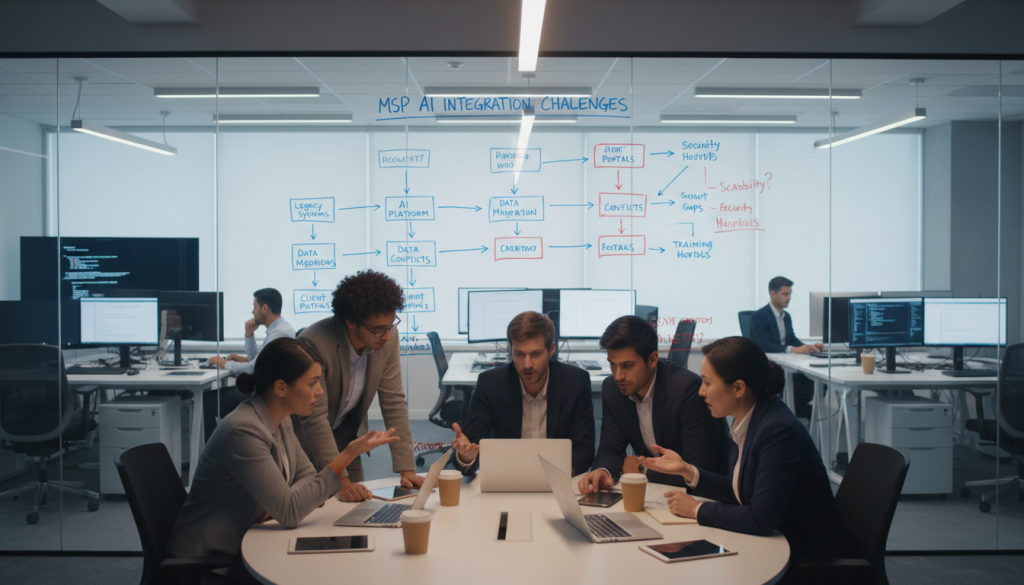
Successful implementation requires careful planning and strategic approaches to ensure compatibility and data cohesion. These considerations form the foundation for effective automation deployment.
Ensuring Compatibility with Legacy Systems
Many client environments still operate legacy software and outdated applications that lack modern integration capabilities. We address compatibility issues through middleware solutions and customized interface development.
This approach enables seamless data exchange between older systems and modern automation platforms. It preserves existing investments while unlocking new operational efficiencies.
Breaking Down Data Silos
Client information frequently resides across disparate platforms including on-premises servers and cloud services. We implement unified data governance frameworks that consolidate information from multiple sources.
This strategy ensures comprehensive visibility across all client environments. It enables accurate analytics and informed decision-making for msps serving diverse clients.
Integration Approach Comparison
| Strategy |
Traditional Method |
Optimized Solution |
| Legacy System Integration |
Manual data transfer |
Automated API bridging |
| Data Consolidation |
Separate platform management |
Unified data governance |
| Custom Application Support |
Extensive manual configuration |
Template-based adaptation |
These strategies enable msps to overcome integration barriers effectively. They ensure successful automation implementation across complex client infrastructure landscapes.
Strategic Considerations for Successful AI Implementation
Organizations embarking on digital transformation journeys must prioritize strategic alignment between technological capabilities and business requirements. We emphasize that successful implementations begin with identifying well-defined challenges rather than adopting technology for its own sake.
Developing a Roadmap for AI Adoption
Effective planning requires clear success metrics and resource allocation strategies. Technical support firms should prioritize high-impact use cases that directly address operational challenges.
We advocate for comprehensive adoption roadmaps that establish measurable objectives. These plans must account for change management and organizational capability development.
Balancing Automation with Human Expertise
The most successful outcomes result from synergy between machine efficiency and human insight. Complex decisions involving ambiguity require human judgment that automated systems cannot fully replicate.
We stress the importance of combining automation capabilities with human creativity. This balanced approach ensures optimal results for client service delivery and business operations.
Continuous improvement planning remains essential as technologies advance and client needs evolve. Regular updates and performance refinement maintain system effectiveness over time.
Future Trends and Innovations in AI for Managed Service Providers
As we look toward the horizon of technological progress, several key innovations promise to transform how support organizations operate and deliver value. These emerging tools will redefine the industry landscape, creating new opportunities for forward-thinking msps.
Emerging Technologies and Edge AI
Edge computing represents a significant shift in data processing capabilities. By 2025, Gartner predicts 75% of enterprise data will originate outside traditional infrastructure.
This decentralization enables real-time decision-making at the network edge. It reduces latency while supporting the growing Internet of Things ecosystem.
Explainable AI addresses transparency concerns by making automated decisions interpretable. Federated learning approaches enhance privacy while enabling personalized services.
Preparing for Continuous Change and Innovation
The World Economic Forum anticipates 50% of workers will require reskilling by 2026. This workforce transformation demands strategic planning from service providers.
Forward-thinking organizations must invest in continuous learning programs. They should focus on developing teams capable of managing evolving technology applications.
Hyper-personalization will become standard through intelligent recommendation engines. These solutions will dynamically adjust to client-specific needs and usage patterns.
Cultivating organizational agility remains essential for navigating this evolving landscape. Successful msps will embrace innovation rather than resist inevitable change.
Leveraging AI for Managed Service Providers: Transforming IT Operations
Practical evidence demonstrates how intelligent systems transform technology support organizations through measurable improvements. We examine compelling case studies that validate the operational benefits achievable through strategic implementation.
Real-World Case Studies and Applications
ABANCA’s deployment of generative automation and natural language processing delivered impressive results. The organization achieved 60% faster response times while recovering 1.2 million hours of productive capacity.
Splunk’s predictive analytics platform helps identify infrastructure issues before they impact client operations. Microsoft Power Virtual Agents automate customer interactions while improving satisfaction rates significantly.
Densify provides actionable insights into cloud consumption patterns. Tableau’s enhanced visualization capabilities translate complex technical data into clear business intelligence that clients understand.
Measuring Impact and ROI
Successful implementations require comprehensive measurement frameworks that extend beyond simple cost reduction. We track improved client satisfaction scores, reduced resolution times, and decreased unplanned downtime.
Establishing baseline metrics before implementation allows organizations to quantify improvements accurately. Consistent tracking of key performance indicators demonstrates tangible value to stakeholders.
These implementations create virtuous cycles where efficiency gains free resources for further innovation. Improved services enhance client retention while market differentiation enables premium pricing strategies.
Conclusion
As we conclude this comprehensive exploration, the strategic integration of advanced automation emerges as the defining competitive differentiator for modern technology support organizations. This transformation represents a fundamental shift in how managed service providers deliver value, moving beyond traditional support models to become strategic partners.
Successful adoption requires balancing technological capabilities with human expertise, ensuring automation augments rather than replaces the creative judgment that defines exceptional service providers. The msps who thrive will be those embracing innovation strategically while maintaining their focus on client relationships.
We encourage starting this journey now with clear objectives and achievable pilot projects. The future belongs to organizations leveraging these tools to deliver proactive support and personalized services. This approach positions technology as a growth driver rather than just an operational necessity.
Forward-thinking organizations are already redefining excellence in our industry, creating unprecedented value for their clients while building sustainable business models. The time for strategic action is present.
FAQ
How does artificial intelligence improve response times for client support tickets?
We leverage intelligent automation to analyze and categorize incoming tickets instantly. This allows our systems to route issues to the correct specialist or resolve common queries automatically, significantly reducing wait times. By learning from historical data, these tools continuously improve their accuracy and speed, ensuring your customers receive faster, more effective support.
Can these solutions integrate with our existing management software and infrastructure?
A>Yes, our platforms are designed for seamless compatibility with major RMM and PSA tools like ConnectWise and Kaseya. We focus on breaking down data silos to create a unified operational view. This integration ensures that your current workflows are enhanced, not disrupted, providing a smooth transition and immediate value.
What role does predictive analytics play in proactive maintenance?
Predictive analytics uses machine learning to examine patterns within your client’s systems. It identifies potential hardware failures or software issues before they cause downtime. This shift from reactive fixes to proactive maintenance enhances system reliability, minimizes disruptions, and allows you to schedule interventions at optimal times, maximizing efficiency.
How do AI-driven cybersecurity solutions enhance protection for our clients?
Our cybersecurity tools employ real-time threat detection and behavioral analytics to monitor environments continuously. They identify anomalous activities that may indicate a breach, enabling immediate response. This proactive approach provides a stronger security posture than traditional signature-based methods, safeguarding critical business data effectively.
What is the typical impact on operational costs after implementation?
Clients typically see a substantial reduction in operational costs due to increased automation of routine tasks. This efficiency frees up your technical staff to focus on more complex, revenue-generating projects. The investment often leads to a strong return by improving resource allocation and reducing the time spent on manual processes.
Author
Praveena Shenoy
- Country Manager, Opsio
Praveena Shenoy is the Country Manager for Opsio India and a recognized expert in DevOps, Managed Cloud Services, and AI/ML solutions. With deep experience in 24/7 cloud operations, digital transformation, and intelligent automation, he leads high-performing teams that deliver resilience, scalability, and operational excellence. Praveena is dedicated to helping enterprises modernize their technology landscape and accelerate growth through cloud-native methodologies and AI-driven innovations, enabling smarter decision-making and enhanced business agility.