By 2025, experts predict that half of all organizations will utilize a managed detection and response solution. This startling statistic underscores the escalating pressure businesses face from sophisticated cyberattacks. The need for effective threat detection systems has never been more urgent.

We recognize that modern businesses operate in a complex digital environment. Selecting the right protection approach is a critical decision for organizational resilience. The marketplace offers a spectrum of solutions, from technology platforms to comprehensive service partnerships.
This analysis explores the fundamental differences between these approaches. We examine how each addresses threat detection, incident response, and compliance. Our goal is to clarify the distinct roles these solutions play in safeguarding sensitive data.
We provide actionable insights to help leaders make informed decisions. This security comparison guide will help you determine the best path for your specific needs and resource constraints.
Key Takeaways
- Cyber threats are increasing, making advanced detection systems essential for business continuity.
- Choosing between a technology platform and a service partnership requires careful evaluation of your organization’s specific needs.
- Key factors to consider include deployment complexity, operational costs, and internal staffing capabilities.
- Each approach offers distinct advantages for threat detection, incident management, and compliance requirements.
- The right choice enhances your detection capabilities while optimizing your overall cybersecurity investment.
- Informed decision-making balances technology, services, and internal resources for maximum protection.
Understanding the Cybersecurity Landscape
As digital transformation accelerates, the attack surface expands exponentially, demanding new approaches to protection. We observe organizations grappling with sophisticated challenges that require comprehensive strategies.
Importance of Threat Detection and Response
Effective threat detection forms the cornerstone of modern digital defense. Without robust capabilities, businesses face severe consequences including data breaches and operational disruptions.
We emphasize that rapid incident response minimizes potential damage. Real-time visibility across IT environments enables proactive mitigation of security incidents.
Evolving Cyber Risks in Today’s Environment
The contemporary risk landscape includes advanced persistent threats and ransomware campaigns. Each presents unique challenges requiring specialized detection methodologies.
Organizations must address expanding vulnerabilities from remote work and cloud migrations. These developments create new entry points that threat actors actively exploit.
We recognize that skills gaps compound these challenges. Finding qualified professionals who can manage detection tools and analyze security events remains difficult for many organizations.
Managed Security Services vs SIEM: Key Differences
Organizations face a fundamental choice between technology platforms and service partnerships when building their cybersecurity defenses. We help clarify these distinct approaches to support informed decision-making.
Defining Each Solution
Security Information and Event Management represents a comprehensive technology platform. It aggregates and analyzes security event data from multiple sources across an organization’s infrastructure.
This platform provides centralized visibility through real-time monitoring and historical analysis. It supports threat detection and compliance reporting as a foundational tool.
Managed security service providers operate as external partners that monitor and maintain cybersecurity infrastructure. They offer subscription-based models for ongoing operations and incident response management.
We recognize Managed Detection and Response as an evolution beyond traditional offerings. It combines advanced technologies with human expertise through dedicated analyst teams.
Core Functions and Operational Roles
The core functional difference lies in operational approach. SIEM solutions serve as monitoring tools that require internal teams to interpret data and execute responses.
These platforms excel at data aggregation and event correlation. However, they depend heavily on proper configuration and skilled analysts to transform raw data into actionable intelligence.
Managed security services provide the human resources and expertise to operate security technologies. They manage devices, establish compliance frameworks, and respond to detected threats.
MDR integrates both advanced detection platforms and expert analysts into a unified service. This approach offers proactive threat hunting and automated response capabilities without requiring extensive internal resources.
Features, Implementation, and Scalability Comparison
The journey from selecting a cybersecurity approach to achieving full operational readiness involves critical implementation considerations. We examine how different solutions translate theoretical capabilities into practical protection.
Each approach offers distinct pathways to operational effectiveness. Understanding these differences helps organizations make informed decisions about their protection strategy.
Key Features and Capabilities
Platforms for log aggregation provide robust features including real-time event correlation and customizable rule creation. These tools enable teams to maintain visibility across complex IT environments and identify potential incidents.
External partners deliver comprehensive capabilities through subscription models. Their offerings typically include vulnerability management, firewall administration, and compliance framework establishment.
Advanced detection solutions combine sophisticated tools with human expertise. They feature 24/7 monitoring, proactive threat hunting, and behavioral analytics through dedicated analyst teams.
Deployment Strategies and Integration
Technology platforms require substantial time investment for implementation, typically six months to a year. Security engineers must configure data ingestion sources and establish correlation rules.
Service partnerships begin with comprehensive assessment of existing infrastructure. This creates a collaborative framework that bridges external expertise with internal operations.
Cloud-based platforms emphasize rapid implementation through automated data collection. They integrate with existing tools while minimizing disruption to operational workflows.
Scalability for Growing Data and Threats
Traditional platforms can handle massive data volumes but require proportional increases in storage infrastructure. Processing power and analyst resources must scale accordingly.
Service scalability depends on provider capacity and service breadth. Organizations can adjust their protection levels based on evolving business needs.
Cloud-native solutions offer inherent scalability that accommodates growing data volumes. They adapt to expanding endpoints and evolving threats without major architectural changes.
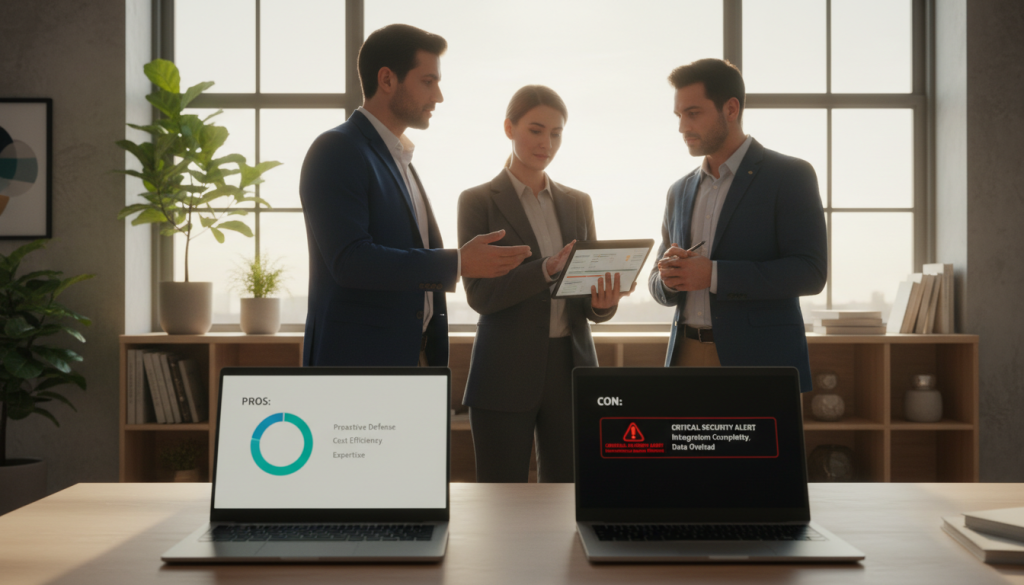
Pros and Cons of Each Security Solution
Every cybersecurity investment decision requires careful evaluation of both capabilities and constraints. We help organizations understand the complete operational picture by examining the distinct advantages and limitations of different protection approaches.
Advantages: Proactive Detection and Continuous Monitoring
Advanced detection solutions deliver significant benefits through proactive threat hunting that identifies sophisticated attacks before they cause damage. These platforms provide continuous 24/7 monitoring across all endpoints and cloud environments.
External service partnerships offer predictable pricing models that facilitate budget planning. They relieve internal teams from day-to-day management burdens while providing access to specialized expertise.
Technology platforms grant organizations complete control over their security operations. They deliver centralized visibility and powerful analytics for identifying patterns across complex infrastructures.
Limitations: Resource Needs and Complexity
Advanced detection solutions present higher implementation costs due to sophisticated technologies and expert services. Organizations may experience reduced operational control as external providers manage response activities.
Service partnerships sometimes demonstrate reactive rather than proactive threat response capabilities. They may lack deep specialization in specific security domains despite offering broad coverage.
Technology platforms demand substantial internal expertise for proper configuration and management. They require constant rule tuning to maintain detection accuracy and can generate excessive false alerts that overwhelm teams.
We recognize that resource considerations fundamentally differentiate these approaches. The optimal choice depends on organizational capabilities, budget constraints, and strategic priorities for threat response and incident management.
Use Cases and Industry Applications
The practical application of cybersecurity solutions varies significantly across different organizational contexts and industry requirements. We help businesses identify which approach aligns best with their specific operational realities.
Different protection methodologies excel in distinct scenarios. Understanding these applications enables more effective investment decisions.
Ideal Scenarios for Managed Security Services
External protection partnerships deliver maximum value for organizations requiring comprehensive coverage. They particularly benefit medium to large enterprises navigating complex compliance frameworks.
Growing businesses rapidly integrating new technologies find these services invaluable. The external expertise helps address resource constraints while maintaining robust protection.
We observe that these solutions excel when internal teams lack specialized skills. They provide 24/7 monitoring and rapid incident response capabilities.
Optimal Environments for SIEM Solutions
Log analysis platforms serve organizations with mature internal security operations. They require teams capable of configuring and tuning detection rules effectively.
Businesses with specific regulatory demands benefit from detailed audit capabilities. The platform’s data aggregation supports comprehensive compliance reporting.
We recommend this approach for companies with established security centers. It provides centralized visibility across distributed IT infrastructures.
Cost, Compliance, and Resource Considerations
Budgetary decisions in cybersecurity protection require comprehensive analysis of both visible and hidden expenses across solution lifecycles. We help organizations understand the full financial implications of different protection approaches.
Effective investment planning extends beyond initial acquisition costs to encompass ongoing operational requirements. Each approach presents distinct financial and operational considerations.
Budgeting for Cybersecurity Solutions
We emphasize evaluating total cost of ownership rather than comparing sticker prices alone. Technology platforms may appear affordable initially but demand substantial ongoing investments.
External partnerships typically follow subscription models that provide budget predictability. These services convert capital expenses into operational expenditures.

| Cost Factor |
SIEM Platform |
MSSP Partnership |
MDR Solution |
| Initial Implementation |
High setup complexity |
Moderate integration |
Comprehensive deployment |
| Ongoing Management |
Internal team required |
Provider responsibility |
Dedicated analyst support |
| Personnel Requirements |
Skilled engineers needed |
Minimal internal staff |
Hybrid resource model |
| Compliance Reporting |
Detailed custom reports |
Periodic assessments |
Continuous documentation |
Compliance, Reporting, and Regulatory Demands
Regulatory requirements significantly influence solution selection. Industries subject to frameworks like HIPAA and GDPR need documented controls and audit trails.
We recognize that reporting capabilities differ across approaches. Each provides distinct methods for demonstrating due diligence to auditors.
Organizations must balance direct costs with compliance capabilities and resource implications. The optimal choice depends on specific regulatory requirements and internal capabilities.
Leveraging MDR, MSSP, and SIEM for Enhanced Cybersecurity
Sophisticated organizations now approach cybersecurity as an integrated ecosystem where different components amplify each other’s strengths. We help businesses understand how these solutions work together rather than competing against each other.
Integrating MDR into Your Security Strategy
We recognize that MDR solutions create a force-multiplier effect by combining data aggregation with expert analysis. These platforms enhance existing investments rather than replacing them.
MDR teams provide the human expertise that transforms raw security data into actionable intelligence. They deliver high-quality alerts and proactive threat hunting capabilities.
The Role of MSSPs in Complementing SIEM Capabilities
We understand that MSSP providers bring operational expertise to SIEM tools. They handle continuous tuning and alert investigation that many organizations lack resources for.
This partnership creates a hybrid model where the SIEM gathers data and the MSSP manages it effectively. Organizations benefit from comprehensive coverage across prevention, detection, and response functions.
Successful integration requires clear coordination between all parties. We recommend understanding these relationships to build mature protection programs that scale with business growth.
Conclusion
Selecting the right cybersecurity framework demands understanding how different solutions complement rather than compete with each other. We recognize that each organization’s unique circumstances dictate the optimal approach to threat protection.
The decision hinges on multiple factors including existing infrastructure, internal expertise, and budget constraints. Organizations seeking comprehensive visibility may prefer SIEM platforms, while those requiring external support benefit from MSSP offerings. MDR solutions deliver proactive threat hunting for businesses with appropriate resources.
We emphasize that successful security outcomes require strategic integration of capabilities. Many organizations achieve optimal protection by combining these approaches, creating layered defenses that address diverse requirements while supporting business growth objectives.
FAQ
What is the primary difference between a Managed Security Service Provider (MSSP) and a SIEM platform?
The core distinction lies in the service delivery model. A SIEM is a technology platform that aggregates and analyzes log data for threat detection. An MSSP is a team of experts that delivers ongoing protection, often using a SIEM as one of their tools. We provide the technology and the skilled analysts to manage it effectively.
Can a SIEM solution meet all my compliance and reporting requirements?
SIEM tools are excellent for collecting the necessary log data for compliance audits. However, generating the specific reports and ensuring continuous adherence to regulations often requires significant manual effort. Our managed services include compliance reporting as a standard offering, reducing your team’s operational burden.
How does Managed Detection and Response (MDR) enhance a traditional SIEM?
MDR adds a critical human layer to SIEM technology. While a SIEM generates alerts, MDR provides a dedicated team of experts to investigate those alerts, validate real incidents, and execute a swift response. This integration transforms raw data into actionable intelligence, stopping threats faster.
Which solution is better for an organization with limited internal cybersecurity resources?
For organizations with small teams, a managed security service is typically the most effective choice. It provides access to a full security operations center (SOC) with advanced capabilities like 24/7 monitoring and incident response, without the need to hire and train specialized staff internally.
How scalable are these solutions for handling growing data volumes and emerging threats?
Both solutions can scale, but they do so differently. A self-managed SIEM requires your team to continually invest in hardware, software licenses, and analysis time. Our managed services are built on scalable cloud infrastructure, automatically adjusting to your organization’s growth and evolving threat landscapes.
What are the key cost considerations when choosing between these options?
A SIEM involves upfront costs for licensing and hardware, plus ongoing expenses for management and skilled personnel. Our services operate on a predictable subscription model, converting large capital expenditures into a manageable operational expense while providing a broader set of capabilities.
Author
Praveena Shenoy
- Country Manager, Opsio
Praveena Shenoy is the Country Manager for Opsio India and a recognized expert in DevOps, Managed Cloud Services, and AI/ML solutions. With deep experience in 24/7 cloud operations, digital transformation, and intelligent automation, he leads high-performing teams that deliver resilience, scalability, and operational excellence. Praveena is dedicated to helping enterprises modernize their technology landscape and accelerate growth through cloud-native methodologies and AI-driven innovations, enabling smarter decision-making and enhanced business agility.