


Dimensional Inspection: Your Questions Answered
Did you know that manufacturing defects cost U.S. companies over $119 billion annually? Most of these failures come from bad measurement processes. This shows why precise measurements are crucial in today’s production.
Precision metrology might seem hard at first. It’s really about checking if a made object is what it’s supposed to be. It’s like a detailed quality check that uses numbers to measure any physical feature.
Dimensional inspection checks everything from huge jet engines to tiny medical parts. It makes sure every part fits exact specs. These quality control measurements check things like size, shape, and surface details very accurately.
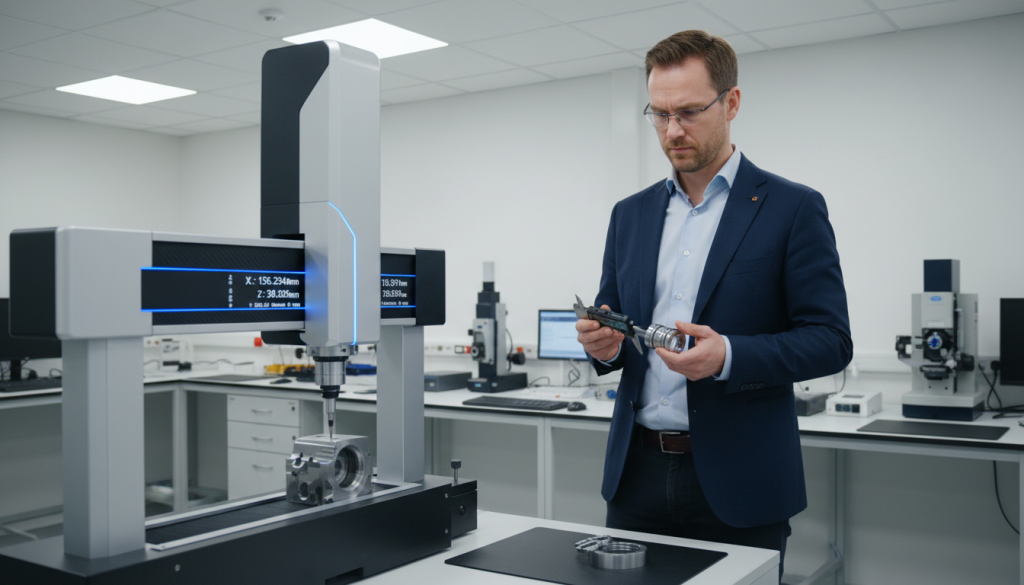
The goal of making things is to make processes that work well, can grow, and are reliable. Without good measurements, production lines can’t stay consistent or meet rules.
In this guide, we’ll cover your top questions about measuring things, choosing the right tools, and how it’s used in different fields. Whether you’re new to checking quality or want to learn more, we’ll share useful tips to improve your making processes.
Key Takeaways
- Dimensional inspection compares made parts to their design specs to ensure quality and accuracy
- Manufacturing defects from bad measurement cost U.S. companies over $119 billion yearly
- This process is used in many fields, from big aerospace parts to small medical devices
- Precision metrology checks physical features like size, shape, angles, roundness, and surface details
- Accurate measurements are key for making processes that work well, can grow, and are reliable
- Quality control measurements help makers meet exact specs, tolerances, and rules
What is Dimensional Inspection?
Dimensional inspection checks if parts match their design exactly. It measures parts’ physical dimensions to see if they meet design standards. This is crucial for everything from big jet engines to small medical devices.
This process is more than just measuring. It checks if parts will work as they should. It’s also known as dimensional measurement or dimensional metrology. It looks at length, width, height, and more.
Core Principles and Critical Importance
Dimensional inspection checks if parts meet design needs. It looks at things like roundness and flatness. Each check makes sure the part will work right in its place.
Being accurate is key because small mistakes can cause big problems. In aerospace, a small mistake in a turbine blade can fail an engine. In medicine, wrong surgical tools can harm patients. Dimensional inspection stops these problems by finding defects early.
We sort dimensional inspection into four main types. Each type meets different needs in quality control.
| Category | Primary Purpose | Key Focus Areas | Typical Applications |
|---|---|---|---|
| First Article Inspection | Verify new manufacturing processes and equipment calibration | Process validation, tool setup, initial production runs | New product launches, manufacturing line setup, supplier qualification |
| Quality Control | Confirm dimensions fall within tolerance levels during production | Statistical process control, batch sampling, trend analysis | Ongoing production monitoring, batch acceptance, process adjustment |
| Regulatory Compliance | Meet FDA, FAA, and other regulatory body requirements | Documentation, traceability, audit trails, certification | Medical devices, aerospace components, defense contracts |
| High-Precision Engineering | Ensure parts fit correctly in larger assemblies | Tight tolerances, geometric dimensioning and tolerancing (GD&T), assembly verification | Precision machinery, optical systems, advanced electronics |
These categories help make manufacturing reliable and consistent. First Article Inspection sets the standard. Quality Control keeps it up. Regulatory Compliance makes sure laws are followed. High-Precision Engineering pushes the limits of what’s possible.
Industry Applications and Real-World Impact
Dimensional inspection is key in many industries. In aerospace, it’s vital for parts like turbine blades. These parts need to withstand high temperatures and forces.
In the car world, it’s used for engine parts and safety systems. Engine parts need to fit perfectly for the engine to work right. Parts like airbag housings and brake components are checked carefully to keep drivers safe.
Medical devices need it the most. Surgical tools and implants must fit perfectly. FDA rules require detailed checks for most medical devices.
In electronics, it’s used for tiny parts like smartphone components. Even tiny mistakes can cause big problems. This is why precision is so important.
Defense contractors also need it a lot. Military gear must work well in tough conditions. Every part is checked carefully to ensure success and safety.
Dimensional inspection saves a lot of money and trouble. Finding problems early can avoid big recalls and damage to reputation. It’s worth it for better quality and happier customers.
It helps make manufacturing better and bigger. Once good methods are found, they can be used over and over. This helps companies grow without losing quality. It also helps find ways to make things better and more consistent.
Key Benefits of Dimensional Inspection
Dimensional inspection brings many benefits beyond just measuring. It helps manufacturers improve quality and cut costs. These gains give them a strong edge in today’s tough market.
Investing in dimensional inspection pays off in many ways. It prevents defects and makes processes better. Let’s look at how it changes production for the better.
Ensures Quality Control
Keeping quality high is a big plus of dimensional inspection. It checks parts carefully to make sure they’re right. This is key in fields like aerospace and medical devices, where safety depends on exact measurements.
It finds problems early, stopping bad parts from going further. Quality control measurements spot issues before they get worse. This saves money and keeps products good.
Regular checks make sure parts fit right when put together. Tolerance analysis shows if parts will work well together. This is very important for parts that must work safely and reliably.
Inspection data does more than just pass or fail. It gives insights into how to make things better. This leads to better products and more efficient processes over time.
Dimensional inspection also helps track quality. It shows how well different parts and people do. This helps make decisions that improve production standards.
Reduces Manufacturing Costs
Finding problems early saves a lot of money. It stops bad parts from causing more trouble and costs. Fixing mistakes later costs a lot more.
Measuring parts early saves money compared to fixing mistakes later. Tolerance analysis is cheaper than fixing problems after they happen. It keeps profits up by fixing issues early.
It also cuts down on waste. Finding problems early means less material is wasted. Part verification at key times saves materials, improving how much is used.
The data from inspections shows how to make things better. It helps find ways to make production cheaper. This makes making things more efficient.
Consider the big cost savings in these areas:
- Reduced scrap and rework: Finding problems early saves materials and labor
- Prevented recalls: Early detection avoids big recall costs
- Improved yield rates: Accurate measurements mean more parts meet standards
- Enhanced reputation: Quality products keep customers happy and trust the brand
- Optimized processes: Data helps make production better and cheaper
It also lowers the risk of expensive recalls. Checking parts early stops bad batches from getting to customers. This keeps customers happy and the brand strong.
Dimensional inspection also keeps production on schedule. Finding problems early means less downtime. This keeps things running smoothly and on time.
Common Techniques in Dimensional Inspection
We use three main techniques for accurate dimensional inspection. Each method has its own strengths for different parts and environments. Knowing these helps manufacturers pick the best for their needs.
Choosing a technique depends on several factors. Part size, material, needed accuracy, and how many parts are made all matter. We’ll look at how each method works and when it’s best.
Contact Measurement with Advanced Equipment
The coordinate measuring machine is top for precision. These machines use probes that touch parts to get data. This data is then turned into signals for analysis.
CMMs range from simple to fully automated. Modern ones can do CAD-based inspections with little help from operators.
There are different CMMs for different needs. Bridge CMMs are great for medium to large parts. Cantilever CMMs are best for small to medium parts where access is easy.
Gantry CMMs handle huge parts in aerospace and cars. They can weigh tons. Portable CMMs, or articulating arms, are flexible for hard-to-move parts.
Coordinate measuring machines are key for industries needing high accuracy and consistency.
| CMM Type | Optimal Part Size | Primary Applications | Key Advantage |
|---|---|---|---|
| Bridge CMM | Medium to Large | General manufacturing, precision engineering | High accuracy and stability |
| Cantilever CMM | Small to Medium | Electronics, medical devices | Easy operator access |
| Gantry CMM | Very Large | Aerospace, automotive assemblies | Massive part capacity |
| Portable CMM | Variable | On-site inspection, complex geometry | Mobility and flexibility |
Non-Contact Laser Technology
Laser scanning is fast and doesn’t touch parts. It uses laser beams and cameras to measure complex shapes. This creates detailed 3D models quickly.
This method is great for delicate parts. It’s also useful for reverse engineering and checking cast or molded parts.
Vision-Based Measurement Solutions
Optical systems use cameras and image processing for measurement. They have lenses and zoom for clear images. Algorithms find part edges for precise measurements.
Optical comparators compare parts to templates. They’re good for small, flat parts. Structured light scanners create 3D images by projecting patterns.
These systems are perfect for small, detailed parts. They’re a good choice when touching parts isn’t possible. Modern CMMs often have both touch and optical sensors.
Hybrid systems combine different technologies. They offer the best of both worlds for quality and efficiency. This is key for today’s quality needs.
Comparing Dimensional Inspection Methods
Choosing the right inspection method is all about finding a balance. You need to think about how accurate you need to be, what the part is like, and how much you can spend. Each method has its own strengths, and knowing these helps manufacturers make smart choices. The method you pick affects how well you can make things, how reliable your measurements are, and how good your quality control is.
Today’s manufacturing needs precise checks across many areas. From tiny parts in aerospace to bigger ones in cars, the right method must match the job. 3D measurement systems have changed quality control a lot. But old methods still have their place in many situations.
Advantages and Disadvantages of Each Method
We break down dimensional inspection into three main types: hand tools, contact sensors, and optical systems. Each has its own good points and bad points that affect how well it works for different jobs.
Hand tools like calipers and micrometers are easy to carry and use. They’re cheap and don’t need much training. But they’re slower than machines and can be less accurate because of human error.
Contact sensors, like coordinate measuring machines, are very accurate for complex shapes. They’re great for parts with tight tolerances. Geometric dimensioning and tolerancing are easy with these tools because they can get precise surface data.
The main problem with contact systems is that parts need to be stiff enough to handle the probe. Soft or fragile parts can’t be measured this way. Also, some surfaces are hard to read with certain probes.
Optical systems, like laser scanners, are very flexible for tough jobs. They can measure delicate parts and small things without touching them. This is really useful for parts that are too small for traditional probes.
Optical systems are fast because they can quickly get lots of data points. 3D measurement systems using light are great for making detailed pictures of complex shapes. This is super helpful for reverse engineering and checking first articles.
But, optical systems have their own challenges. Some materials and surfaces are hard to measure because of how they reflect or absorb light. Special techniques might be needed for certain materials.
| Inspection Method | Primary Advantages | Key Limitations | Best Applications |
|---|---|---|---|
| Precision Hand Tools | Portable, affordable, easy to use, immediate results | Slow acquisition, operator-dependent accuracy, limited complexity | Field measurements, simple geometries, routine quality checks |
| Contact Sensor Systems | High accuracy, complex geometry capability, excellent repeatability | Requires rigid parts, slower than optical, potential surface damage | Precision manufacturing, aerospace components, hard materials |
| Non-Contact Optical Systems | Fast data acquisition, no part contact, comprehensive surface capture | Surface finish sensitive, material property constraints, higher cost | Fragile parts, reverse engineering, complex 3D shapes |
Selecting the Right Technique for Your Needs
Choosing the right method means looking at a few key things. You need to think about how accurate you need to be, what the part is like, and your budget. The right choice depends on many factors, including what you need technically and what you can do practically.
First, you need to think about what kind of sensor you need. Parts that are stiff and don’t reflect light well are good for contact systems. But parts that are soft or fragile need non-contact methods. Some parts might need special tools or CT scans to measure.
The precision you need also plays a big role. Parts with very tight tolerances need high-precision tools. But if your tolerances are looser, you have more options and might save money.
How portable you need the equipment is also important. For shop floor checks, handheld scanners are great. But for lab work, you might need a stationary CMM for better accuracy.
The size and shape of the part also matter. Small parts need special tools, while big ones might need big CMMs. Parts with complex shapes are best measured with optical systems.
How fast you need to measure also affects your choice. For making lots of parts, fast automated systems are best. But for making a few precise parts, you might want to focus on getting detailed data.
How automated you want your inspection to be is also key. Automated systems are consistent and don’t rely on people. But manual systems are more flexible and can be easier to use.
It’s also important to think about how easy the system is to use. Complex systems need a lot of training. But simpler systems can be used by more people, spreading out the work.
Getting advice from experts is crucial. They can help you find the best method for your needs. The right choice balances many factors, including how accurate you need to be, how fast you need to be, and what you can afford.
How Dimensional Inspection Works
The dimensional inspection process uses careful steps and special tools to check if parts match their design. We use systematic methods and advanced tech to ensure accurate measurements in various settings. This knowledge helps manufacturers improve their quality control.
At its core, precision metrology has one key rule: never change the item being measured. This rule guides all our inspection work. We compare what an object is with what it should be according to design.
Process Overview
We follow a detailed inspection workflow for consistent and reliable results. This method works for simple parts or complex assemblies. Each step builds on the last to ensure thorough part verification.
The first step is to decide which dimensions to measure. We figure out if we need to check length, width, height, angles, roundness, flatness, position, or surface characteristics. This choice depends on the part’s function and the tolerances in engineering drawings.
Next, we pick the right measurement equipment based on the part and its tolerance needs. The choice depends on part size, material, surface finish, and needed accuracy levels. A deep dive into dimensional inspection shows how different methods fit different needs.
Calibration is the third key step. We set up measurement procedures and check that instruments give accurate readings. Calibration links our measurements to national or international standards.
The fourth step is to take actual measurements, either manually or automatically. We collect dimensional data according to set procedures. This stage needs careful attention to environment and proper technique.
In the fifth step, we compare the measurement data to specifications. This shows if parts are within acceptable tolerance ranges. Modern software often automates this comparison for efficiency.
Lastly, we document the results and make pass/fail decisions. Quality assurance teams use this info to spot trends, track process capability, and take corrective actions when needed. Detailed reports support ongoing improvement efforts.
Tools and Equipment Used
We group inspection equipment into three main types based on their measurement principles. Each type is suited for specific applications and offers unique benefits. Knowing these categories helps manufacturers pick the right tools for their needs.
Precision hand tools are the base of dimensional measurement. These tools include:
- Calipers for measuring inside, outside, depth, and step dimensions
- Micrometers for precise thickness, length, depth, and diameter readings
- Bore and ID gages for internal measurements
- Fixed gages for quick attribute checks
- Protractors and angle gages for angular measurements
- Indicators and comparators for detecting small variations
- Air gage instruments using pneumatic principles
- Plug and ring gages for cylindrical features
- Threaded gages for verifying screw threads
These tools are still crucial, even with new tech. They offer portability, affordability, and reliability for many tasks. Skilled operators can achieve high accuracy with well-maintained hand tools.
Contact sensor systems offer enhanced capabilities for complex part verification. CMM equipment leads this category, with various types like bridge, cantilever, gantry, and portable models. These machines use probes to touch part surfaces and record three-dimensional coordinates.
Articulating arms with rotary encoders are flexible for measuring large parts or components in place. Form and contour tracers focus on evaluating geometric tolerances. Optical CMMs combine non-contact and contact tech for versatile measurement.
Non-contact optical sensor systems are changing metrology. Optical comparators project magnified silhouettes for edge detection and profile comparison. Vision systems use advanced algorithms for automatic feature identification and dimension measurement.
3D scanners are at the forefront of non-contact measurement. Laser scanners use triangulation to capture point clouds. Structured light systems project patterns and analyze distortions. Range scanners with LiDAR technology measure distances to create detailed three-dimensional models.
Each equipment type is best for specific part characteristics and measurement needs. We consider part geometry, size, material, surface finish, required accuracy, and inspection volume when choosing tools. The right equipment balances measurement capability with practical factors like cost, speed, and operator skill.
Modern inspection often uses a mix of equipment types. A complete measurement strategy might include hand tools for quick checks, CMMs for critical dimensions, and optical scanners for complex geometries. This integrated approach boosts efficiency while keeping measurement integrity.
The Role of Technology in Dimensional Inspection
Dimensional inspection has seen a big change thanks to technology. Now, we use advanced software and hardware together. This makes our work more accurate, efficient, and easy to understand.
Technology is key to good dimensional inspection. Software plays a big role in how good your data will be. The right tools help us measure better, work faster, and talk better with our teams.
Modern Software Capabilities
Today’s metrology software is way better than before. Tools like Metrolog X4 and PolyWorks have changed what we can do with 3D systems. They help us through every step of inspection.
These softwares use new tech to find part edges very precisely. They also move and measure things on their own, saving time and reducing mistakes. Now, we can quickly switch between different parts without using physical templates.
We use advanced tools for more than just basic measurements. Modern platforms offer:
- Tools for quality control that spot problems early
- Alerts for when measurements are off
- Visual heat maps to show where parts don’t meet specs
- GD&T analysis for complex shapes
- Algorithms that find defects without human help
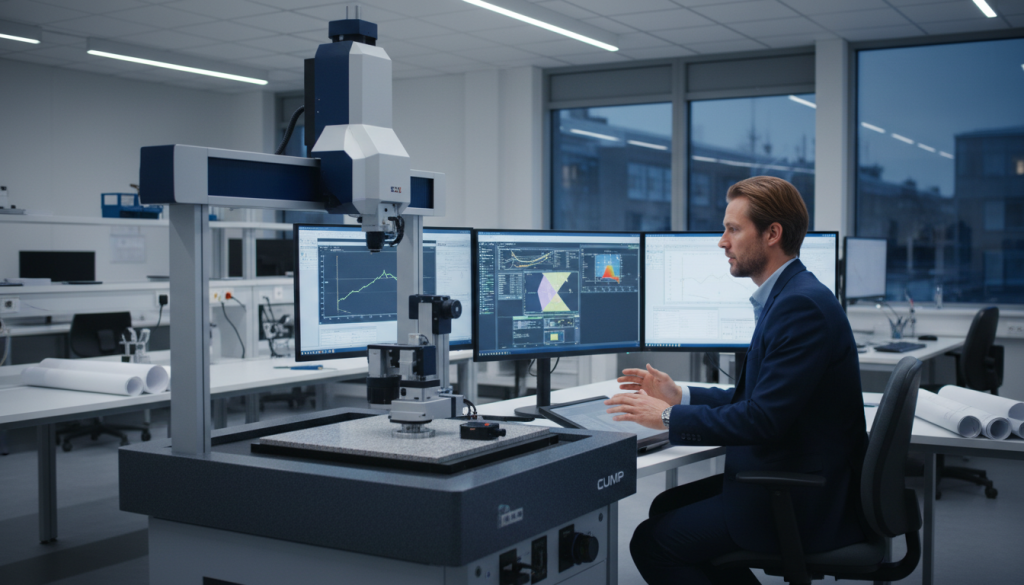
Modern software is great at making reports. It can show results in many ways, for different people and needs. Some teams want detailed reports, while others prefer quick summaries.
The best thing is making CAD comparisons that show differences clearly. These visual reports help everyone understand quality fast, even if they don’t know about metrology.
We can save and use inspection routines for different parts and batches. This makes measuring things the same way faster and saves time. The software remembers what to measure, in what order, and with what rules.
CAD System Connectivity
Connecting CMM equipment with CAD systems is a big step forward. Now, we can import designs directly and use them for measuring. This cuts down on setup time a lot.
This change makes inspection better. The software finds the right dimensions and tolerance zones from the CAD model. We don’t have to enter coordinates or use old drawings anymore.
When we inspect using CAD, we see how parts differ from the design right away. A map shows where and how much each point is off. Colors make it easy to see who needs to look at what.
This tech helps in many ways:
- First article inspection: Check if new parts match the design before making more
- Reverse engineering: Measure parts to make accurate CAD models for old parts
- Design verification: Make sure parts meet the engineer’s design
- Competitive analysis: Look at how competitors make their products
- Tool wear monitoring: Track when tools need to be replaced
CAD integration makes inspections 40-60% faster than before. Not having to enter coordinates saves a lot of time and reduces mistakes. Setting up is as easy as loading a CAD file and placing the part on the CMM.
This tech also gives instant feedback through overlays. As the probe touches the part, the software shows the measured point on the CAD model. This helps operators check they’re measuring the right thing and catch any big differences right away.
Perhaps most importantly, CAD systems connect design, manufacturing, and inspection. When engineers change designs, the updated CAD models go straight to inspection. This keeps everyone on the same page and avoids confusion.
The future of dimensional inspection is all about more technology. As 3D systems and software get better, we’ll see closer ties between design and checking. These improvements will make quality checks faster and more reliable in all kinds of manufacturing.
Industry Standards for Dimensional Inspection
We follow international standards to check the precision of every measurement. These standards make sure our measurements are accurate and reliable. Without them, manufacturers would find it hard to meet customer needs or follow rules.
Industry standards are key in precision metrology. They set the rules for who can inspect, how to calibrate equipment, and how to document results. They also help prove that measurements are connected to national and international standards.
For sectors like aerospace, medical devices, and cars, following these standards is crucial. Companies that do quality control measurements must show they follow these standards. This helps avoid legal problems and ensures products are safe before they are used.
ISO Standards
The International Organization for Standardization sets global guidelines for dimensional inspection. ISO 17025 is a key standard for testing and calibration labs. It outlines how to show technical competence and get valid results.
When looking for dimensional inspection services, ISO 17025 accreditation is important. Labs with this certification have shown they can manage quality, use tested methods, and keep their equipment calibrated. The standard covers everything from who does the work to the environment that could affect accuracy.
Measurement traceability is at the heart of ISO 17025. Every measuring tool must be calibrated back to primary standards, like NIST. This chain ensures measurements are consistent and trustworthy.
Other ISO standards are also vital for dimensional inspection. ISO 1101 defines symbols and rules for product specifications and tolerancing. It gives a common language for design and inspection across the globe.
ISO 10360 deals with tests for coordinate measuring machines. It sets up how to check if CMMs are accurate. Regular checks help find when equipment needs to be recalibrated.
ISO standards for specific industries add more rules for dimensional inspection. The car industry follows IATF 16949, while aerospace and medical devices use AS9100 and ISO 13485. Each standard has specific rules for quality control measurements and documentation.
ASME Guidelines
The American Society of Mechanical Engineers has standards that work with ISO ones. ASME Y14.5 is the main standard for geometric dimensioning and tolerancing in the U.S. It explains how to communicate dimensional and geometric needs on drawings and CAD models.
Understanding ASME Y14.5 is key for anyone in dimensional inspection. It gives clear meanings for symbols, modifiers, and datums in tolerance analysis. This way, inspection technicians can check parts against the designer’s exact plan.
ASME Y14.5 is more than a drafting rule. It makes a common language between design, making, and checking. This reduces mistakes, cuts down on rework, and makes sure everyone understands tolerances the same way.
The ASME B89 series covers how to check dimensional measuring tools. These standards cover various tools like calipers and CMMs. They say how to test these tools to make sure they work right.
Regulatory bodies often ask for ASME standards in certain fields. The FAA needs aerospace to follow strict checking rules based on ASME. The FDA wants medical device makers to show they can measure accurately using ASME methods. Defense contractors must meet MIL-SPEC, which often uses ASME standards.
ASME guidelines require detailed reports for measurements. These reports must include who did the test, when it was done, how accurate it was, and what was accepted. Good reports show that parts were checked correctly and meet the needed standards.
UKAS (United Kingdom Accreditation Service) checks if labs follow these standards. UKAS accreditation shows a lab works well and gives reliable data. Many customers now ask for UKAS-accredited services for important measurements.
The table below compares key features of major dimensional inspection standards:
| Standard | Primary Focus | Key Requirements | Industry Application |
|---|---|---|---|
| ISO 17025 | Laboratory competence and quality management | Calibration traceability, personnel qualifications, measurement uncertainty | All industries requiring certified testing |
| ISO 1101 | Geometric product specifications | Tolerancing symbols, datum definitions, form and position controls | Manufacturing and design engineering |
| ASME Y14.5 | Geometric dimensioning and tolerancing | GD&T symbology, datum reference frames, feature control | North American manufacturing sectors |
| ASME B89 | Measurement equipment performance | Accuracy verification, calibration procedures, uncertainty evaluation | Metrology laboratories and quality departments |
Certification and documentation prove parts were checked right. When manufacturers show reports that follow ISO and ASME standards, they show they care about quality and follow rules. This is very important when parts fail or when there are questions about who is to blame.
Many industries now need suppliers to show they can measure accurately. These studies check if precision metrology tools can measure within the needed limits. The results must be documented in a way that auditors can quickly check if everything is okay.
Using many standards together makes a strong framework for dimensional inspection. ISO standards give the quality management and traceability rules. ASME standards define the technical language and how to check equipment. Together, these standards help make sure dimensional inspection is consistent and reliable, supporting quality goals in manufacturing.
Challenges in Dimensional Inspection
Dimensional inspection is key for quality, but it faces many challenges. These include technical, financial, and operational hurdles. Knowing these challenges helps manufacturers improve their quality control systems.
Modern manufacturing is complex. Even with good plans, dimensional inspection can still face problems. Issues like choosing the right equipment and managing staff can affect accuracy and schedules.
Obstacles That Impact Measurement Accuracy
Choosing the right sensors is a big challenge. The wrong sensors can lead to bad results. For example, laser sensors on shiny surfaces can scatter light, making data unreliable.
Structured light scanners have trouble with dark objects. Vision systems struggle with clear glass. It’s important to match sensors to the parts being measured.
Understanding tolerance requirements is hard. Some think they need very precise measurements, while others are okay with less. This confusion can lead to spending too much on equipment or not enough.
Geometric dimensioning and tolerancing (GD&T) adds to the complexity. Getting these wrong can mean accepting bad parts or rejecting good ones.
The lack of skilled metrology personnel is a big problem. It takes special knowledge to use advanced machines and understand complex specs. Finding people with this expertise is hard.
Buying high-precision equipment is expensive. It’s a big investment that needs careful thought. Small companies often can’t afford it.
Inspection backlogs can slow down production. If inspections can’t keep up, it causes delays. These delays can affect the whole production line.
Getting different results from the same equipment is a problem. Things like temperature changes and humidity can make measurements less reliable. This makes it hard to trust the results.
Practical Approaches to Resolution
Start by analyzing the parts before choosing measurement technology. Look at things like how rigid the parts are and their surface properties. This helps pick the right tools.
Using both contact and non-contact sensors can give the best results. This mix helps overcome the weaknesses of each type of sensor.
Working together from the start helps. Design, manufacturing, and quality teams need to agree on what’s needed. Regular checks on tolerance requirements help avoid mistakes.
To deal with the lack of skilled people, try a few things:
- Train your own team in metrology
- Work with experienced service providers
- Buy easy-to-use equipment
- Create mentorship programs
There are ways to manage the cost of equipment. Leasing can spread out the cost. Outsourcing some work can also help.
Look at the long-term benefits of dimensional inspection. This includes saving money by avoiding defects and reducing waste. This view can make the initial cost seem worth it.
To solve backlog problems, make processes more efficient. Use automated systems and focus on the most important parts. Make sure you have enough resources to keep up with production.
To improve consistency, follow strict guidelines:
- Write detailed Standard Operating Procedures (SOPs)
- Keep equipment in good shape
- Control the environment
- Regularly check the measurement system
Use statistical methods to monitor the system. This helps catch problems early. Regular calibration keeps equipment accurate.
Keep detailed records of measurements and conditions. This helps solve problems faster. Good record-keeping is an investment that pays off.
Best Practices for Performing Dimensional Inspection
Success in dimensional inspection comes from following proven methods. These methods ensure consistency and accuracy. By setting up strong procedures, we turn routine checks into reliable quality control steps that boost manufacturing excellence.
Organizations that follow best practices see better results. Their inspection programs give valuable data for ongoing improvement. We’ve found key practices that set industry leaders apart from those struggling with quality issues.
Preparing for Inspection
Getting ready for inspection is key to success. This initial phase is crucial. Every measurement’s accuracy depends on decisions made before starting.
Equipment preparation starts with correct installation and calibration checks. We must ensure all tools work right before starting any inspection. Regular calibration against certified standards is vital.
Keeping calibration records is essential. These records prove measurement systems work correctly. We suggest setting up calibration schedules based on the equipment’s needs and past performance.
Environmental control greatly affects measurement accuracy, mainly in precision metrology. Temperature, vibration, humidity, and dust can cause big errors. We recommend doing inspections in a controlled environment at 68°F (20°C).
Even small temperature changes can affect parts. Parts made at high temperatures need time to cool down before inspection. We wait until they reach room temperature to avoid measurement errors.
Part preparation needs careful attention to cleanliness and how parts are fixed. We clean parts to remove oils and other contaminants. Proper fixing prevents parts from moving during measurements.
Knowing what to measure starts with reviewing specifications. We look at 3D CAD models, engineering drawings, and customer requirements before starting. This ensures we cover all important details.
The quality of preparation affects the reliability of results. Spending time on proper setup leads to more confident measurements and less rework.
Creating detailed inspection plans helps keep processes consistent. These plans outline where to measure, what to accept, and how often. We develop Standard Operating Procedures (SOPs) to ensure clear, repeatable processes.
Operator preparation includes training, certification, and checking skills. We offer comprehensive training on equipment, measurement theory, and interpreting specifications. Certified operators provide more reliable data.
| Preparation Element | Critical Requirements | Frequency | Documentation Needed |
|---|---|---|---|
| Equipment Calibration | Traceable standards, certified artifacts, verification procedures | Annually or per manufacturer specifications | Calibration certificates, verification records |
| Environmental Monitoring | Temperature 68°F ±2°F, humidity control, vibration isolation | Continuous monitoring during inspection | Environmental logs, control charts |
| Part Stabilization | Thermal equilibrium, clean surfaces, secure fixturing | Every inspection cycle | Checklist completion, soak time records |
| Operator Certification | Training completion, competency assessment, SOP familiarity | Initial and annual refresher | Training records, certification documents |
Documentation and Reporting
Good documentation is as important as the measurements themselves. Inspection reports are key for traceability, supporting improvements, meeting customer needs, and showing compliance.
Effective inspection reports have specific elements. They clearly show the part being inspected and reference specifications. Complete data includes actual values and tolerances for each characteristic.
Reports clearly state pass/fail results, often using colors or symbols. Statistical summaries help understand manufacturing stability. This data includes mean, standard deviation, and process capability indices.
Traceability builds confidence in results. We document equipment calibration, environmental conditions, operator details, and inspection dates. This info helps investigate any doubts about measurement validity.
Professional metrology software like Metrolog X4 and PolyWorks creates reports in various formats. We provide results as DSIS files, Excel spreadsheets, PDFs, and CAD comparisons. Different stakeholders need different formats, and flexible reporting meets these needs.
CAD comparisons offer powerful visualization tools. We overlay actual data on CAD geometry, showing color maps of deviations. These visual aids make complex dimensional relationships clear.
Document control procedures keep reports accessible for required periods. We use both electronic and physical filing systems for easy retrieval during audits or inquiries. Version control prevents confusion when specifications change.
Reports must prove parts meet standards. We structure documentation for customer audits, third-party reviews, and regulatory submissions. Clear, professional reports show our commitment to quality.
Non-conformance communication needs quick attention and clear protocols. We flag failing parts and notify relevant people right away. Quick communication stops more defective parts from being made, saving costs.
Corrective action requests link findings to process improvements. We document root causes, solutions, and verification of effectiveness. This approach turns inspection into active quality improvement.
Following these best practices makes dimensional inspection programs valuable. Organizations that prepare well and document thoroughly see fewer quality issues, faster inspections, and happier customers. Systematic approaches lead to better manufacturing performance and a competitive edge.
Dimensional Inspection in Manufacturing
Dimensional inspection has changed how companies check quality and work more efficiently. As production gets faster and more precise, it’s key to check every part before it’s put together. This method is not just about quality checks; it’s a way to keep improving and stay ahead.
With more automation, accurate measurements are more important than ever. This ensures products are made on time and with the right quality. Modern factories work at speeds that were unthinkable not long ago. This fast pace brings both chances and risks that need to be managed with careful measurement.
The Impact on Production Efficiency
Some think dimensional inspection slows down production or adds too much cost. But the truth is different. Part verification programs actually make manufacturing more efficient by stopping problems before they get worse.
Dimensional inspection saves time in fast-paced environments. Automated lines can make thousands of parts an hour. Without checking, these lines can also make bad parts fast, leading to waste and unhappy customers.
Dimensional inspection makes processes repeatable, scalable, and reliable. This means lower costs and prices for customers. Repeatability means every part, from the first to the last, meets the same standards.
Fixing problems early saves a lot of money. For example, fixing a defect during making might cost $10. But fixing it later could cost $100. And if a customer finds a problem, it could cost over $10,000.
Regular checks ensure parts meet design specs and follow strict standards. Modern tools give data for improving processes. For example, they can show if a part is getting out of spec over time, so it can be fixed before it’s too late.
First Article Inspection is key to check if new processes or tools work right. It stops bad parts from being made. We suggest doing a thorough First Article Inspection when there’s a change in process or new tooling is installed.
Using smart sampling plans helps keep quality without checking every part. This balances costs and risks. A good plan gives statistical confidence in product quality and uses inspection resources wisely.
Modern automated systems can check parts in real-time. They can make changes right away if something’s not right. This makes dimensional inspection a proactive tool, not just a check at the end.
Case Studies of Successful Implementations
Many industries have seen the real value of good dimensional inspection programs. These examples show how different fields use measurement technology to solve problems and improve.
An aerospace company used coordinate measuring machines to check turbine blades. They needed to make sure the blades were precise to keep engines safe and working well. By using a detailed CMM inspection plan, they met strict standards and kept FAA approval.
This program caught small problems that manual checks missed. Over three years, it saved over $4.2 million by avoiding bad parts and engine failures. It also made checking blades much faster.
An auto maker had to check brake parts fast, as they made 1,200 parts an hour. They used automated vision systems for quick checks. This way, they could check every part and keep up with production speed.
The vision system checked important parts like rotor thickness and mounting holes. It rejected parts that didn’t meet standards. In six months, complaints dropped by 78% and manual checks were no longer needed.
A medical device maker needed precise metrology for orthopedic implants. They had to meet strict specs and FDA rules. They set up a special lab with CMMs and trained staff.
Every implant was checked thoroughly. The results were linked to production batches and materials. This helped with FDA submissions and kept patients safe. The company had no recalls for five years, a big achievement in medical devices.
An industrial equipment maker outsourced checks for gearbox housings to a specialist. The housings had complex shapes that the maker’s tools couldn’t handle. The specialist used portable CMMs and laser scanning for checks.
This partnership helped the maker meet tight deadlines and keep quality high. The outsourced checks found problems early, leading to better processes. The project cost was 40% less than buying in-house equipment.
Success in these examples comes from understanding tolerance needs and choosing the right tools. Trained staff and using data for improvement are also key. This mindset turns dimensional inspection into a tool for growth and staying competitive.
These stories show that dimensional inspection can bring real benefits across industries. The technology and effort needed vary, but the goal is always the same: to make manufacturing better.
Future Trends in Dimensional Inspection
New advancements are making dimensional inspection smarter, faster, and more accessible. We’re seeing a big change with artificial intelligence and advanced measurement tech. These changes will change how quality control works in every industry.
Intelligent software is being added to CMM equipment. This makes systems that can think and learn. They use data from past inspections to improve their work. This is a big change in quality assurance.
Smart Systems and Intelligent Automation
Artificial intelligence is changing dimensional inspection. It’s turning measurement systems into tools that predict quality issues. Machine learning looks at past data to spot problems before they happen.
CMM equipment can now do complex inspections on its own. It uses advanced probing and runs programs during off-peak hours. This makes it work harder and faster.
Measurement strategies are getting smarter. They adjust plans based on what they find. If a part looks like it might not meet standards, they check it more closely.
AI can spot problems that humans might miss. It gets better at telling good parts from bad ones over time. This makes it more reliable than manual checks.
Machine learning helps pick the most important measurements. This makes inspections faster and still finds all the defects. It helps make products faster without losing quality.
Closed-loop systems are the next big thing in quality control. Dimensional inspection data helps machines adjust on the fly. This keeps production smooth and accurate.
Revolutionary Measurement Technologies
Portable devices are making precision easier to use on the shop floor. Handheld optical CMMs use cameras to measure parts anywhere. This brings lab-quality accuracy to any location.
These devices use 3D measurement systems that work well in tough places. They’re flexible, so we can check big parts or complex assemblies anywhere. This makes dimensional inspection more flexible.
Multi-sensor platforms are getting more advanced. They use contact probes, lasers, and vision to measure in one go. This makes inspections easier and more efficient.
Computed tomography scanning is a game-changer for complex parts. It lets us measure inside parts without taking them apart. This is great for checking 3D prints and complex assemblies.
Advanced software does more than just report measurements. It shows how parts compare to designs in real time. It can also find and sort defects automatically.
Cloud-based systems manage metrology data from anywhere. They help teams work together and spot global quality trends. This makes quality management easier and more effective.
Digital twins are becoming important in quality management. They keep a record of every part’s history. This helps engineers make better design choices.
New standards are being set for digital inspection. They ensure that new tech meets quality and accuracy standards. This keeps quality high as tech advances.
Even with new tech, the basics of dimensional metrology stay the same. Accuracy, traceability, and not changing the object being measured are still key. These principles guide new tech to ensure quality stays reliable.
How to Choose a Dimensional Inspection Service
Finding the right partner for dimensional inspection is important. Start by figuring out what you need. Do you want a first article check, batch sampling, or full part validation? Knowing this helps you find the right service.
Essential Selection Criteria
Look at the provider’s technical skills and industry knowledge. Check their CMM equipment and when it was last checked. They should use the latest measurement tools, like tactile and non-contact scanning.
Accreditation is key. ISO 17025 shows they follow strict quality control and procedures. Ask for proof of national standard traceability.
Flexibility is important. Can they do rush jobs? Do they inspect big items on-site? What report formats do they use?
Important Vendor Questions
Ask about their speed and capacity. Look at sample reports for clarity. Find out if they can explain any issues and offer engineering advice.
Also, check their pricing. Know if it’s per part, hour, or project. The best partner will help you meet your manufacturing goals with reliable data.
FAQ
What exactly is dimensional inspection and why is it important?
Dimensional inspection checks the size of parts to see if they match the design. It looks at things like length, width, and angles. This is key because small mistakes can cause big problems in fields like aerospace and medicine.
It’s the backbone of quality control in making things. It ensures parts fit together right and meet safety standards.
What are the main types of dimensional inspection techniques?
There are three main ways to do dimensional inspection. Coordinate Measuring Machines (CMMs) use probes to measure parts. They come in different types for various sizes and shapes.
Laser scanning uses lasers and cameras to create 3D models. It’s great for delicate parts. Optical measurement systems use cameras and light to measure parts. They’re perfect for small, detailed parts.
How do I choose between contact and non-contact measurement methods?
Choosing depends on the part and what you need. Contact methods like CMMs are good for rigid parts. Non-contact methods like laser scanning are better for soft or small parts.
Think about the part’s characteristics and what you’re measuring. Also, consider if you need to measure inside the part.
What is a Coordinate Measuring Machine and when should we use one?
A Coordinate Measuring Machine (CMM) is a precise tool for measuring parts. It’s used for parts that need high accuracy and complex shapes.
There are different types of CMMs for various needs. They can be used for many types of parts, from small to very large.
How does laser scanning work for dimensional inspection?
Laser scanning uses lasers and cameras to create 3D models. It’s fast and accurate, perfect for delicate parts. It’s great for capturing detailed surface data quickly.
But, it can struggle with shiny or transparent surfaces. You need to consider the surface characteristics when using this method.
What are the key benefits of implementing dimensional inspection?
Dimensional inspection ensures quality and saves money. It catches errors early, preventing costly mistakes. It also helps in making processes better.
By investing in dimensional inspection, you can lower costs and protect your brand’s reputation.
What software platforms are used in modern dimensional inspection?
Modern software like Metrolog X4 and PolyWorks is key. They offer advanced features like edge detection and automated measurement. They help in creating detailed reports and analyzing data.
These platforms make dimensional inspection more efficient and accurate.
How does CAD integration improve dimensional inspection?
CAD integration is a big leap in dimensional inspection. It allows for direct comparison of measured data with CAD models. This makes it easier to spot deviations.
It also reduces setup time and minimizes errors. CAD integration is essential for reverse engineering and competitive analysis.
What industry standards govern dimensional inspection?
We follow standards like ISO 17025 and ASME Y14.5. These ensure our measurements are accurate and reliable. They are crucial for industries like aerospace and medical devices.
These standards help us maintain quality and meet regulatory requirements.
What is ISO 17025 and why does it matter for dimensional inspection?
A: ISO 17025 sets standards for testing and calibration labs. It ensures our measurements are reliable and recognized worldwide. It’s essential for quality and regulatory compliance.
Following this standard helps us maintain the highest standards in dimensional inspection.
What is geometric dimensioning and tolerancing in dimensional inspection?
Geometric Dimensioning and Tolerancing (GD&T) is a language for design and inspection. It ensures everyone understands the design intent. It goes beyond basic measurements to include geometric characteristics.
GD&T analysis is crucial for ensuring parts fit and function correctly.
What equipment and tools are used in dimensional inspection?
We use various tools like calipers and CMMs. Coordinate Measuring Machines (CMMs) are used for precise measurements. Non-contact optical systems include laser scanners and vision systems.
Choosing the right tool depends on the part’s characteristics and the measurement needed.
What is First Article Inspection and why is it important?
First Article Inspection (FAI) verifies new manufacturing processes. It checks if parts meet design specifications before full production. It’s crucial for quality and regulatory compliance.
FAI ensures that the manufacturing process is validated and ready for production.
What are the most common challenges in dimensional inspection?
Challenges include choosing the right sensor and understanding tolerance requirements. There’s also a shortage of skilled metrology personnel. Equipment costs and inspection backlogs are also issues.
Measurement repeatability and reproducibility can be a problem too.
How can we overcome common dimensional inspection challenges?
To overcome challenges, analyze part characteristics before selecting sensors. Early collaboration between design and manufacturing teams helps with tolerance understanding.
Training programs and partnering with experienced service providers can address personnel shortages. Leasing options and outsourcing can help manage costs.
Optimizing processes and using automated routines can reduce backlogs. Improving repeatability and reproducibility requires Standard Operating Procedures and equipment maintenance.
What environmental conditions affect dimensional inspection accuracy?
Temperature, vibration, humidity, and airborne contaminants can affect accuracy. Temperature changes cause parts and equipment to expand or contract.
Proper environmental control is essential for accurate measurements.
What should be included in dimensional inspection reports?
Reports should include clear part identification and reference to specifications. They should also have complete measurement data and pass/fail determinations.
Statistical summaries and traceability information are also important. Reports should be generated using professional metrology software.
How does dimensional inspection improve production efficiency?
Dimensional inspection enhances efficiency by catching errors early. It prevents costly mistakes and ensures repeatable, scalable, and reliable processes.
It helps in optimizing processes and reducing inspection costs. Automated systems provide real-time quality feedback for immediate corrections.
What is the difference between contact and non-contact dimensional inspection?
Contact methods physically touch the part, while non-contact methods use optical technologies. Contact methods are better for rigid parts and offer high accuracy.
Non-contact methods are suitable for soft or small parts and can measure complex geometries quickly. Both methods have their advantages and are often used together.
How often should dimensional inspection equipment be calibrated?
Calibration frequency depends on several factors. It includes manufacturer recommendations, industry standards, and