


Surface Inspection: Your Questions Answered
Did you know that a single microscopic particle measuring just 20 nanometers can ruin an entire semiconductor wafer? This can cost thousands of dollars. In today’s world, even tiny defects can cause big problems. They can make products not work right and even be unsafe.
Quality control is key in many fields. It’s used in making semiconductors and medicines. Companies use defect detection to keep their work safe. It’s about finding tiny particles or dirt in clean places.
In this guide, we answer your big questions about checking surfaces. We look at how to check wafer quality. We help you find the best way to check your products.

We want to give you useful tips. We aim to help you lower costs and make better products. This is for all your work areas.
Key Takeaways
- Microscopic defects as small as 20 nanometers can cause significant product failures and financial losses in manufacturing
- Quality control through systematic examination is critical across semiconductor, pharmaceutical, and precision engineering industries
- Multiple technologies exist for defect detection, from optical methods to electron microscopy, each with specific advantages
- Early contamination detection prevents costly downstream failures and protects manufacturing yield rates
- Integrated automated systems now combine real-time monitoring with AI-powered pattern recognition for predictive quality management
- Effective protocols reduce defect-related costs while improving product safety and reliability standards
What is Surface Inspection?
Surface inspection is a key quality control step that helps manufacturers avoid costly mistakes and safety issues. We check material surfaces carefully to find problems early. This way, we can prevent big production problems.
This process uses both human skills and advanced technology. It helps keep product quality high in many industries.
Material inspection is more than just looking at things. Today, we can find tiny particles and scratches that could affect how things work. Every surface tells us about how something was made. We check these stories to make sure things are made right.
Understanding the Core Principles
Surface inspection means checking material surfaces for defects and other issues. We look at surfaces in many ways, from big to tiny. This helps us find all kinds of problems.
We use both hands-on checks and automated systems, depending on what’s needed. Trained inspectors are great for tricky jobs. But, machines are faster and more consistent for making lots of things.
Surface inspection is like the first line of defense against quality problems. Finding issues early saves money and keeps things safe. Even tiny defects in semiconductors can cause big problems later on.
Material inspection is very important because of the risks. In places like pharmacies, dirty surfaces can harm patients. We find where problems come from, like people or equipment.
Checking wafer surfaces is crucial in making chips. Small defects can hurt how well a chip works and how many can be made. Making chips involves many steps that can introduce flaws.
In precise manufacturing, small problems on tools or parts can cause big errors. These errors can spread and affect many products. A small mistake can ruin thousands of items.
Industry-Specific Implementation Approaches
Different fields use surface inspection in their own ways. We adjust our methods for each industry’s needs. This makes sure we catch problems well and work efficiently.
Semiconductor fabrication needs to check wafer surfaces for tiny flaws. We use special tools to find these small problems. Even tiny dirt can ruin a whole batch of chips.
In the pharmaceutical world, we focus on keeping surfaces clean. We make sure areas are clean to meet strict standards. This is crucial for making safe medicines.
Here are some key areas where surface inspection is used:
- Aerospace manufacturing: We check parts for flaws that could be dangerous in flight.
- Electronics assembly: We look for dirt or defects on circuit boards and parts.
- Precision metrology: We check surface plates to make sure measurements are accurate.
- Automotive production: We find paint and body panel problems.
- Medical device manufacturing: We make sure implant surfaces are safe and clean.
Each area needs its own special way of checking things. For example, aerospace parts are tested without damaging them. Electronics use machines to check lots of boards fast. Medical devices need careful checks to keep patients safe.
Good surface inspection means knowing how things are made and how they’re used. What’s okay in one field might be a big problem in another. We make sure our checks match what’s really important.
Surface inspection keeps getting better as making things gets more advanced. New materials and smaller parts mean we need better tools. We keep improving to keep products safe and of high quality.
How Does Surface Inspection Work?
We use many technologies to check surfaces thoroughly. Each method is chosen based on what’s needed. We shine light or probe the surface, capture signals, and analyze them to find problems. This way, we can spot defects accurately in different materials and places.
Different problems need different solutions. Some tasks need super-precise work, while others just need a quick check. We use a mix of technologies to ensure quality control is reliable.
Advanced Technologies for Precision Detection
Many surface checks start with optical methods. These use visible or ultraviolet light to see surfaces clearly. High-resolution cameras capture images. This is great for finding big defects.
Darkfield inspection is better for small flaws. It catches scattered light, not just reflected light. This helps see tiny scratches and particles, perfect for shiny or clear materials.
Confocal microscopy looks at surfaces in depth. It focuses light at specific points. This is useful when you need to know about defects under the surface.
Laser scanning systems are very precise. They use laser beams to scan surfaces and photodetectors to catch light. They can spot tiny particles, making them great for tiny electronics.
Electron-based techs go even further. Scanning Electron Microscopy (SEM) uses electron beams for super-clear images. It’s perfect for seeing tiny details and what materials are made of.
Atomic Force Microscopy (AFM) works at the atomic level. It scans surfaces to map them in incredible detail. This is key for nanotechnology research.
Special methods are used for specific materials. Infrared checks silicon wafers for hidden problems. X-ray inspection looks inside complex electronics.
Essential Sensors and Measurement Tools
For precise work, we need special tools. Master precision levels check flatness with amazing accuracy. They use sensitive tools to measure tiny angles.
Autocollimators check flatness too. They project light and measure how it comes back. This shows if a surface is flat or not.
Repeat-o-Meters are useful in factories. They measure surface changes, helping keep quality high. They’re key for checking big areas.
Differential levels compare heights at different points. This makes measurements more reliable. It’s good for checking large surfaces.
Laser interferometry is the best for measuring flatness. It uses light waves to see tiny surface changes. We use it for top-quality work.
| Technology Type | Resolution Range | Primary Applications | Key Advantages |
|---|---|---|---|
| Optical Inspection | 0.5-10 micrometers | General surface defects, scratches, particles | Fast scanning, non-contact, cost-effective |
| Laser Scanning | 20 nanometers-1 micrometer | Semiconductor wafers, precision optics | High sensitivity, automated operation |
| Scanning Electron Microscopy | 1-10 nanometers | Defect morphology analysis, material characterization | Exceptional resolution, compositional analysis |
| Atomic Force Microscopy | Sub-nanometer | Nanotechnology research, surface roughness | Atomic-level imaging, three-dimensional mapping |
| Laser Interferometry | Sub-micron | Optical flatness, precision calibration | Absolute accuracy, traceable standards |
Using many sensors together makes inspections better. This way, we get more information about surfaces. It helps us spot defects more accurately.
Intelligent Data Analysis Methods
Raw data needs smart processing to be useful. Modern systems use advanced methods to turn data into useful info. Machine learning is at the heart of these systems.
These algorithms learn from lots of images. They can spot defects quickly and accurately. They get better with more data.
Statistical process control (SPC) watches how inspections go over time. It tracks defects to catch problems early. This helps us fix issues before they get worse.
AI can find complex defects that others miss. It looks at images in detail, spotting subtle changes. This is great for new manufacturing processes.
Systems can act fast based on what they see. They check products as they move along, stopping bad ones early. This keeps quality high.
Looking at past data helps predict future quality. This way, we can stop problems before they start. It makes inspections more proactive.
Tools make complex data easy to understand. Heat maps and graphs show what’s going on. This helps everyone make quick decisions.
Types of Surface Inspection
We divide surface inspection into three main types. Each has its own strengths for finding defects in modern manufacturing. Knowing these differences helps us pick the best method for each job.
The choice of method depends on the type of defect, the value of the part, how many are made, and how fast they need to be checked. Sometimes, people are needed for detailed checks. Other times, machines are better for speed and consistency.
Visual Inspection Methods
Visual inspection is the oldest and most common way to check surfaces. It uses people looking closely, sometimes with magnifying tools, to spot defects. It’s simple and doesn’t need much equipment.
In places like pharmacies, visual checks are combined with special tests for germs. Technicians use special plates to collect germ samples. These plates have agents that stop cleaning chemicals from messing up the test.
Other visual methods include fluorescent penetrant inspection for finding cracks and basic microscopy for detailed looks. These are good when you need the touch and eye of a person to find things machines can’t.
But, visual checks have limits. Inspectors can get tired and make mistakes over time. They also see things differently, which can lead to problems. Microscopic or subsurface defects are hard for people to see without tools, making this method not always reliable.
Automated Inspection Solutions
Automated systems are the new way to check surfaces. They use machine vision, artificial intelligence, and robotics to find defects fast and accurately. These systems are used in many places where making things quickly and reliably is key.
These systems have cameras, special lights, and machines to move things around. They also have smart software to analyze images. In making semiconductors, these systems can check whole wafers in minutes, finding many defects.
Automated systems have big advantages. They don’t rely on people, so they don’t get tired or make mistakes. They also give detailed reports, helping to predict and prevent problems.
They can also talk to other systems in real time. If they find too many defects, they can alert people right away. This helps make fewer bad products and saves materials.
Non-Destructive Testing Techniques
Non-destructive testing (NDT) lets us check materials without damaging them. This is important for expensive parts or when you can’t damage the item. It’s used when you need to check everything without losing any material.
NDT includes many special ways to check surfaces. Infrared thermography finds temperature changes that show hidden problems. Ultrasonic testing uses sound waves to find problems inside. Eddy current testing checks conductive materials for surface issues.
X-ray and CT scans show what’s inside without cutting it open. These advanced tests are great for checking things like airplane parts or medical devices without damaging them. They help ensure quality at every stage without losing any material.
The main plus of NDT is that it doesn’t hurt the item being checked. This means you can check finished products, expensive prototypes, or unique items without making them unusable. It’s perfect for checking quality at different stages without wasting anything.
| Inspection Method | Primary Applications | Defect Detection Capability | Speed and Throughput | Cost Considerations |
|---|---|---|---|---|
| Visual Inspection | General manufacturing, pharmaceutical surface sampling, initial screening | Surface-level defects, visible contamination, macro-scale imperfections | Moderate speed, limited by human factors | Low equipment cost, higher labor expenses |
| Automated Solutions | Semiconductor, automotive, high-volume production lines | Microscopic surface defects, pattern anomalies, dimensional variations | High-speed continuous operation | High initial investment, low ongoing costs |
| NDT Techniques | Aerospace components, medical devices, critical infrastructure | Surface and subsurface defects, internal discontinuities, material property changes | Varies by technique, generally slower than automated visual | Moderate to high equipment costs, specialized operator training required |
Choosing the right inspection method is about finding the best fit for the job. Often, we use a mix of methods to get a complete picture of surface quality. This way, we can catch all kinds of defects.
Industries Utilizing Surface Inspection
Many industries use surface inspection to keep their products reliable. This technology is key in areas where small flaws can cause big problems or losses. It’s used in manufacturing, aerospace, and electronics.
Different industries face unique challenges. Product quality standards vary dramatically across sectors. Companies that invest in good inspection systems do better and stay competitive.
Production Facilities and Material Verification
Manufacturing places a big emphasis on surface inspection. Car plants check painted surfaces for flaws before cars are sold. Metal shops look for scratches and finish issues in rolled materials.
Precision machining checks parts for surface roughness and size accuracy. These checks are crucial for parts to fit right and work well. Material inspection helps avoid costly rework and keeps production on track.
Pharmaceutical facilities do strict surface sampling. They follow USP <797> guidelines for cleanrooms. Sampling frequency depends on risk levels:
- High-risk compounding needs weekly testing
- Medium-risk gets checked monthly
- Low-risk is tested quarterly
Sampling is done after compounding to catch contamination. Quality control measures in pharma protect patients and follow rules.
Aviation and Defense Applications
Aerospace has the strictest inspection rules. We check turbine blades for tiny cracks that could cause engine failure. Composite materials are also closely examined for flaws.
Structural parts are checked for corrosion and wear. Non-destructive tests like eddy current and X-ray check for damage. These tests keep parts safe and working right.
The FAA requires detailed inspection records. Every part must have inspection records throughout its life. Aviation safety depends entirely on finding problems before they happen.
Semiconductor and Circuit Board Manufacturing
Electronics need very precise surface inspection. Semiconductor plants check wafers at many stages. They look for particles and defects that could affect chip quality.
Spotting defects early saves a lot of money. Material inspection helps keep production steady and allows for quick fixes. Undetected flaws can cost millions to fix later.
PCB makers use automated systems to check for defects. Display makers inspect glass and pixels for flaws. The push for smaller features makes inspection harder.
Advanced tech is needed to find tiny defects fast. Product quality in electronics depends on good inspection. Without it, companies can’t meet the demand for perfect products.
Benefits of Surface Inspection
Companies that invest in surface inspection see big wins. These wins touch quality, money, and safety. They make their production better and more competitive.
Over time, the benefits of surface inspection grow. Companies get better at making products and meet customer needs. This makes their investment worth it.
Maintaining Excellence Through Quality Control
Surface inspection boosts quality control right away. It finds problems before they reach customers. This keeps brands safe and builds trust.
Spotting defects early lets us fix them fast. In chip making, finding issues early saves a lot of money. It stops problems before they cost a lot to fix.
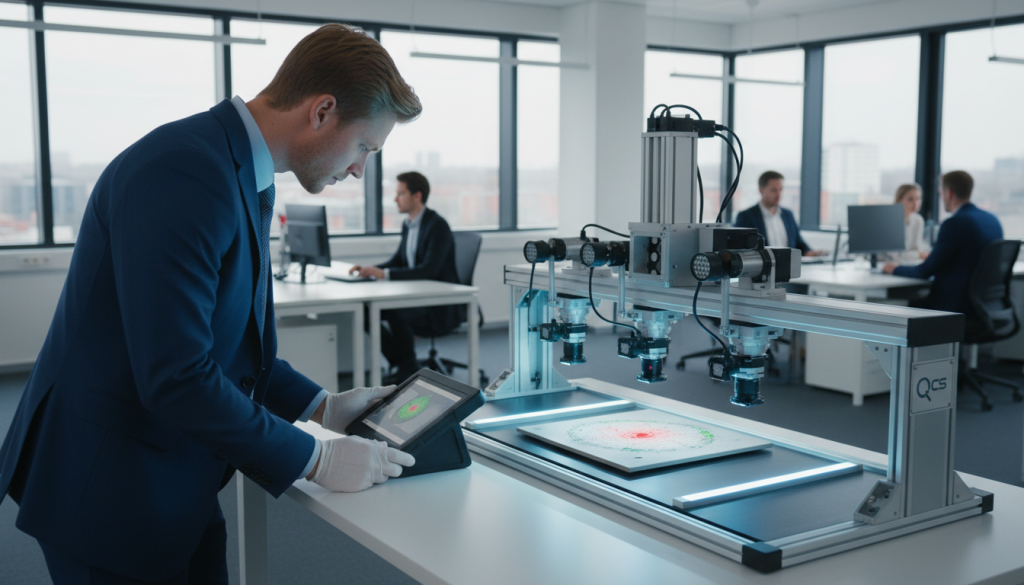
Using data from inspections helps us see trends. We can predict and prevent quality problems. This keeps products consistent.
In making medicines, surface checks ensure safety. They check if workers are following clean rules. This keeps medicines safe for patients.
Financial Advantages Through Cost Reduction
Surface inspection brings big savings. It stops costly mistakes and saves money. This is very important in expensive industries.
In chip making, finding problems early saves a lot. It stops wasting money on bad chips. This means more money for good chips.
Less waste means more money saved. Even small improvements save a lot. This is true for making lots of products.
Using machines for checks saves money on people. Machines work all the time without getting tired. This means more money for better things.
Knowing when to fix machines saves time and money. It stops machines from breaking down. This keeps production going smoothly.
Protection Through Enhanced Safety
Safety is key in industries where defects can harm people. We focus on systems that keep people safe. This is more than just following rules.
In planes, finding cracks stops big accidents. Our checks find problems before they cause trouble. This keeps everyone safe.
In medicines, checking surfaces keeps patients safe. We find contamination early. This stops bad medicines from getting to patients.
Medical devices need checks to be safe. We find dirt that could harm people. This keeps implants safe for patients.
In food, checks find contamination that could make people sick. Our systems find bacteria and dirt. This keeps food safe for everyone.
Keeping records of checks helps with rules and safety. It shows we are careful. This keeps products safe for everyone.
Challenges in Surface Inspection
Even with the latest technology, we still face big challenges in surface inspection. These challenges affect how well we can find defects. Understanding these issues helps us improve quality control in different manufacturing settings.
Modern production is complex, and our inspection tools must handle many tasks at once. We have to balance finding defects accurately with keeping production fast and affordable. This is crucial in high-volume manufacturing where time is everything.
Common Issues Faced
Our systems often run into technical and operational problems. False positive detection rates can overwhelm people, making them miss real defects. When systems flag too many things as defects, people start to ignore warnings.
On the other hand, missing real defects is a bigger problem. This can lead to poor quality products reaching customers. Finding the right balance between catching all defects and avoiding false alarms is a big challenge.
Working with different materials adds complexity. Changes in material can confuse our algorithms, leading to errors. This is a big issue in industries that use many different materials.
Choosing between fast inspection and detailed results is tough. High-resolution methods like scanning electron microscopy are very detailed but slow. AFM systems have limited scan areas and slow scan speeds that make them unsuitable for whole-wafer inspection in production environments.
Environmental factors also make things harder:
- Vibration interference from nearby equipment can degrade measurement precision
- Temperature fluctuations cause thermal expansion that affects dimensional accuracy
- Ambient lighting variations create inconsistent optical inspection conditions
- Airborne contamination can settle on surfaces during inspection cycles
- Humidity changes affect both equipment performance and sample characteristics
In precision metrology, even small environmental changes can affect measurements. Master precision level inspection requires extreme care and sensitivity to avoid errors.
Training and consistency in technique are ongoing challenges. Visual inspection and manual sampling depend on the skill of the operator. Maintaining consistent results across different shifts and people is crucial.
Mitigation Strategies
We use various strategies to improve our defect detection systems. These include technological advancements and procedural improvements. We need to plan carefully and keep refining our methods based on results.
Algorithm optimization using machine learning helps reduce false positives. By training systems on large defect libraries, we improve their ability to distinguish real defects from false ones. This makes our detection more reliable and reduces unnecessary alerts.
Using multiple inspection technologies together can also help. For example, combining optical systems with laser scanning improves accuracy. This approach increases our confidence in detection results and provides better information about defects.
Statistical sampling strategies help us balance thoroughness with speed:
- Critical area coverage – Inspect 100% of high-risk zones where defects have the greatest impact
- Stratified sampling – Divide surfaces into zones and sample proportionally based on defect history
- Random sampling intervals – Prevent predictable patterns that could be exploited or anticipated
- Adaptive sampling – Increase inspection density when defect rates rise above thresholds
Controlling the environment improves measurement consistency. Using vibration isolation tables, temperature stabilization systems, and controlled lighting reduces errors. These investments help improve accuracy and reduce false alarms.
Training programs with regular checks ensure consistent technique. We assess and refresh skills regularly. Random quality checks help avoid the Hawthorne effect where people change their behavior when being watched.
Technological Limitations
Despite our efforts, there are fundamental limits to surface inspection systems. The tradeoff between resolution and speed cannot be overcome by engineering alone. High-resolution techniques require scanning point by point, which is slow for whole-surface examination.
Subsurface defect detection varies greatly across technologies. Optical inspection provides less sensitivity to subsurface flaws and lower resolution than electron-based techniques, yet electron microscopy cannot examine large areas efficiently. Infrared methods penetrate silicon substrates but sacrifice resolution, creating a persistent compromise between penetration depth and detail.
Cost limits the use of advanced inspection technologies to high-value applications. Semiconductor manufacturing can afford expensive equipment because of the high product value. Other industries must settle for less capable but more affordable solutions that may not detect all surface defects.
Integrating new inspection systems into existing production lines is challenging. Limited space, incompatible data systems, and throughput bottlenecks complicate retrofits. Legacy equipment may lack the communication protocols needed for seamless integration with modern quality management platforms.
These technological boundaries remind us that perfect defect detection is still a goal, not a reality. We keep improving our inspection capabilities while acknowledging that some limitations require breakthrough innovations rather than incremental improvements to overcome.
The Future of Surface Inspection
We are on the brink of a new era in surface inspection. New technologies are coming together to unlock capabilities we thought were impossible. These innovations will change how we detect defects and ensure quality.
Today, semiconductor fabs use surface inspection in their monitoring systems. These tools collect defect data in real time. This data helps improve processes and predict defects, paving the way for more advanced methods.
Emerging Technologies Reshaping Inspection Capabilities
New technologies are set to change surface inspection across industries. Multi-spectral and hyperspectral imaging systems can analyze dozens or hundreds of wavelength bands at once. This allows for material identification, composition analysis, and defect detection in one scan.
Quantum sensing technologies are also making a big impact. They can detect individual atoms or molecular-scale contamination that classical sensors can’t. Advanced photonics, including metamaterials and structured illumination, enable super-resolution imaging beyond traditional limits.
Inline atomic force microscopy is set to revolutionize surface inspection at the nanoscale. These systems bring nanoscale resolution to production-speed inspection. Three-dimensional surface reconstruction using photometric stereo, structured light, or focus stacking provides detailed topographic data for complex surfaces.
Portable and handheld inspection devices are now more advanced. They have better sensors and edge computing capabilities. These devices bring lab-grade inspection to the field for maintenance and quality verification. Automated vision systems are becoming more compact without losing accuracy or resolution.
AI technologies are being used to recognize patterns in defects and surface anomalies and prevent them in the future.
Key Trends Shaping the Industry
The surface inspection industry is seeing big changes. Inspection speed is increasing through faster sensors and better scanning strategies. Future tools may inspect over 1,000 wafers per hour with sub-10nm sensitivity.
Resolution is getting better, moving towards atomic-scale imaging for everyday production. This change will move beyond research into everyday manufacturing. Inspection systems are becoming more integrated with process equipment, providing real-time feedback for better control.
Data from high-resolution surface inspection is growing fast. Production lines now generate terabytes daily. This is driving the need for edge computing and smart data reduction strategies. New ways to manage and analyze data are needed.
| Capability | Current State | Future Projection | Impact |
|---|---|---|---|
| Inspection Speed | 200-400 wafers/hour | 1,000+ wafers/hour | Increased production throughput |
| Detection Resolution | 20-50nm defects | Sub-10nm atomic scale | Enhanced defect detection accuracy |
| Data Processing | Post-process analysis | Real-time AI processing | Immediate corrective action |
| Inspection Mode | Defect detection | Defect prediction | Proactive quality control |
We’re moving from detecting defects to predicting them. Systems now use past data to forecast where and when defects will occur. This predictive approach is changing how we manage quality.
Artificial Intelligence Transforming Inspection Processes
AI and machine learning are changing surface inspection. AI systems can now classify defects with accuracy that rivals human experts. They learn from millions of examples, getting better over time.
Anomaly detection algorithms can spot new defect types without specific training. This is very useful in changing manufacturing environments. Predictive maintenance models analyze data to forecast equipment failures before they happen.
Automated vision systems use AI to recognize complex defects. They can now understand natural language, allowing operators to ask questions. For example, an operator can ask to see all edge defects on a product from the past week.
AI optimizes processes based on inspection feedback. This approach prevents defects before they happen. Generative adversarial networks create synthetic defect images for training when real examples are hard to find.
Transfer learning lets inspection systems trained on one product quickly adapt to new ones. This makes deployment faster and reduces the need for extensive training. Minimal retraining is needed when switching between similar products or materials.
As AI grows, we expect fully autonomous inspection systems. These systems will learn and adapt to production changes on their own. The future of surface inspection is about systems that not only find problems but prevent them.
Best Practices for Effective Surface Inspection
Getting great results in surface inspection is more than just having the right tech. It’s about a mix of human skill, reliable equipment, and systems working together. Companies that focus on these areas often get the best results in checking product quality.
The key to a good inspection program is three main parts. Each part helps the others, making a strong system that finds problems well and avoids mistakes. When done right, these steps turn surface inspection into a big advantage for quality control.
Building Expertise Through Comprehensive Training
Skilled people are the heart of successful surface inspection. Good training means finding and classifying defects well in all inspections. Without trained staff, even the best equipment can’t give good results.
Teams doing visual inspections need training on spotting defects, how to classify them, and optical basics. They learn to use equipment right and know its limits. We check their skills often to keep them sharp.
In pharmacies, staff or vendors need to take surface samples carefully. They must know how to do it, document it, and handle exceptions. This knowledge is crucial for their job.
Sampling should happen randomly at the end of the day and be linked to specific staff and products. This way, everyone knows who’s responsible and avoids the Hawthorne effect. It’s important to train on the difference between contact plates and larger plates for gloved fingertip sampling.
People working with automated systems need different skills than those doing visual checks. They learn how to use the system, solve basic problems, and understand how it works. The engineers behind these systems need to know a lot about optics, image processing, and more.
Keeping skills up with regular training, learning about different inspection tools, and staying updated on industry news is key. This keeps the team ready for new challenges.
Hands-on training with real defects is better than just classroom learning. Using interactive defect libraries helps people learn at their own pace. This makes them more confident and improves product quality.
Maintaining Equipment for Consistent Performance
Keeping equipment in top shape is crucial for reliable results. We set up maintenance plans based on what the maker says and our own experience. These plans include cleaning optics, checking mechanics, verifying sensors, and updating software.
Professional calibration by labs ensures our equipment is accurate. For precise tools, labs check their accuracy against national standards. This gives us confidence in our measurements.
We watch the environment where we inspect to make sure it’s right. We check things like temperature, humidity, and dust levels. If these get out of range, we fix it right away to keep our results good.
Systems that watch how equipment is doing help us catch problems early. This includes checking how fast it works, how often it makes mistakes, and how often it’s down. Tracking these helps us see when something’s going wrong and fix it before it fails.
We keep detailed records of all maintenance. This helps us troubleshoot and meet rules. Having all this info helps us keep improving and makes sure our tech works well.
Creating Seamless Quality System Integration
We make sure inspection data fits into the bigger picture of quality management. This makes surface inspection a key part of keeping quality high. Connected systems give us real-time info and help us act fast on quality issues.
Systems that track quality over time get data from inspections. If something looks off, they alert us before we make a lot of bad product. Systems that manage how things are made use inspection results to decide what to do with products.
In pharmacies, clear rules say how to take samples and what to do with results. Plans for when things go wrong help keep quality up. Random sampling and linking it to staff and products keeps things fair and accurate.
Systems that find and fix problems use inspection data to improve. When we see patterns of defects, we investigate and fix the root cause. Keeping all inspection info in one place helps everyone stay on the same page.
We have clear steps for dealing with different kinds of defects. This makes sure the right people know what to do when problems arise. Dashboards show everyone how we’re doing, from the people checking things in real-time to the bosses looking at the big picture.
By integrating inspection into the whole quality system, we create a cycle of improvement. Companies that do this well get better product quality and use their resources better. This makes surface inspection a key part of quality control, not just a rule to follow.
Surface Inspection Standards and Regulations
Surface inspection rules change a lot based on the industry, use, and where you are. We deal with these rules every day to make sure our quality control meets all standards. Each field has its own rules for checking surface flaws in their products.
These rules set the minimum for how to inspect, how often, and what to accept. They also say how to keep records to show you followed the rules. It’s not just a choice for companies that want to be sure of their quality and get into the market.
Sector-Specific Requirements and Guidelines
Different fields have their own detailed standards for surface checks. We follow these to keep our work consistent and reliable. Pharmaceutical compounding follows USP Chapter 797, which means they have to check surfaces carefully to avoid contamination.
This rule says they should check surfaces after they’re done making things. They do this to see if there’s any contamination. They also check more often if the place where they work is riskier.
They need to check a certain area, 24-30 cm², which is like a 55mm diameter circle. They use special media to take samples. These samples need to sit at 30-35°C for 48-72 hours to check for contamination.
They have to check inside special areas that keep things clean, like ISO Class 5. This way, they can see if people are keeping things clean and if the environment is controlled well. We do these checks as part of our NDT programs to make sure we’re controlling contamination.
Semiconductor making uses SEMI standards for checking surfaces. SEMI M58 and M59 are about checking for particles on wafers. These rules help make sure different tools give the same results.
These standards help tools from different makers work together. They make sure data can be shared easily between places. We use these standards when we pick and check our tools for making semiconductors.
Aerospace needs AS9100 quality management rules that include NDT for important parts. This rule adds to ISO 9001 with special rules for aerospace. Military rules (MIL-STDs) have more checks for defense where failure could be very bad.
Precision metrology uses ISO 1 for surface plates. This rule sets standards and tests for surface plates. We use these to pick the right surfaces for measuring and calibrating.
| Industry Sector | Primary Standard | Key Surface Inspection Requirement | Typical Frequency |
|---|---|---|---|
| Pharmaceutical Compounding | USP Chapter 797 | 24-30 cm² surface sampling with contact plates in ISO Class 5 environments | Post-compounding and periodic based on risk |
| Semiconductor Manufacturing | SEMI M58/M59 | Particle detection on patterned and unpatterned wafer surfaces | Per wafer or sampling plan |
| Aerospace Manufacturing | AS9100, MIL-STDs | NDT methods for critical component surface defects | Per specification and risk assessment |
| Precision Metrology | ISO 1 | Surface plate flatness verification to grade specifications | Annual or per calibration schedule |
Achieving and Maintaining Regulatory Compliance
We make sure our surface inspection meets the rules by following strict guidelines. We have quality systems that outline how to inspect and what to do with the results. These systems cover how often to inspect, how to take samples, what to accept, and how to document it all.
Personnel certification through ASNT shows our inspectors are skilled in NDT. We make sure our team has the right certifications for their jobs. Getting certified means they’ve passed tests and keep up with new knowledge.
Calibrating our equipment by labs that follow ISO/IEC 17025 shows we’re accurate. These labs give us certificates that prove our tools work right. These certificates are important for keeping our inspections reliable.
For surface plates, calibration includes certified flats and detailed maps. These maps show how flat the surface is. We keep these up to date to show we’re connected to national standards.
In fields like pharmaceuticals and medical devices, regulatory inspections by FDA or equivalent agencies check if we follow the rules. We get ready for these audits by keeping all our documents in order. This includes procedures, training records, and inspection results.
Our quality control documents also have calibration certificates and CAPA records. These show we’re always following the rules. We do mock audits and internal checks to find problems before outsiders do. This helps us improve and avoid surprises.
The Critical Role of Standardization
Standardization is key for being consistent and comparable. It helps everyone talk the same language and follow the same rules. When everyone uses the same terms and standards, results are easier to understand and act on.
Standardized ways of checking surfaces make sure results are the same no matter who does them. We train our team to follow the same steps for consistent results. This is important for tracking trends and controlling quality.
Using clear rules for what’s acceptable means we can decide if surfaces are good or not without guessing. We use these rules to judge if surfaces meet standards. This makes sure we’re fair and consistent in our evaluations.
Standardization lets us compare ourselves to others and get better. We look at how we do compared to industry standards to find ways to improve. This helps us stay competitive and keep getting better.
Equipment interoperability improves when tools work together smoothly. We can mix tools from different makers into one system. This makes it easier to pick the best tools without worrying about compatibility.
We help make standards better by joining industry groups and technical committees. Our experience helps shape the rules and gives us a heads-up on new ones. This helps us plan ahead and stay up to date.
Conclusion: The Importance of Surface Inspection in Quality Assurance
Throughout this guide, we’ve looked at how surface inspection is key to making products better. It’s used in many areas, like making parts for planes and chips for computers. Finding and checking defects is crucial for success in all fields.
Essential Takeaways for Manufacturing Excellence
Surface inspection tools have grown from simple looks to advanced systems. These tools can quickly check products and find small defects. This helps companies making precise items keep their quality high.
Testing the environment early can stop problems before they start. Using AI and machine learning is making it easier to predict and catch defects right away.
Choosing the right inspection method is important. There are many options, like optical systems, laser scanning, and non-destructive testing. Each one is best for different types of defects and materials.
Taking Action on Your Inspection Strategy
We suggest reviewing your current inspection methods against what’s best in the industry. Look for areas where you can improve and consider new technologies. Also, invest in training to make your team better at inspection.
Begin with small tests of new inspection tools. Track how they do, see if they’re worth it, and then use them more widely. Focusing on good surface inspection will make your customers happier, keep you safe, and help you stay ahead in the market.
FAQ
What exactly is surface inspection and why is it important?
Surface inspection is checking material surfaces for defects and contaminants. It uses both visual and automated methods. This process is crucial for quality control in many industries.
In semiconductor manufacturing, tiny defects can affect chip performance. In pharmaceuticals, surface contamination can harm patient safety. Precision manufacturing relies on surface inspection to avoid errors.
What technologies are used in modern surface inspection systems?
Modern systems use various technologies like optical and laser scanning. Scanning Electron Microscopy (SEM) and Atomic Force Microscopy (AFM) offer high-resolution images. Infrared and X-ray inspections check internal structures.
Automated vision systems use AI for real-time defect detection. These technologies help improve quality and efficiency.
What are the main types of surface inspection methods?
There are three main types: visual, automated, and non-destructive testing (NDT). Visual methods use basic tools, while automated systems rely on AI and robotics. NDT techniques examine materials without damage.
Each method has its own strengths and weaknesses. Choosing the right method depends on the specific needs of the industry.
Which industries depend most heavily on surface inspection?
Many industries rely on surface inspection. In manufacturing, it checks painted surfaces and machined components. In pharmaceuticals, it ensures cleanliness and safety.
In aerospace, it detects cracks and corrosion. In electronics, it examines semiconductor wafers and PCBs. Display manufacturers use it to check glass substrates and pixel arrays.
What are the key benefits of implementing comprehensive surface inspection programs?
Comprehensive programs improve quality control and prevent defects. They ensure products meet standards and protect brand reputation. In semiconductor manufacturing, early detection saves time and money.
They also reduce costs and enhance safety. In pharmaceuticals, it ensures cleanliness and compliance. Inspection programs support regulatory requirements and protect consumers.
What challenges does surface inspection face and how can they be addressed?
Surface inspection faces challenges like false positives and false negatives. In pharmaceuticals, condensation can spread contamination. Substrate variability complicates defect detection.
High-resolution techniques like SEM and AFM provide detailed images but are slow. Environmental factors like vibration and temperature can affect accuracy. Strategies like algorithm optimization and environmental controls help mitigate these challenges.
How is artificial intelligence transforming surface inspection?
AI and machine learning are revolutionizing surface inspection. AI systems can classify defects accurately and predict equipment failures. Automated optical inspection uses AI for complex defect recognition.
Natural language interfaces allow easy communication with inspection systems. AI-driven process optimization continuously improves manufacturing. Future systems will be fully autonomous and require minimal human oversight.
What are best practices for pharmaceutical surface sampling under USP ?
USP Chapter 797 mandates surface sampling in pharmaceutical compounding. It requires sampling at the end of compounding and periodic repetition based on risk level. Contact plates with tryptic soy agar media are used for sampling.
Incubation is done at 30-35°C for 48-72 hours with plates inverted. This prevents condensation from creating false results. Sampling is required inside ISO Class 5 primary engineering controls.
How does surface inspection integrate with quality management systems?
Surface inspection integrates with quality management systems to ensure comprehensive quality assurance. Inspection data is used in statistical process control systems. Manufacturing execution systems receive real-time results for automated dispositioning.
Corrective and preventive action systems link inspection findings to root cause investigations. Document management systems maintain inspection specifications and historical data. This integration enables data-driven decision making and continuous improvement.
What are the main regulatory standards governing surface inspection?
Surface inspection operates under various regulatory frameworks. In pharmaceutical compounding, USP Chapter 797 mandates specific methods and frequencies. In semiconductor manufacturing, SEMI standards define equipment interfaces and measurement methods.
In aerospace, AS9100 incorporates quality management requirements. ISO 1 establishes specifications for surface plates. Compliance processes require documented quality systems and training records.
What innovations are shaping the future of surface inspection?
The future of surface inspection is shaped by convergent technologies. Multi-spectral and hyperspectral imaging systems capture surface data across dozens or hundreds of wavelength bands. Quantum sensing technologies offer sensitivity levels impossible with classical sensors.
Advanced photonics and inline atomic force microscopy developments promise to break conventional limits. Three-dimensional surface reconstruction provides comprehensive topographic data. Inspection throughput will increase through parallel processing and optimized scanning strategies.
How can manufacturers assess and improve their current surface inspection capabilities?
Manufacturers should conduct a comprehensive audit of their inspection processes. Document current technologies, procedures, frequencies, and performance metrics. Benchmark against industry standards and best practices to identify gaps.
Evaluate emerging technologies for applicability and return on investment. Invest in personnel training and establish integration with quality management systems. Consider pilot programs to evaluate advanced technologies before full-scale deployment.
What training is required for personnel performing surface inspection?
Training is essential for effective inspection programs. Visual inspection personnel need training in defect recognition and classification. Automated inspection system operators require training in system operation and troubleshooting.
Engineers supporting these systems need deeper knowledge of optics and image processing. Continuous skill development through refresher training and cross-training maintains workforce capability. Hands-on training with real defect samples accelerates learning.
What maintenance practices ensure consistent surface inspection system performance?
Regular equipment maintenance ensures consistent performance. Establish preventive maintenance schedules based on manufacturer recommendations and operational experience. Cover optical cleaning, mechanical calibration, sensor verification, and software updates.
For precision metrology equipment, periodic calibration by accredited laboratories provides certified documentation of measurement accuracy. Environmental monitoring verifies that conditions remain within specifications. Condition monitoring systems track key performance indicators and identify degradation patterns.