What if your manufacturing operation could eliminate nearly 20% of costs while simultaneously improving product quality? This isn’t just a theoretical question—it’s the reality facing business leaders who recognize that traditional quality control methods can no longer keep pace with modern production demands.
Manufacturers across industries face a critical challenge: quality-related expenses consume 15-20% of annual sales revenue. These costs represent billions in rework, scrap, warranty claims, and recalls that directly impact profitability and brand reputation. As production speeds accelerate and consumer expectations rise, maintaining consistent standards becomes increasingly difficult.
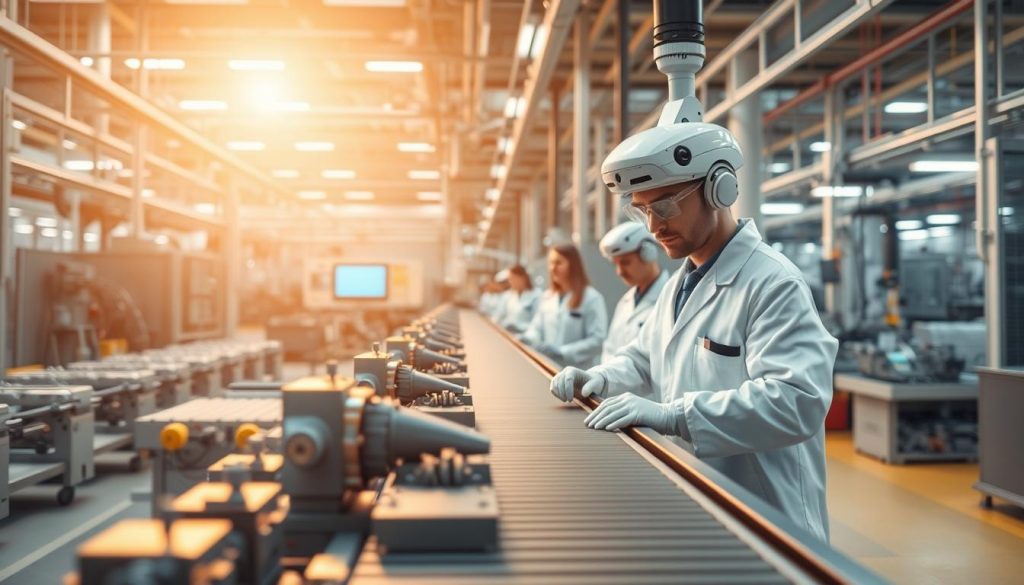
We understand these pressures intimately. The traditional approach to visual inspection relies heavily on human judgment, which naturally varies in consistency and precision. This comprehensive guide explores how intelligent automation transforms this critical inspection process, combining human expertise with computational accuracy to deliver unprecedented quality assurance.
Throughout this buyer’s guide, we’ll navigate the fundamentals of advanced visual inspection technologies, evaluate their capabilities, and explore real-world applications that drive measurable improvements. We position ourselves as your trusted partner in this digital transformation journey, leveraging our expertise to help reduce operational burdens while accelerating business growth.
Key Takeaways
- Quality control costs represent 15-20% of annual sales revenue for many manufacturers
- Traditional inspection methods struggle with consistency at high production speeds
- Intelligent automation combines human expertise with computational precision
- Advanced systems can significantly reduce rework, scrap, and warranty claims
- Implementation requires understanding both technical capabilities and operational needs
- Proper integration drives measurable improvements in production quality control
- Digital transformation in inspection processes supports long-term business growth
Introduction to AI Visual Inspection in Modern Manufacturing
The persistent challenge of maintaining consistent product quality while scaling operations has become a defining issue for modern manufacturers. We recognize that traditional approaches to quality assurance are struggling to keep pace with today’s production demands.
Understanding Visual Inspection Challenges
Manual inspection processes have served as the foundation of quality control for decades. Trained personnel examine products meticulously for defects and inconsistencies.
This approach faces significant limitations. Human inspectors are susceptible to fatigue and subjective judgment, leading to inconsistent results across shifts. The time-consuming nature of thorough examination adds substantially to production cycles.
Manufacturing companies increasingly struggle to hire sufficient qualified personnel. This creates bottlenecks that threaten operational scalability and delivery timelines.
The Evolution from Manual to AI-Driven Systems
The transition from traditional methods represents a paradigm shift in manufacturing quality control. We explain how intelligent automation addresses fundamental limitations.
Traditional rule-based machinery requires extensive programming and lacks flexibility. These systems cannot adapt to product changes or new defect types effectively.
| Aspect |
Manual Inspection |
Automated Solution |
| Consistency |
Variable across shifts |
Consistent performance |
| Speed |
Time-consuming process |
Rapid assessment |
| Adaptability |
Limited flexibility |
Learns from new data |
| Defect Detection |
Subject to human error |
Comprehensive analysis |
Advanced systems combine computational precision with continuous learning capabilities. This evolution enables organizations to maintain rigorous standards despite workforce challenges.
Exploring the AI Visual Inspection System
Modern manufacturing demands a new approach to quality assurance that combines human expertise with advanced computational capabilities. We believe this integration represents the future of production excellence.
How Machine Learning and Computer Vision Work Together
These innovative solutions blend sophisticated algorithms with advanced imaging capabilities. High-resolution cameras capture detailed product photographs that feed into trained learning models.
The machine learning component analyzes patterns in the visual data. It identifies acceptable variations and detects anomalies with remarkable precision. This process continuously improves as more information becomes available.
Comparing Traditional and Enhanced Methods
Traditional approaches rely heavily on human judgment and rule-based machinery. These methods struggle with consistency and flexibility across different product variations.
Enhanced methods offer significant advantages in speed and accuracy. They can process ultra-high resolution images and detect multiple defect types simultaneously. The technology adapts quickly to new products without extensive reprogramming.
We’ve observed that mature implementations provide an additional layer of quality assurance. They work collaboratively with human operators rather than replacing them entirely. This partnership combines computational precision with human contextual understanding.
Key Benefits of AI-Driven Visual Inspection
Operational excellence in modern manufacturing increasingly depends on sophisticated quality management technologies that deliver measurable returns. We help manufacturers transform their quality control processes through intelligent automation that addresses fundamental production challenges.
Increased Accuracy, Consistency, and Cost Savings
Intelligent quality assessment delivers transformative benefits in defect detection. Production trials demonstrate up to 10x improvement in accuracy compared to traditional methods.
These solutions maintain unwavering consistency across all operations. They apply identical standards regardless of shift changes or production volumes.
| Benefit Category |
Traditional Methods |
Intelligent Solutions |
| Detection Accuracy |
Variable human performance |
Consistent high precision |
| Operational Costs |
High labor expenses |
Significant savings |
| Process Speed |
Time-consuming manual checks |
Rapid automated assessment |
| Error Reduction |
Subject to human factors |
Objective consistent results |
Scalability and Traceability in Production Processes
Manufacturers gain exceptional scalability with these advanced solutions. Systems easily expand to accommodate growing production demands without extensive reconfiguration.
Comprehensive data capture provides complete traceability throughout quality processes. This information supports regulatory compliance and enables continuous improvement initiatives.
Stored inspection data empowers manufacturers to identify patterns and optimize operations. These insights lead to higher-quality products and enhanced brand reputation.
Real-World Use Cases and Industry Applications
The proof of any technological advancement lies in its practical application and measurable impact. We see compelling evidence across numerous sectors where automated quality assurance delivers transformative results.
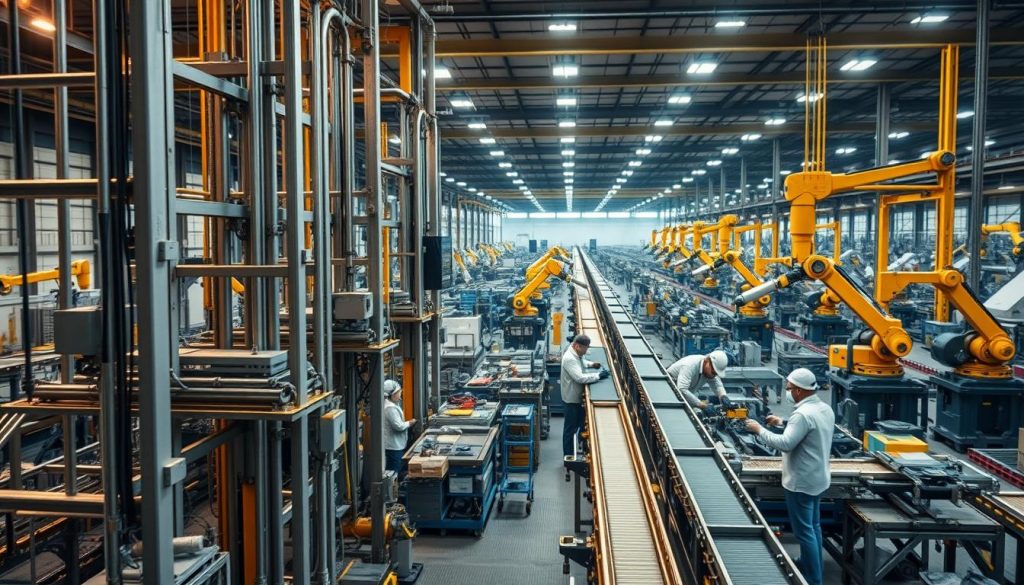
These applications demonstrate a clear return on investment by enhancing precision and reliability.
Manufacturing, Automotive, and Aerospace Applications
In general manufacturing, automated detection identifies flaws in electronics, machinery, and consumer goods. This ensures finished products meet strict specifications before they reach customers.
The automotive sector relies on this technology for critical assembly checks. It verifies paint quality, inspects welding seams, and examines engine blocks for microscopic cracks. This level of quality control is essential for vehicle safety.
Aerospace applications demand the highest level of accuracy. The technology scrutinizes critical components where even a minor defect could have severe consequences. It provides the consistent verification that aerospace standards require.
Impact on Quality Control and Production Efficiency
These real-world cases show a direct boost to operational efficiency. Production lines maintain speed while incorporating rigorous checks at every stage.
| Industry |
Application Focus |
Key Benefit |
| Electronics |
PCB Component Verification |
Catches missing parts and soldering issues |
| Semiconductors |
Wafer-Level Defect Detection |
Identifies microscopic anomalies |
| Mining |
Equipment Wear Monitoring |
Prevents breakdowns for continuous operation |
| Field Service |
Post-Maintenance Verification |
Ensures repairs are complete and documented |
From initial assembly to final inspection, the technology integrates seamlessly. It supports technicians and improves overall production quality control. This leads to fewer returns and a stronger brand reputation.
These diverse use cases across industries highlight the technology’s adaptability. Companies achieve higher consistency and better resource allocation.
Overcoming Challenges in Implementing AI Solutions
Manufacturers frequently encounter practical challenges when integrating sophisticated detection technologies into existing workflows. We understand that initial setup costs and technical complexity can seem daunting. These hurdles require careful planning and strategic approaches.
Integration with Existing Systems and IT Infrastructure
Connecting new quality control systems with current manufacturing machines presents technical complexity. We help navigate this process by providing standard interfaces. This ensures seamless integration without disrupting operations.
Our solution minimizes customization requirements. It works with your existing operational technology. This approach saves time and reduces implementation risks significantly.
Minimizing Data Collection and Training Difficulties
Modern training methods have transformed implementation feasibility. Advanced models now achieve production-ready performance with minimal data. This eliminates the need for thousands of labeled images.
The training process has become more efficient. Companies can start with modest data sets and improve continuously. This accelerates the path to operational benefits.
We help manufacturers avoid “pilot purgatory” by focusing on clear business outcomes. Our approach ensures that inspection systems deliver measurable value from the start. This strategic implementation supports long-term business growth.
Innovative Components and Technologies Behind AI Visual Inspection
The technological foundation supporting modern quality control represents a sophisticated integration of hardware and software components working in concert. We help manufacturers understand how these elements combine to create robust detection capabilities that transform production quality assurance.
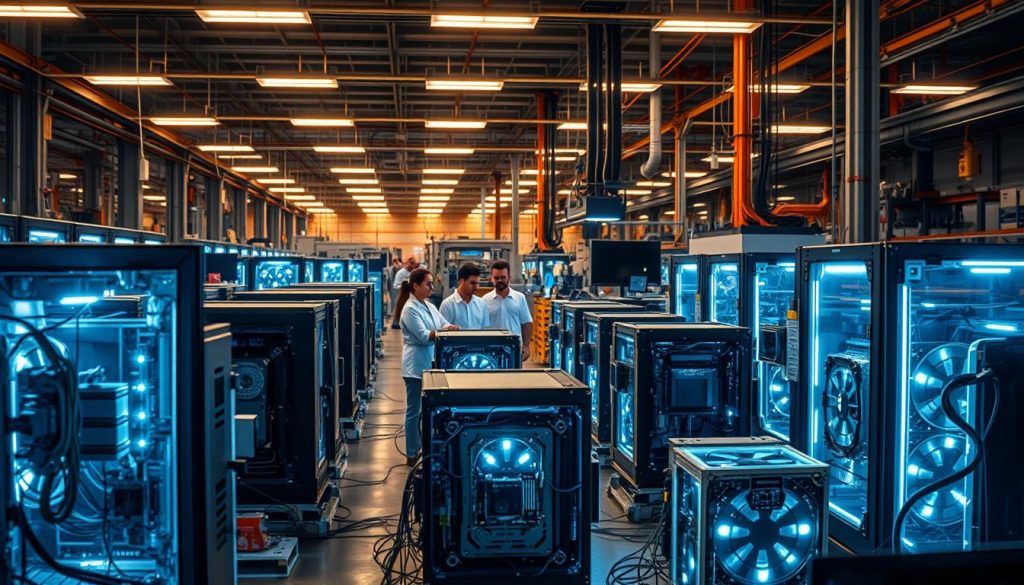
Advanced camera systems serve as the critical sensory foundation, capturing extraordinarily detailed product images. High-resolution imaging extending to 100 megapixels reveals microscopic defects and surface variations invisible to human observers.
Role of Advanced Cameras and Deep Learning Models
Sophisticated computer vision algorithms form the analytical backbone of these solutions. They process captured images to extract meaningful features and identify patterns associated with both normal and defective conditions.
Deep learning models, particularly convolutional neural networks, enable capabilities far beyond simple anomaly detection. These advanced architectures can simultaneously detect multiple defect types, accurately classify issues, and precisely localize problems within complex product images.
| Technology Component |
Primary Function |
Key Capability |
Impact on Quality |
| High-Resolution Cameras |
Image Capture |
100+ megapixel detail |
Reveals microscopic defects |
| Computer Vision Algorithms |
Pattern Recognition |
Feature extraction |
Identifies subtle variations |
| Deep Learning Models |
Defect Analysis |
Multi-defect detection |
Comprehensive quality assessment |
| Training Data Annotation |
Model Education |
Quality labeling |
Determines system accuracy |
The training process where labeled images teach models to recognize visual characteristics is crucial. High-quality annotated data directly determines the accuracy and reliability that inspection systems achieve in production environments.
These solutions continuously improve their performance by learning from human operator feedback. They catalog new defect types as quality engineers identify them, refining detection models based on expanding operational knowledge.
Manufacturers can begin realizing benefits even with limited initial training data. Modern systems learn incrementally from operator feedback, becoming progressively more accurate as they accumulate operational experience.
Getting Started with Your AI Visual Inspection Investment
Beginning your journey toward automated quality control requires careful planning and strategic execution. We guide manufacturers through a structured approach that ensures smooth implementation and rapid return on investment.
Step-by-Step Buyer’s Guide for Implementation
The foundation of any successful deployment begins with clearly defining your specific quality objectives. We help identify the exact defect types requiring detection and establish accuracy thresholds that align with your production standards.
Gathering comprehensive training data represents the next critical phase. Quality engineers collect labeled images representing both acceptable and defective products. The quality of this data directly impacts the performance of your detection model.
We then move to model selection and customization, choosing appropriate architectures that balance accuracy with processing speed. The training process uses cross-validation techniques to ensure reliable learning.
Essential Tips for Seamless Onboarding
Deployment requires careful integration with existing systems and processes. We ensure compatibility with current software and hardware configurations.
System optimization focuses on achieving the right balance between thoroughness and speed. This includes hardware upgrades and software refinements to meet production requirements.
Comprehensive training for your team ensures effective system operation and interpretation of results. We provide ongoing support to maintain optimal performance over time.
Scaling the solution across additional production lines follows successful pilot implementation. This phased approach minimizes disruption while maximizing business value.
Conclusion
Forward-thinking manufacturers are embracing a new era of quality assurance that delivers unprecedented precision and efficiency. We’ve explored how this technology transforms operations by detecting defects with remarkable accuracy.
These solutions offer a compelling business case through cost reduction and enhanced product quality. The flexibility to scale across production lines makes adoption practical and profitable.
Modern implementations provide comprehensive traceability and analytical capabilities. This supports continuous improvement and regulatory compliance.
While implementation requires careful planning, turnkey options simplify the process significantly. The technology’s versatility across industries demonstrates its transformative potential.
We invite you to explore how these innovative solutions can address your specific challenges. Let us help you enhance your processes and achieve new levels of operational excellence.
FAQ
What industries benefit most from automated quality control solutions?
Our technology delivers significant advantages across multiple sectors, including automotive manufacturing, aerospace assembly, and electronics production. These industries require meticulous attention to detail and benefit greatly from the enhanced precision and consistency offered by our deep learning models.
How does computer vision technology improve defect detection?
Computer vision systems analyze product images with exceptional speed and accuracy, identifying minute imperfections that might escape human observation. This capability ensures higher quality standards and reduces the likelihood of defective products reaching customers.
What are the primary advantages of implementing machine learning in manufacturing processes?
Machine learning algorithms continuously improve their performance by learning from new data, leading to increasingly accurate inspections over time. This adaptive approach helps businesses achieve greater operational efficiency and maintain consistent product quality.
Can these systems integrate with existing production lines?
Yes, our solutions are designed for seamless integration with current manufacturing setups. We work closely with your team to ensure minimal disruption during implementation, allowing you to enhance quality control without overhauling your entire operation.
What training data is required to get started?
We begin by analyzing a representative sample of your products, including both acceptable and defective examples. This data trains our models to recognize quality standards specific to your business, ensuring tailored performance from day one.
How does this technology impact production speed?
Automated inspection accelerates the entire manufacturing workflow by performing quality checks much faster than manual methods. This increased throughput helps businesses meet growing demand while maintaining rigorous quality standards.
What support is available during implementation?
Our team provides comprehensive guidance throughout the onboarding process, from initial setup to full-scale deployment. We ensure your staff gains confidence in using the system effectively, maximizing the return on your investment.
Author
Praveena Shenoy
- Country Manager, Opsio
Praveena Shenoy is the Country Manager for Opsio India and a recognized expert in DevOps, Managed Cloud Services, and AI/ML solutions. With deep experience in 24/7 cloud operations, digital transformation, and intelligent automation, he leads high-performing teams that deliver resilience, scalability, and operational excellence. Praveena is dedicated to helping enterprises modernize their technology landscape and accelerate growth through cloud-native methodologies and AI-driven innovations, enabling smarter decision-making and enhanced business agility.