In today’s competitive manufacturing environment, maintaining exceptional product standards while boosting operational efficiency presents a significant challenge. Business leaders constantly seek ways to achieve sustainable growth and market differentiation.
We’ve partnered with manufacturers across various sectors and witnessed how visual inspection technology transforms quality assurance. This approach revolutionizes defect prevention and process optimization.
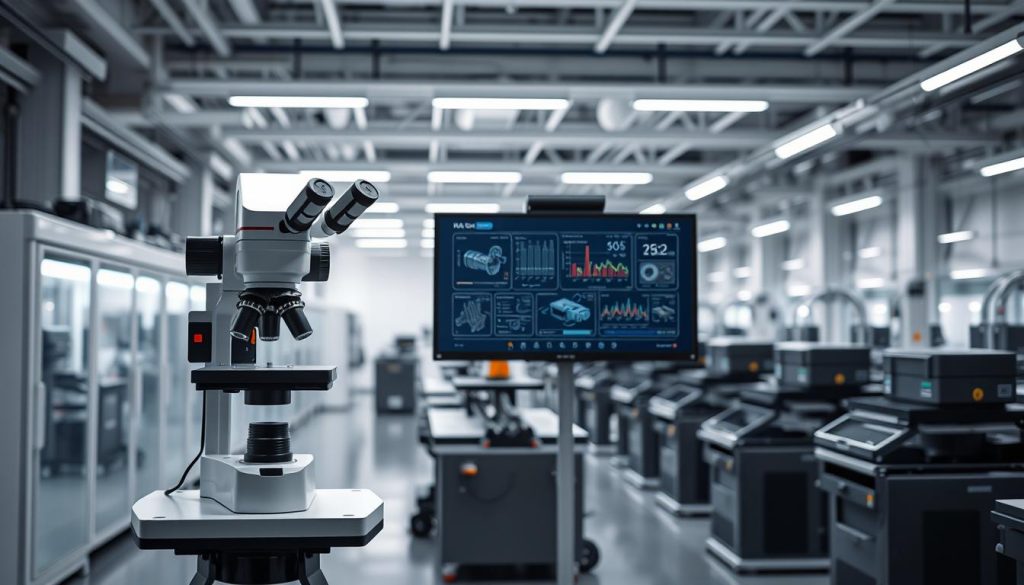
Our commitment focuses on helping you understand how automated inspection systems can reduce operational burdens. These solutions replace manual oversight, freeing your team for strategic initiatives that drive business value.
Manufacturers implementing these advanced solutions achieve measurable improvements in product consistency. They experience reduced waste, lower rework costs, and enhanced customer satisfaction through reliable delivery of defect-free products.
This guide demonstrates our collaborative approach to sharing industry expertise. We’ll walk you through fundamental concepts, practical applications, and implementation strategies.
By exploring computer vision and artificial intelligence in quality control, we aim to equip you with knowledge for informed decisions. Our mission extends beyond explaining technology to enabling your business growth.
Key Takeaways
- Automated visual inspection reduces human error in quality control
- Manufacturers achieve better product consistency with advanced systems
- Operational efficiency improves through process automation
- Reduced waste and rework costs lead to significant savings
- Customer satisfaction increases with reliable defect-free delivery
- Strategic resource allocation becomes possible with automated oversight
- Industry expertise helps in effective technology implementation
Understanding Image Analysis in Industrial QA
The foundation of effective quality control begins with capturing precise visual data that machines can interpret reliably. We help manufacturers understand how this technology transforms raw information into valuable insights.
The Basics of Image Acquisition and Processing
Machine vision systems start by acquiring pictures through carefully designed illumination and camera setups. The interaction between lighting, optics, and workpiece geometry creates the essential contrast needed for accurate assessment.
Modern processing techniques transform raw visual data using sophisticated algorithms. These methods enhance relevant features and suppress noise, preparing information for automated decision-making. The conversion of one-dimensional line scans into comprehensive two-dimensional pictures enables diverse processing.
How Image Analysis Enhances Quality Assurance
Robust visual assessment in manufacturing applications provides objective, repeatable measurements. This approach eliminates variability and fatigue factors inherent in human inspection.
We’ve implemented vision systems that automatically detect subtle product variations and monitor process parameters in real-time. This capability triggers corrective actions before defects propagate through production.
Through integration of advanced methodologies, organizations achieve unprecedented precision in defect detection and dimensional verification. This satisfies stringent industry standards while protecting brand reputation.
The Role of Image Analysis for Industrial QA in Quality Control
In precision-driven manufacturing environments, automated visual systems provide the critical oversight needed for consistent product quality. These technologies extend far beyond simple pass-fail checks, incorporating sophisticated methodologies that identify, classify, and measure anomalies with precision surpassing human capabilities.
Defect Detection and Measurement Techniques
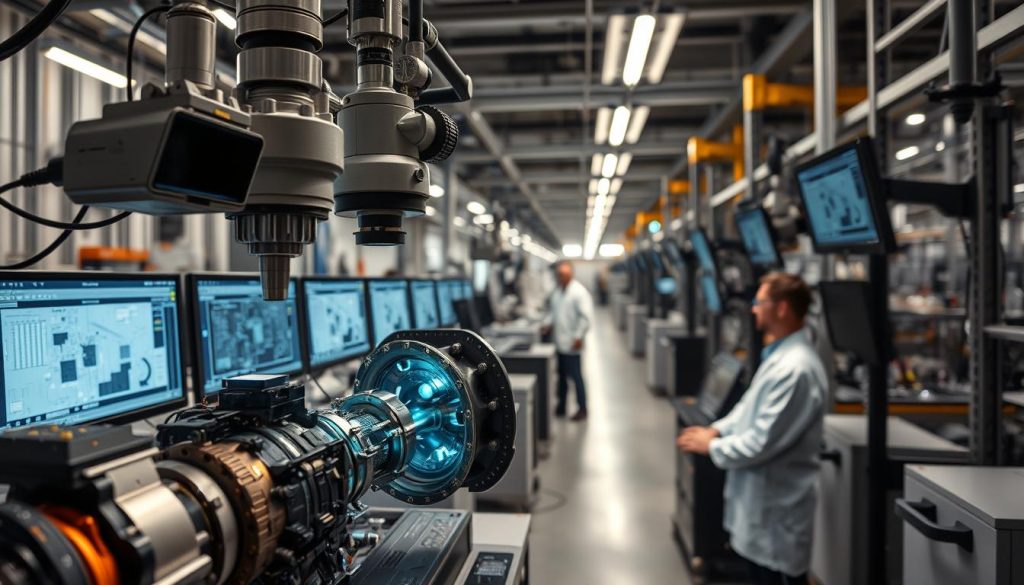
We implement surface analysis methodologies that employ intelligent thresholding algorithms to separate defective areas from acceptable surfaces. This approach enables comprehensive measurement of flaw characteristics including size, shape, location, and severity, supporting data-driven decisions about product disposition.
Our experience across semiconductor, automotive, and electronics production demonstrates how advanced detection prevents flawed products from reaching customers. This protects brand reputation while reducing costly warranty claims and recalls that impact operational efficiency.
Presence detection capabilities verify required components are correctly installed during assembly processes. Simultaneously, these systems identify foreign objects, contamination, or incorrect parts that could compromise final product quality.
We distinguish between cosmetic imperfections acceptable under certain standards and critical flaws rendering products unusable. This intelligence enables manufacturing operations to balance quality requirements with production efficiency through informed sorting decisions.
Through integration of multiple techniques including blob analysis and precision gauging, we empower quality control systems to generate detailed inspection reports. These documents provide essential traceability, support continuous improvement initiatives, and demonstrate compliance with industry regulations.
Implementing Effective Image Processing Techniques
Successful implementation of automated quality systems relies heavily on foundational processing methods that transform raw visual information into actionable insights. We help manufacturers establish robust processing pipelines that optimize captured data for reliable defect detection.
Enhancing Image Contrast and Resolution
Sophisticated lookup table transformations significantly improve contrast in challenging lighting conditions. These algorithms amplify subtle features in dark regions where critical defects might otherwise remain hidden.
We implement square root lookup tables to provide greater contrast to features in low-light areas. This approach ensures your inspection systems reveal essential details for accurate assessment.
Applying Filters and Thresholding Methods
Specialized filters including Sobel, Laplacian, and Canny algorithms emphasize boundaries and transitions that define part geometry. These tools extract precise feature data necessary for accurate measurement and verification.
Morphological filters remove noise artifacts and isolate relevant objects from textured backgrounds. Dilation, erosion, opening, and closing operations significantly improve subsequent analysis reliability.
Advanced thresholding methods separate objects based on carefully calibrated gray level criteria. This technology extracts regions of interest for detailed examination of potential defects.
Our color analysis approach transforms images into HSI color space where hue values remain consistent despite lighting variations. This ensures reliable differentiation of colored components and detection of color-based defects.
Leveraging Advanced Technologies in Image Analysis
Manufacturing operations now benefit from unprecedented precision through sophisticated vision technologies that learn and adapt. These innovations move beyond traditional rule-based approaches to handle complex inspection challenges with remarkable accuracy.
Deep Learning and AI Innovations
We implement neural network algorithms that continuously improve through exposure to diverse product examples. These systems excel at recognizing subtle patterns and classifying items with growing reliability.
Our deep learning applications handle real-world variability effectively. They distinguish between acceptable variations and true defects without requiring complete reprogramming for new configurations.
3D Imaging and Thermal Vision Applications
Three-dimensional technologies add crucial depth perception for volumetric verification. We deploy these systems for complex geometry measurement in automotive components like gears and pistons.
Thermal cameras detect temperature anomalies invisible to standard vision systems. This approach identifies overheating electronics and ensures proper storage conditions for temperature-sensitive products.
| Technology Type |
Primary Applications |
Key Benefits |
Implementation Complexity |
| Deep Learning Vision |
Pattern recognition, defect classification |
Adapts to new products, handles variability |
Medium (requires training data) |
| 3D Imaging Systems |
Dimensional verification, assembly completeness |
Measures complex shapes, adds depth data |
High (precise calibration needed) |
| Thermal Vision Cameras |
Temperature monitoring, hidden defect detection |
Reveals heat-based anomalies, non-contact measurement |
Medium (specialized equipment) |
These advanced technologies represent a significant leap in inspection capabilities. When building a comprehensive AI image analysis system, we help select the optimal combination of modalities for your specific requirements.
The integration of multiple imaging approaches creates robust quality assurance solutions. This comprehensive strategy ensures detection of both visible and hidden defects across diverse product categories.
Practical Steps for Integrating Image Analysis into Production
Integrating automated inspection into existing production workflows demands careful planning and precise execution from the outset. We begin by evaluating your current data ecosystem, mapping sources and assessing integration requirements.
System Setup and Calibration Essentials
Our collaborative approach establishes robust hardware configurations with properly positioned cameras and optimized lighting. These systems maintain consistent acquisition throughout manufacturing shifts.
We implement location tools that adapt inspection routines when workpiece placement varies. During setup, software trains on reference positions, automatically compensating for translation during runtime.
Cloud Integration for Scalability and Data Management
Cloud integration provides strategic advantages for modern manufacturing businesses. Centralized storage enables remote monitoring and advanced algorithm implementation.
Automated data management stores inspection results with embedded metadata like serial numbers and timestamps. This maintains complete traceability for regulatory compliance.
| Implementation Phase |
Key Activities |
Expected Outcomes |
| Planning & Assessment |
Data ecosystem evaluation, goal setting |
Clear integration roadmap |
| System Configuration |
Hardware setup, calibration, positioning |
Consistent image acquisition |
| Cloud Integration |
Data management setup, remote access |
Scalable storage and analysis |
| Testing & Deployment |
Real-world simulation, performance optimization |
Reliable production performance |
Through this structured approach, your business achieves seamless integration of automated inspection systems. The process ensures reliable performance and valuable data insights.
Optimizing Industrial QA Through Automation and Data Insights
Forward-thinking manufacturers are discovering that data-driven quality management creates unprecedented opportunities for business growth and customer satisfaction. This strategic optimization transforms traditional approaches into powerful competitive advantages.
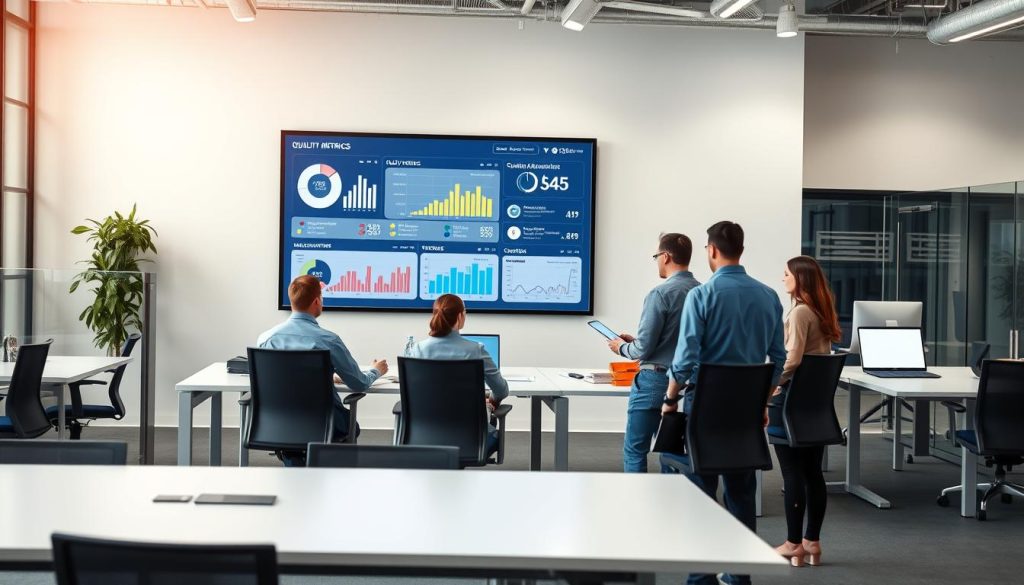
Our experience confirms that 59% of manufacturers now leverage AI-powered systems to maintain consistent product quality. This widespread adoption demonstrates the measurable business value automation technology delivers.
We help organizations achieve substantial cost savings through reduced labor requirements and minimized material waste. Simultaneously, enhanced product quality strengthens customer loyalty and enables premium pricing strategies.
Operational efficiency improves dramatically with real-time monitoring and 24/7 automated inspection capabilities. These systems also simplify regulatory compliance through comprehensive documentation and traceability.
The data insights generated extend beyond immediate quality control applications. They drive innovation in product development and reveal subtle process improvement opportunities.
Through strategic optimization of your quality systems, we help position your business to thrive amid evolving industry standards. This approach ensures consistent product quality while maximizing operational efficiency.
Conclusion
The strategic implementation of advanced visual inspection represents a fundamental shift in modern manufacturing excellence, moving beyond traditional quality control to create sustainable competitive advantages through precision and automation.
Our extensive experience across diverse sectors confirms these systems deliver measurable returns through superior defect detection accuracy and operational efficiency. Successful adoption requires thoughtful integration with existing processes and comprehensive personnel training.
The resulting data extends beyond immediate quality decisions, providing valuable insights for continuous improvement. This positions your business for sustained growth in today’s technology-driven landscape.
We remain committed to helping manufacturers harness this transformative potential, reducing operational burdens while enabling data-driven excellence that distinguishes industry leaders.
FAQ
How does this technology improve product quality control?
Our systems utilize advanced cameras and software to detect minute defects with exceptional accuracy. This automation ensures consistent adherence to quality standards throughout the manufacturing process.
What industries benefit most from these inspection systems?
We serve a wide range of sectors including automotive, electronics, and food production. Any industry requiring high precision in component assembly and product integrity gains significant advantages.
Can these solutions integrate with existing production processes?
A>Absolutely. Our team specializes in seamless integration, ensuring that new inspection technologies work harmoniously with your current equipment. We focus on enhancing efficiency without disrupting workflow.
What role does deep learning play in defect detection?
Deep learning algorithms enable our systems to identify complex patterns and anomalies that traditional methods might miss. This technology continuously improves detection capabilities over time.
How does cloud integration support quality assurance?
Cloud-based data management allows for real-time monitoring and analysis across multiple production lines. This provides valuable insights for process optimization and maintains comprehensive quality records.
What training is required for operating these vision systems?
We provide comprehensive training and ongoing support to ensure your team can effectively manage the technology. Our user-friendly interfaces simplify daily operations and data interpretation.
Author
Praveena Shenoy
- Country Manager, Opsio
Praveena Shenoy is the Country Manager for Opsio India and a recognized expert in DevOps, Managed Cloud Services, and AI/ML solutions. With deep experience in 24/7 cloud operations, digital transformation, and intelligent automation, he leads high-performing teams that deliver resilience, scalability, and operational excellence. Praveena is dedicated to helping enterprises modernize their technology landscape and accelerate growth through cloud-native methodologies and AI-driven innovations, enabling smarter decision-making and enhanced business agility.