What if you could spot manufacturing flaws before they become costly problems? In the demanding world of steel production, the ability to detect imperfections early is the difference between profit and loss. Traditional inspection methods often miss critical issues that emerge during the initial casting phase.
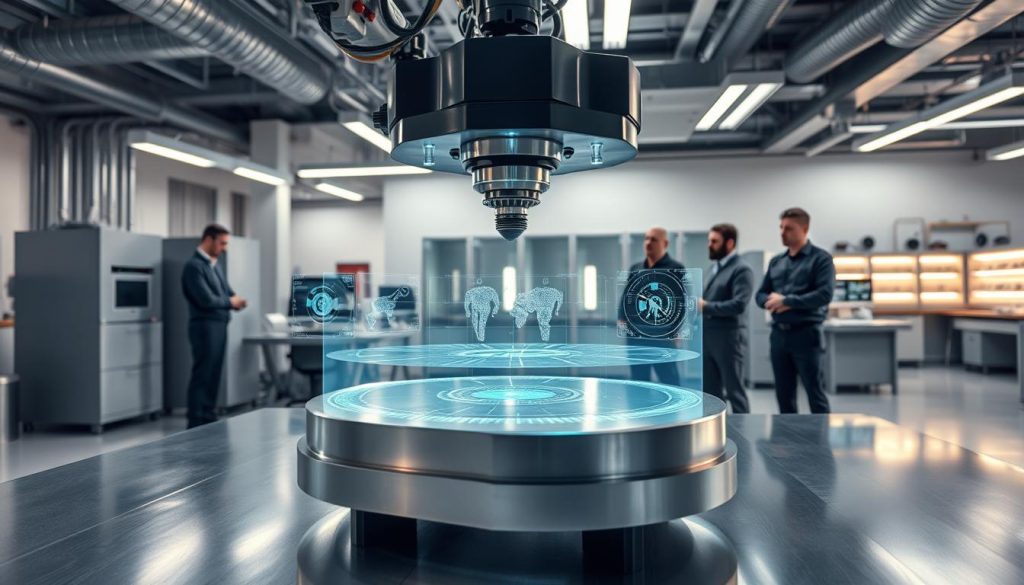
We understand that up to 60% of quality-relevant imperfections originate at the slab casting stage. These hidden issues frequently go unnoticed until later production phases, where correction becomes exponentially more expensive and disruptive to your operations. This gap in early detection represents a significant challenge for manufacturers striving for excellence.
That’s where advanced technological solutions come into play. By leveraging artificial intelligence and sophisticated imaging, we can now identify these production anomalies with unprecedented accuracy. This approach transforms how manufacturers maintain product integrity throughout the manufacturing process.
Our integrated approach combines deep industry knowledge with cutting-edge analytical capabilities. We provide the tools to catch problems at their source, enabling proactive quality management rather than reactive damage control. This shift in methodology empowers businesses to achieve new levels of operational efficiency and product reliability.
Key Takeaways
- Early detection of manufacturing imperfections prevents costly downstream issues
- Advanced imaging technology provides superior accuracy over manual methods
- Proactive quality management enhances overall operational efficiency
- AI-driven solutions offer scalable inspection capabilities
- Integrated systems help maintain consistent product quality standards
- Technological innovation transforms traditional manufacturing processes
Overview of AI-Driven Slab Surface Inspection
Manufacturing excellence now hinges on the ability to identify production anomalies instantly. We’ve developed sophisticated inspection systems that leverage artificial intelligence to transform quality assurance in industrial settings.
Innovative Approach to Defect Detection
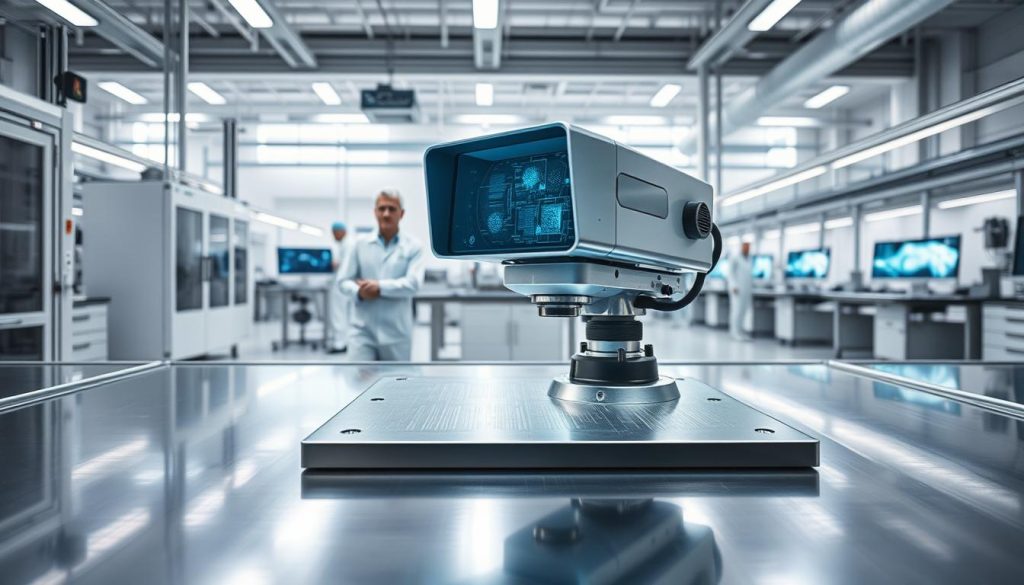
Our technology employs a dual-method architecture combining 2D imaging with 3D laser triangulation. This powerful combination enables comprehensive analysis of material conditions.
The inspection process captures both surface-level variations and depth-critical information. This multi-dimensional approach ensures no imperfection goes unnoticed.
Real-Time Data and Automated Classification
Instant data processing allows for immediate identification of quality issues. Our systems generate actionable information as materials move through production lines.
Automated classification technology categorizes findings by type and severity. This supports continuous process improvement and product traceability.
For comprehensive insights into industrial automation, explore our detailed steel industry machine vision system resource.
Key Features and Benefits of the Vision System
By integrating two distinct imaging methods, we achieve a level of detail that single-mode systems cannot match. This powerful combination allows for a complete analysis of material conditions.
2D/3D Imaging and Laser Triangulation
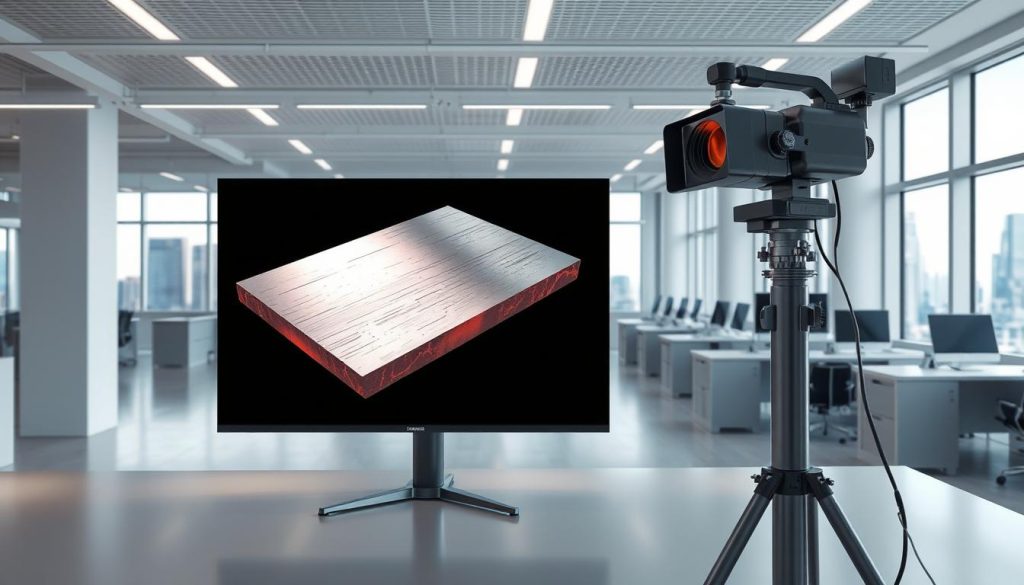
Our technology employs parallel 2D and 3D sensors. The 2D component identifies contrast-based anomalies, while laser triangulation provides precise topographical data.
This dual approach captures both superficial marks and critical depth information. It ensures comprehensive flaw characterization for accurate remediation strategies.
Cloud Integration and Improved ROI
Seamless cloud connectivity transforms inspection data into accessible business intelligence. This supports process optimization and cross-facility benchmarking.
The result is a rapid return on investment. Cost efficiency is achieved through early filtering of substandard products and a significant reduction in rework.
Enhanced Quality Control and Waste Reduction
Real-time feedback enables immediate corrective actions, such as automatic grinder adjustment. This precision directly minimizes material waste.
Key operational benefits include:
- Reliable detection of flaws under extreme production conditions.
- Inline measurement of dimensions for improved downstream handling.
- Consistent final product quality and enhanced operational performance.
Industrial Applications of Slab Surface Defect Vision System
Partnerships with industry leaders like Hyundai Steel and Shandong Steel validate the operational benefits of automated surface monitoring. These collaborations demonstrate how our technology integrates seamlessly into demanding manufacturing environments, providing a foundation for continuous improvement.
Integration with Production Lines and Process Optimization
We deploy our technology across the entire steel manufacturing chain. This provides comprehensive quality coverage from liquid steel to finished products.
The key stages of application include:
- Continuous Casting: Monitoring begins as material first solidifies, capturing quality at its origin.
- Hot Rolling Mills: The solution performs reliably under extreme heat and mechanical stress.
- Cold Rolling and Finishing: Even subtle imperfections are detected, ensuring final product excellence.
As Li Fuping, Technical Director at Shandong Steel, notes, this integration provides “meaningful information to address defect causes and optimize our processes,” leading to improved product quality and increased production capacity.
Adaptability Under Extreme Temperatures and Conditions
Our heavy-duty sensor design ensures stable performance in challenging environments. The equipment handles high temperatures, vibration, and scale without compromising accuracy.
Real-time inspection occurs at full line speed, providing immediate data for decision-making. Specialized software tracks repeating marks, linking them to specific rolls for predictive maintenance.
Tae Soo Moon from Hyundai Steel highlights the “proactive support” and “continuous innovation” that make this robust system a valuable partner for achieving manufacturing excellence.
Conclusion
Forward-thinking manufacturers now recognize that comprehensive inspection solutions deliver substantial competitive advantages. This strategic approach transforms traditional quality control into a value-generating capability that directly enhances operational performance.
Recent research, including findings from advanced detection models, demonstrates how automated inspection achieves remarkable accuracy while maintaining real-time performance. This technological improvement delivers measurable returns through reduced material waste and optimized process efficiency.
We partner with manufacturers to implement these intelligent systems, ensuring they achieve superior product quality while minimizing operational cost. Our collaborative approach focuses on sustainable improvement and long-term competitive advantage.
The integration of sophisticated inspection technology represents more than just a technical solution—it’s a fundamental shift toward manufacturing excellence. By leveraging actionable data and advanced detection capabilities, businesses can achieve unprecedented levels of product consistency and customer satisfaction.
FAQ
How does this inspection technology improve our production quality?
Our technology leverages advanced imaging and artificial intelligence to automatically identify imperfections in real-time. This allows for immediate feedback and corrective actions during the manufacturing process, significantly enhancing the final product’s surface quality and consistency while reducing material waste.
What types of defects can the system detect on hot slabs?
The vision system is engineered to identify a wide array of imperfections, including cracks, scratches, and scale marks. It performs reliably even under the extreme temperatures typical of hot production lines, ensuring comprehensive quality control from the earliest stages.
Can the system be integrated into our existing production line?
A>Yes, our solution is designed for seamless integration with current industrial automation and control systems. We focus on a straightforward installation process that minimizes disruption to your operations while maximizing performance and data connectivity for process optimization.
What is the return on investment for implementing this quality control solution?
The investment yields a strong ROI through multiple channels. You will see reduced costs associated with waste, lower manual inspection labor, and decreased downtime. More importantly, it leads to a superior, more consistent product, enhancing your market reputation and customer satisfaction.
How does the cloud integration feature benefit our operation?
Cloud connectivity enables centralized data management and analysis from any location. This provides your team with actionable insights into production trends and defect rates, supporting continuous improvement initiatives and informed decision-making for long-term operational efficiency.
Author
Praveena Shenoy
- Country Manager, Opsio
Praveena Shenoy is the Country Manager for Opsio India and a recognized expert in DevOps, Managed Cloud Services, and AI/ML solutions. With deep experience in 24/7 cloud operations, digital transformation, and intelligent automation, he leads high-performing teams that deliver resilience, scalability, and operational excellence. Praveena is dedicated to helping enterprises modernize their technology landscape and accelerate growth through cloud-native methodologies and AI-driven innovations, enabling smarter decision-making and enhanced business agility.