What if the biggest obstacle to improving your mining operation’s efficiency isn’t your equipment, but the very way you classify your raw material? For too long, the industry has relied on methods that provide an incomplete picture, leading to costly inconsistencies and unpredictable processing behavior.
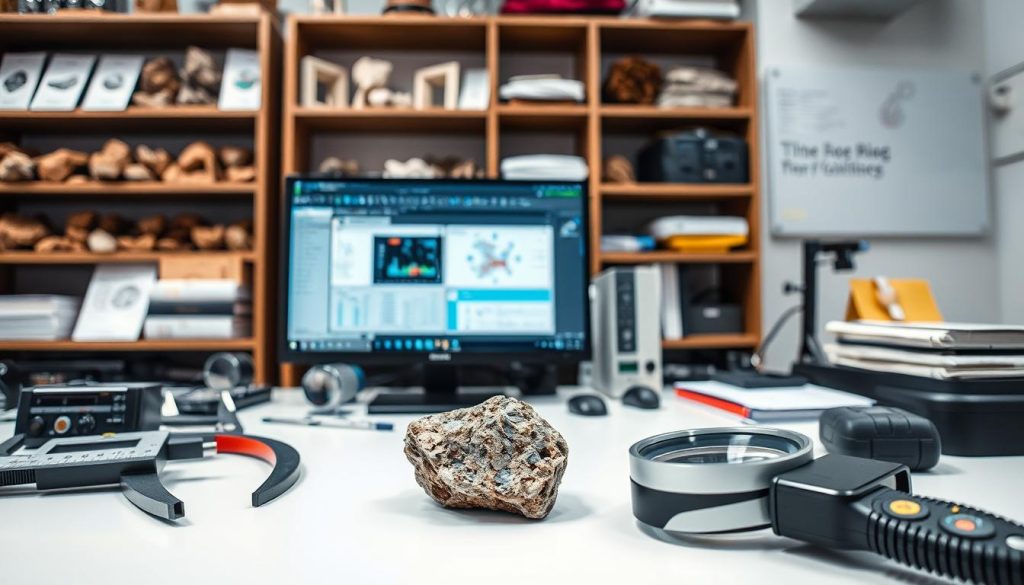
We understand the persistent challenges mining companies face. Subjective classification methods can vary between personnel and shifts, creating quality issues that ripple through the entire value chain and impact profitability. Relying solely on chemical analysis often misses critical textural characteristics that directly influence how material behaves during processing.
This guide introduces a transformative approach that moves beyond traditional chemistry-only methods. We provide a comprehensive framework for optimizing processing efficiency and product quality. Our collaborative method combines technological adoption with organizational change management, ensuring sustainable operational improvements.
Key Takeaways
- Move beyond traditional chemistry-only classification for a more complete material understanding.
- Address challenges like unpredictable processing behavior and subjective classification methods.
- Gain critical insights into textural characteristics that chemical analysis misses.
- Achieve objective, repeatable classification that correlates with physical performance.
- Implement a framework that combines technology with organizational practices for lasting results.
- Drive measurable improvements in efficiency, material handling, and final product quality.
Understanding Ore Grade Visual Inspection
Many operations focus heavily on chemical composition as the primary measure of resource quality. This singular focus, however, often overlooks critical physical attributes that dictate how material behaves during processing. We see that classifying resources by chemistry alone creates a significant gap in predicting their actual performance.
A more complete understanding integrates mineral phase proportions and textural characteristics. These factors directly influence flowability and hardness, which are vital for efficient material handling.
The Role of Ore Classification in Mining Efficiency
Comprehensive classification serves as the bedrock of operational efficiency. It moves beyond simple grade determination to create a reliable framework. This framework helps predict how resources will perform throughout the entire value chain.
Current practices often depend on subjective assessments, leading to inconsistencies. Standardized protocols are essential. They ensure that classification remains accurate and repeatable across different shifts and locations.
This approach directly addresses challenges like unpredictable behavior in downstream processes. It provides a clear link between initial assessment and final product quality.
Key Benefits of Implementing Visual Inspection
Adopting systematic visual inspection methods yields substantial advantages. Organizations gain the ability to foresee processing behavior with greater accuracy. This proactive management minimizes disruptions and enhances overall productivity.
Key benefits include improved material handling efficiency and a significant reduction in operational downtime. Furthermore, it helps minimize the generation of ultrafines, which represent economic losses.
By linking chemistry, mineralogy, and process performance, companies can achieve more consistent results. For a deeper dive into advanced techniques, explore how optical image analysis is revolutionizing this field.
Incorporating Texture Analysis and Data Analytics
Beyond elemental analysis lies a critical dimension that determines processing success: the intricate physical architecture of mining resources. We integrate texture characterization to bridge the gap between chemical composition and actual operational performance.
How Ore Texture Impacts Processing Performance
Texture characterization examines mineral phase proportions, porosity amount, and distribution patterns. This detailed analysis reveals why materials with identical chemistry can behave differently during processing.
Variations in structural characteristics directly influence flowability, hardness, and grinding efficiency. These differences can cause bottlenecks, unplanned downtime, and excessive ultrafine generation that reduces recovery rates.

Leveraging Data for Effective Material Handling
We transform raw textural information into actionable insights through advanced data analytics. Machine learning algorithms analyze relationships between texture parameters and processing outcomes.
This approach enables predictive modeling that optimizes material handling protocols. Organizations gain the ability to anticipate performance issues before they disrupt operations, ensuring consistent product quality.
Utilizing Optical Image Analysis for Process Optimization
When consistency and objectivity become critical success factors, automated image analysis emerges as the definitive solution. We leverage cutting-edge optical systems that transform how mining operations characterize their materials, delivering unprecedented accuracy across diverse operational environments.
Overview of Mineral4/Recognition4 Optical Image Analysis
Our approach centers on the Mineral4/Recognition4 system, built upon advanced Zeiss microscopy platforms. This sophisticated technology provides comprehensive mineralogical analysis whether deployed on-site or in laboratory settings.
The system delivers detailed output including particle size distribution, mineral liberation characteristics, and complete textural classification. This method captures critical information about porosity and mineral associations that traditional approaches often miss.
Enhancing Objectivity with Automated Mineral Identification
Automated identification eliminates the subjectivity inherent in manual characterization techniques. Where human inspection varies with experience and conditions, our system maintains consistent accuracy across all assessments.
This analytical method adapts to various material types and sizes, from fine particles to larger fragments. The resulting analysis provides reliable data that directly informs processing decisions and quality control measures.
Advanced Techniques in Sensor Calibration and Automated Inspection
The challenge of maintaining sensor accuracy in harsh mining environments requires sophisticated solutions. We address the critical issue of offline or miscalibrated instruments that undermine effective process control.
Integrating Real-Time Sensor Data in Harsh Environments
Advanced sensor technologies like X-ray fluorescence and gamma-ray systems provide the foundation for automated analysis. These instruments face constant challenges from dust, vibration, and temperature extremes.
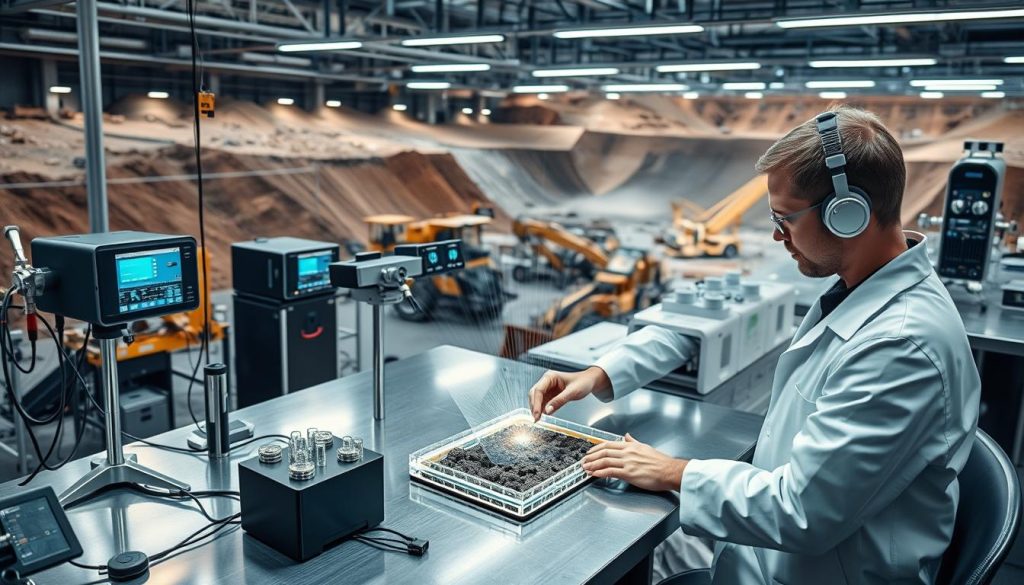
Integrating real-time data into plant control systems enables dynamic monitoring as materials move through processing circuits. This provides operators with immediate feedback for proactive adjustments.
Overcoming Calibration Challenges with Machine Learning
Machine learning algorithms analyze patterns in sensor data over time, identifying performance drift automatically. They adjust calibration parameters to maintain measurement accuracy despite changing conditions.
These systems continuously improve by learning relationships between sensor readings and laboratory results. They compensate for systematic biases and provide confidence estimates for verification needs.
Optimizing Grading and Gauging Processes for Consistency
Managing material variability represents a significant challenge for consistent grading processes. Natural fluctuations in composition and particle size affect sensor readings and processing performance.
Optimization demands systematic approaches including representative sample collection and statistical process control methods. Automation technologies reduce reliance on manual checks while providing continuous monitoring.
Implementing Best Practices in Mining Operations
The successful integration of new characterization technologies into mining operations requires careful planning and skilled personnel. We focus on building organizational capabilities through structured implementation approaches.
Practical Steps for Integration and Training
Our implementation process begins with a comprehensive assessment of current classification methods. We identify pain points where existing practices create inconsistencies in material understanding.
Cross-functional collaboration brings together geologists, metallurgists, and quality control personnel. This team approach ensures all perspectives contribute to process improvement.
Training programs represent critical success factors for sustainable development. We provide different support levels based on organizational roles and responsibilities.
>
| Training Approach |
Target Audience |
Key Benefits |
Implementation Timeline |
| Hands-on Equipment Training |
Technical Staff |
Immediate operational competence |
2-4 weeks |
| Data Interpretation Workshops |
Supervisory Personnel |
Improved decision-making |
4-6 weeks |
| Strategic Planning Sessions |
Management Teams |
Long-term productivity gains |
Ongoing |
We recommend staged technology deployment starting with pilot implementation. This approach minimizes operational disruption while demonstrating value.
Quality control procedures must evolve to incorporate new characterization information. Updated specifications account for textural parameters alongside traditional metrics.
Establishing feedback mechanisms creates continuous improvement cycles. Processing plant performance data informs mine planning practices, enhancing overall industry standards.
Conclusion
Our journey through this guide confirms that true mining efficiency demands a holistic view of material characteristics. We have shown that integrating advanced analysis with real-time monitoring creates a powerful system for operational excellence.
This transformation delivers measurable benefits, from predicting material behavior to ensuring consistent product quality. It allows for optimized handling across the entire particle size range.
Successful adoption requires a commitment to technology, training, and process evolution. We stand ready to support your organization in this journey.
By embracing these integrated methods, you position your operation for sustained performance improvements and a significant competitive advantage.
FAQ
How does visual classification improve mining productivity?
Our approach enhances productivity by providing immediate data on material composition. This real-time analysis allows for better decision-making in processing streams, directly boosting operational throughput and reducing waste.
What advantages does automated analysis offer over manual methods?
Automated systems deliver superior objectivity and consistency, eliminating human error. They process information continuously, supporting higher levels of quality control and enabling more reliable performance across operations.
Can these techniques handle variability in material samples?
Yes, advanced technology is designed to manage natural variability. By leveraging machine learning, our systems adapt to changing conditions, ensuring accurate evaluation and consistent output regardless of material differences.
How does real-time monitoring impact process control?
Continuous monitoring delivers instant feedback, allowing for immediate adjustments. This proactive support helps maintain optimal processing conditions, improving overall efficiency and product quality.
What role does data analytics play in material handling?
Analytics transform raw information into actionable insights. This deep understanding of material properties enables smarter handling strategies, optimizing flow and reducing bottlenecks in the production chain.
Are these methods suitable for harsh mining environments?
Absolutely. Our robust systems are engineered to perform reliably in challenging conditions. They provide critical support for grading and gauging processes, ensuring consistent results even in demanding settings.
Author
Praveena Shenoy
- Country Manager, Opsio
Praveena Shenoy is the Country Manager for Opsio India and a recognized expert in DevOps, Managed Cloud Services, and AI/ML solutions. With deep experience in 24/7 cloud operations, digital transformation, and intelligent automation, he leads high-performing teams that deliver resilience, scalability, and operational excellence. Praveena is dedicated to helping enterprises modernize their technology landscape and accelerate growth through cloud-native methodologies and AI-driven innovations, enabling smarter decision-making and enhanced business agility.