What if you could eliminate human error from your production line, while speeding up inspections and cutting costs? This is not a distant dream but a practical reality for manufacturers who embrace advanced technology. We see how modern solutions are transforming the landscape of quality assurance.
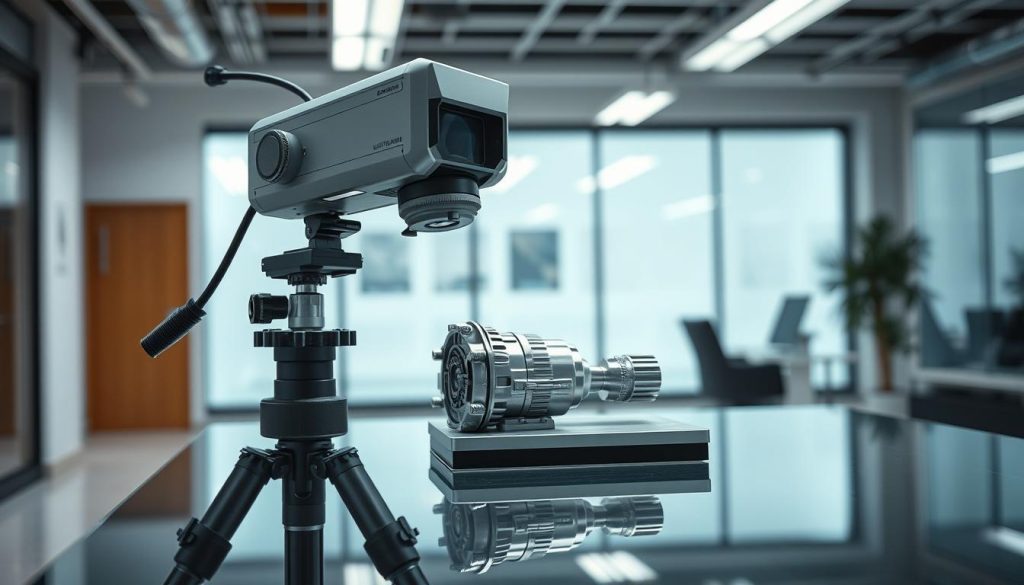
In today’s competitive market, achieving flawless product quality is non-negotiable. Industries like aerospace, automotive, and medical devices rely on extreme accuracy. A single micron can mean the difference between success and failure. This is where powerful tools come into play.
These technologies use high-resolution cameras and smart software to capture and analyze parts without contact. They protect delicate components while gathering precise data. This approach not only ensures integrity but also provides immediate feedback. Manufacturers can make real-time adjustments, preventing defects before they escalate.
Adopting these advanced inspection solutions leads to significant operational benefits. You can reduce inspection times, minimize errors, and collect valuable data. This supports continuous improvement and helps maintain strict compliance standards. Ultimately, it builds a foundation for sustained growth and customer trust.
Key Takeaways
- Advanced inspection technologies replace manual methods, boosting accuracy and efficiency.
- They are vital in industries where minute tolerances impact safety and performance.
- Non-contact inspection preserves delicate parts and ensures data integrity.
- Real-time feedback allows for immediate corrections, enhancing process control.
- These systems reduce operational costs and support continuous improvement.
- They help companies meet stringent quality standards and customer expectations.
Introduction to Dimensional Measurement Vision Systems
The evolution of industrial inspection has reached a pivotal point where optical technologies deliver accuracy previously unimaginable. We define these sophisticated solutions as advanced technological platforms that employ high-resolution imaging to quantify physical attributes without contact. This approach ensures exceptional precision, particularly in sectors where micron-level deviations can compromise product integrity.
These platforms utilize high-resolution cameras, specialized sensors, and analytical software to capture detailed images and extract precise data from components. Manufacturers can verify that parts meet exact specifications with confidence. The technology examines maximum and minimum sizes, inner and outer diameters, roundness, angles, edge positions, and various geometric features.
Non-contact inspection methods excel at measuring intricate geometries and tight tolerances essential for complex components. Recent advancements in micro-feature characterization have improved measurement uncertainties by over 20%. This demonstrates the transformative potential of automation in industrial processes.
The ability to measure multiple attributes simultaneously represents a significant productivity advantage. Compared to traditional manual methods that required substantial time and effort, modern solutions dramatically reduce downtime. This efficiency makes comprehensive inspection practical where it was previously challenging to implement.
| Inspection Method |
Traditional Manual |
Modern Optical |
| Measurement Speed |
Slow, sequential |
Fast, simultaneous |
| Accuracy Level |
Human-dependent |
Consistent, micron-level |
| Data Collection |
Limited, manual recording |
Comprehensive, automated |
| Complex Geometry Handling |
Challenging |
Excellent capability |
Beyond simple pass/fail judgments, these tools provide numerical data for accurate dimensions across multiple sections. This enables effective data management for traceability and continuous improvement initiatives. The combination of speed, precision, and data intelligence creates a foundation for superior quality control in modern manufacturing environments.
Fundamentals of Machine Vision and Image Processing
At the heart of modern industrial inspection lies a powerful trio of technologies working in concert. We see how cameras, sensors, and software create a seamless workflow for capturing and analyzing part details. This collaboration forms the backbone of reliable digital inspection processes.
Understanding Cameras, Sensors, and Software
High-resolution cameras capture detailed images that form the foundation for analysis. Line-scan cameras are perfect for inspecting continuous materials like textiles. Area scan systems handle discrete objects with precision.
Specialized sensors, such as 3D profile sensors, detect deviations from design parameters. They measure critical dimensions in demanding applications like aerospace manufacturing. This ensures components meet exact specifications.
Advanced software processes the collected data through sophisticated algorithms. It performs object recognition, defect detection, and measurement analysis. This transforms raw visual information into actionable quality control data.
Core Principles of Digital Measurement
Three fundamental principles guide effective digital inspection: accuracy, repeatability, and efficiency. Accuracy refers to the overall correctness of the results. Repeatability ensures consistent outcomes across multiple inspections.
Efficiency means performing measurements quickly without compromising quality. Technologies like white light interferometry achieve nanometer-scale resolution. CCD technology provides high sensitivity in low-light conditions.
These principles work together to create a robust foundation for industrial quality assurance. They enable reliable judgments about whether measurements fall within specified tolerances.
Implementing a Dimensional Measurement Vision System
The journey toward automated quality assurance begins with a well-planned implementation strategy that aligns with production goals. We guide manufacturers through each step, ensuring smooth integration of advanced inspection technologies.
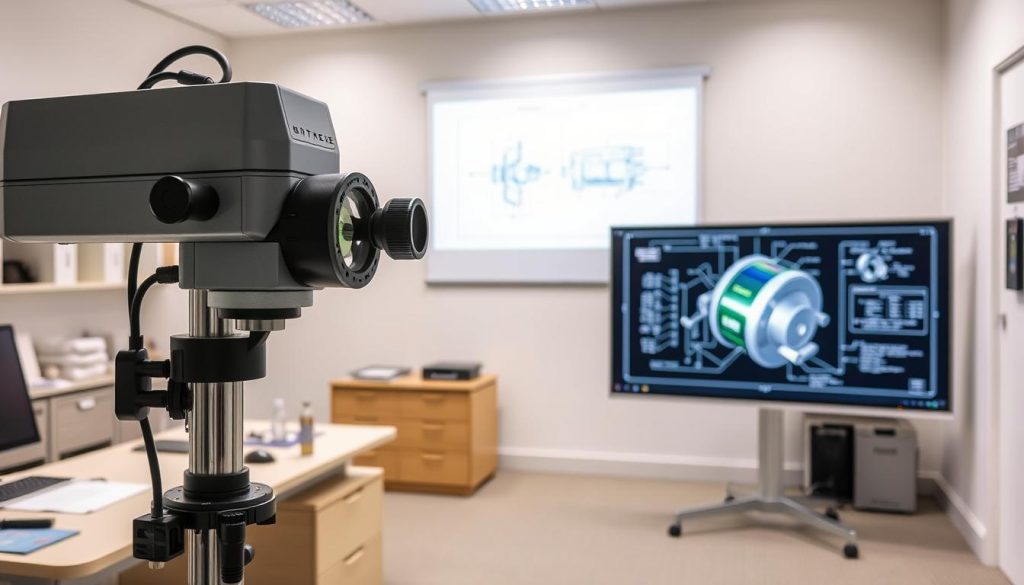
Successful implementation starts by assessing specific requirements. We consider which attributes need verification, required accuracy levels, and inspection speed needs. Environmental conditions and integration with existing infrastructure are equally important.
Modern machine vision solutions like IVS® enable high-speed data capture from images. These platforms make it simple to measure multiple part areas simultaneously. They automatically judge whether results fall within specified tolerances.
Real-time calibration provides high-performance capabilities that are easy to set up. Production teams can configure these tools without extensive technical expertise. Edge detection and contour analysis deliver exact matching for reliable outcomes.
Hardware selection is critical for optimal performance. We help choose cameras with sufficient resolution and appropriate lighting systems. Stable mounting fixtures ensure consistent positioning relative to inspection targets.
Powerful gauging wizards incorporated into these platforms enable sophisticated analysis. They provide sub-pixel precision for reliable data collection. This supports everything from basic geometrical checks to micron-level detection.
Careful consideration of the production environment ensures long-term reliability. Vibration control, temperature stability, and contamination protection maintain consistent operation. This approach delivers trustworthy results throughout extended operational periods.
Optimizing Accuracy with Pixel Resolution and Sub-Pixel Processing
Achieving the highest levels of inspection accuracy depends on a deep understanding of the fundamental relationship between digital images and physical dimensions. This relationship is defined by pixel resolution, which is the actual physical length each pixel represents.
We calculate this critical value using a straightforward formula: Pixel resolution equals the field of view in millimeters divided by the camera’s pixel count in the same direction. For instance, a 2-megapixel camera inspecting a 100mm area delivers a resolution of 0.083 mm per pixel.
This resolution directly determines the finest detail the system can resolve. It also forms the basis for setting practical tolerance thresholds, which are typically calculated in units of ±5 pixels to ensure stable judgment.
Calculating Pixel Resolution and Tolerance
The choice of camera and field of view directly impacts potential accuracy. A higher megapixel count yields a finer resolution, allowing for tighter tolerances. This enables manufacturers to select components that match their specific quality control requirements precisely.
Using the resolution value, we determine the actual dimensional tolerance in millimeters. This practical approach ensures that the inspection process is both reliable and repeatable, providing a solid foundation for pass/fail decisions.
Benefits of Sub-Pixel Edge Detection
While pixel resolution sets a baseline, sub-pixel processing dramatically enhances precision. This advanced technique performs calculations in units smaller than a single pixel. It analyzes the transition between light and dark areas to find edges with exceptional accuracy.
The system converts these transitions into waveforms and identifies gradient peaks. By calculating the position within a fraction of a pixel, it achieves high precision that would otherwise require a much higher-resolution camera.
This method is particularly valuable for cost-effective solutions, as it optimizes performance without necessitating a hardware upgrade. It allows businesses to achieve superior results from their existing inspection systems.
Edge Detection Techniques and Their Impact on Measurement Precision
The ability to precisely identify boundaries within digital images represents a critical advancement in automated quality control processes. We employ sophisticated edge detection methodologies that transform visual information into reliable dimensional data.
Differential Processing and Edge Sensitivity
Our approach begins by scanning targets perpendicular to the detection direction. This creates projection waveforms representing intensity transitions across feature boundaries.
Mathematical differentiation then identifies rapid shade changes. Larger differential values indicate potential edge locations. This processing targets the rate of change in pixel intensity values.
The system applies correction to normalize edge strength waveforms. Peaks exceeding specified sensitivity thresholds become confirmed edge points. This method remains unaffected by illumination changes, ensuring consistent results.
Generating Reliable Numerical Data
Final precision enhancement involves calculating waveform characteristics across three pixels. This achieves extraordinary accuracy, measuring edge positions in units of 0.001 pixel.
These techniques provide not only pass/fail judgments but also numerical data of accurate dimensions across multiple sections. The resulting measurement data supports traceability management and process improvement initiatives.
Manufacturers gain comprehensive documentation for compliance and statistical process control. This reliable information foundation enables continuous quality enhancement throughout production cycles.
Industrial Applications and Benefits of Machine Vision Systems
The integration of smart imaging solutions into production workflows delivers unprecedented advantages for quality assurance processes. We see how these technologies transform manufacturing operations across multiple industries.
Enhancing Quality Control in Manufacturing
These optical technologies excel in diverse manufacturing applications. They provide exceptional accuracy for delicate components like semiconductors and thin films. The non-contact approach prevents damage while ensuring precise results.
In automotive production, these solutions inspect complex parts with intricate geometries. They verify critical dimensions without slowing down assembly lines. This maintains consistent product quality throughout high-volume manufacturing.
Another practical example involves capacitor inspection. Advanced imaging divides components into segments for detailed analysis. This enables detection of minute variations in diameter and lead wire alignment.
Real-Time Calibration and Data Recording
Modern optical platforms automatically transmit data to acquisition systems. This enables continuous monitoring and immediate process adjustments. The benefits include reduced downtime and improved operational efficiency.
Automatic data recording provides comprehensive documentation for compliance. Image saving and inspection reporting offer brand protection against potential recalls. This creates a foundation for continuous improvement initiatives.
These technologies help factories achieve higher standards while reducing costs. They eliminate human error and enable rapid response to production changes. The result is enhanced product quality across all manufacturing stages.
Advancements from Manual Gauging to Automated Inspection
Industrial quality assurance has undergone a revolutionary shift from operator-dependent manual techniques to consistent automated processes. We trace this evolution to understand how modern manufacturing achieved unprecedented levels of precision and reliability.
Historical Perspectives on Measurement Methods
Traditional approaches relied heavily on manual gauging with tools like calipers and microgauges. These methods inevitably introduced variability due to operator differences and environmental conditions.
Inspection jigs provided basic pass/fail judgments but lacked numerical data for process improvement. Other historical techniques included optical comparators and profile measurement systems, all sharing common limitations.
These older approaches required substantial time investments and created operational challenges. Full inspection programs incurred significant labor costs, while sampling risked missing defective parts.
| Aspect |
Manual Methods |
Automated Solutions |
| Operator Dependency |
High variability between workers |
Consistent regardless of operator |
| Data Recording |
Limited manual documentation |
Comprehensive automated records |
| Inspection Speed |
Time-consuming processes |
Rapid high-speed assessment |
| Error Rate |
Subject to human error |
Minimal error potential |
The emergence of machine vision systems addressed these historical limitations effectively. Automated inspection now delivers the speed, accuracy, and data intelligence that modern production demands.
Enhancing Efficiency with Non-Contact Inline Inspection Methods
Inline inspection represents a fundamental shift in how manufacturers approach quality assurance, integrating verification seamlessly into production processes. This approach eliminates the traditional bottleneck of offline sampling.
We see how this methodology transforms quality control from an interruption to an integrated component of manufacturing. It ensures continuous monitoring without disrupting workflow.
Automation and Reduced Downtime
The automation advantage of inline inspection is transformative. These technologies capture images and extract data automatically, eliminating manual intervention. This reduces human error and increases consistency.
By integrating directly into production lines, these solutions dramatically cut downtime. There’s no need to remove components for offline assessment. Real-time feedback enables immediate corrections.
| Inspection Aspect |
Traditional Offline |
Modern Inline |
Efficiency Gain |
| Inspection Time |
Minutes per part |
Seconds per part |
80-90% reduction |
| Production Stoppage |
Frequent and lengthy |
Minimal to none |
Near elimination |
| Data Availability |
Delayed reporting |
Real-time feedback |
Immediate action |
These platforms measure multiple parameters simultaneously. Angles, roundness, and lengths are assessed in a single cycle. This comprehensive approach provides complete part verification.
The speed of modern inspection technologies matches high-volume production rates. They maintain precision while keeping pace with manufacturing demands. This creates a true efficiency multiplier effect.
Integrating Vision Systems Within Modern Production Lines
Modern production environments demand interconnected quality monitoring that flows with the manufacturing rhythm rather than interrupting it. We help manufacturers embed automated inspection directly into their workflows, creating a seamless quality assurance process.
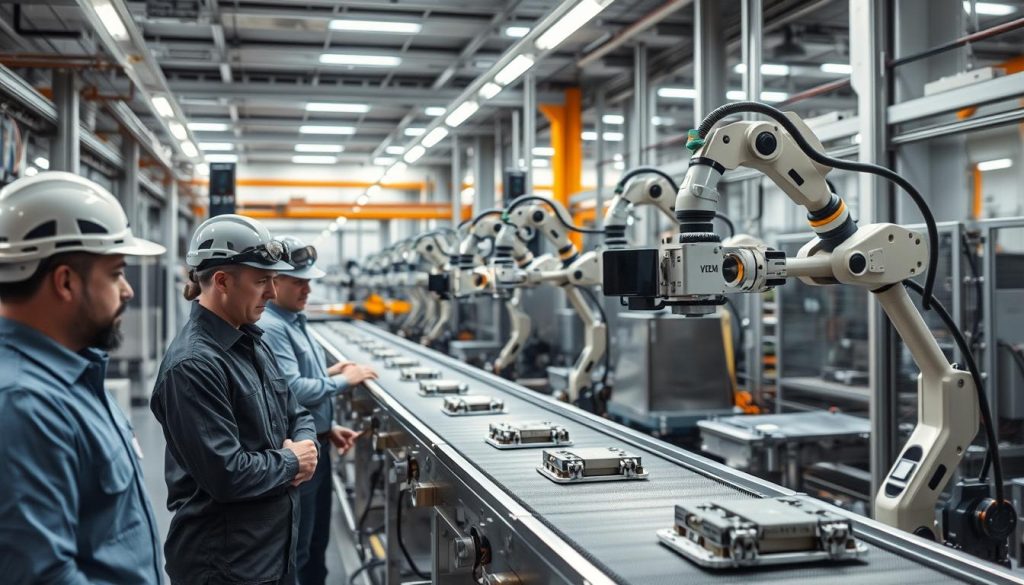
Robots equipped with inline inspection capabilities provide immediate feedback during manufacturing operations. This approach dramatically improves testing efficiency and enables real-time corrective actions.
Data Acquisition and Statistical Process Control
Our solutions capture comprehensive data automatically, eliminating manual recording errors. This information flows directly into statistical process control (SPC) tools for continuous analysis.
Manufacturers can track trends over time and identify process drift before tolerances are exceeded. The system calculates capability indices like Cp and Cpk, enabling data-driven improvements.
Industry 5.0 and IIoT trends highlight the need for flexible measurement platforms. These technologies integrate artificial intelligence and analytics to optimize outcomes.
Traceability and Inspection Reporting
Automatic data recording provides complete documentation for compliance and audits. Image saving and inspection reporting offer protection against complaints or recalls.
All measurement information can be saved to factory information systems or SQL databases. This supports both immediate traceability management and long-term process enhancement.
Such comprehensive data serves dual purposes: regulatory compliance and continuous quality improvement. Manufacturers gain insights that drive systematic enhancements across their operations.
Conclusion
In today’s competitive manufacturing landscape, we recognize that advanced optical inspection technologies have become essential tools for achieving operational excellence. These solutions represent a significant evolution from traditional manual methods, offering unprecedented levels of accuracy and consistency.
The fundamental advantages are clear: non-contact operation protects delicate components, sub-pixel processing enables micron-level precision, and inline integration eliminates production bottlenecks. Automation ensures consistent results while comprehensive data collection supports continuous improvement initiatives.
Successful implementation requires careful consideration of specific application needs, but the resulting benefits in quality enhancement and cost reduction justify investment across all manufacturing sectors. From automotive to medical devices, companies increasingly rely on these technologies to meet stringent tolerances and regulatory requirements.
We encourage manufacturers to view these solutions as strategic investments that deliver superior products while optimizing operational efficiency. As Industry 5.0 and IIoT trends continue to evolve, establishing this foundational infrastructure now ensures future competitiveness in global markets.
FAQ
How do these systems enhance manufacturing quality control?
Our systems enhance manufacturing quality control by providing non-contact, high-speed inspection capabilities. They automate the detection of defects and deviations in product dimensions, ensuring consistent quality. This automation reduces human error and increases throughput.
What role does pixel resolution play in measurement accuracy?
Pixel resolution is fundamental to measurement accuracy. It determines the smallest detectable feature on a part. Higher resolution allows for finer detail capture, which is critical for precise dimensional analysis and reliable data.
Can these systems integrate with existing production lines?
A>Yes, our vision systems are designed for seamless integration with existing production lines. They support various communication protocols for real-time data exchange. This facilitates immediate feedback and process adjustments.
What are the benefits of sub-pixel edge detection?
Sub-pixel edge detection significantly improves measurement precision beyond the limits of a single pixel. This technique provides more accurate positioning of edges, leading to higher repeatability in inspection tasks.
How does automation impact production efficiency?
Automation through machine vision drastically increases production efficiency by enabling continuous, inline inspection. It minimizes manual intervention, reduces downtime, and accelerates the entire manufacturing process.
What industries benefit most from these inspection solutions?
Industries such as automotive, electronics, and pharmaceuticals benefit greatly. These sectors require stringent quality standards and benefit from the high precision and reliability of automated inspection.
How is data handled for traceability and reporting?
Our systems capture and store comprehensive inspection data, supporting full traceability. This data can be used for detailed reporting, statistical process control, and compliance with industry regulations.
What makes non-contact inspection methods advantageous?
Non-contact inspection methods prevent part damage and wear. They allow for high-speed assessment without physical contact, making them ideal for delicate or high-volume production environments.
Author
Praveena Shenoy
- Country Manager, Opsio
Praveena Shenoy is the Country Manager for Opsio India and a recognized expert in DevOps, Managed Cloud Services, and AI/ML solutions. With deep experience in 24/7 cloud operations, digital transformation, and intelligent automation, he leads high-performing teams that deliver resilience, scalability, and operational excellence. Praveena is dedicated to helping enterprises modernize their technology landscape and accelerate growth through cloud-native methodologies and AI-driven innovations, enabling smarter decision-making and enhanced business agility.