

The landscape of modern business is increasingly defined by agility and scalability, largely driven by the adoption of public cloud services. While cloud platforms offer unparalleled opportunities for innovation and rapid deployment, effectively managing their associated expenses is a critical challenge. Public cloud cost optimization is not merely about cutting costs; it's about maximizing value and ensuring every dollar spent contributes efficiently to business goals.
This comprehensive guide will explore the strategies, tools, and best practices essential for achieving significant and sustainable public cloud cost optimization. We will delve into understanding your cloud spend, implementing effective optimization techniques, and fostering an organizational culture that prioritizes efficiency. Whether you're seeking AWS cost savings, Azure spending optimization, or GCP cost reduction strategies, this guide provides actionable insights for every cloud journey.
The Imperative of Public Cloud Cost Optimization
Public cloud environments offer incredible flexibility, but without careful management, costs can quickly escalate beyond expectations. Many organizations initially migrate to the cloud for perceived savings, only to find their public cloud expenses growing rapidly. This often stems from a lack of visibility and proactive governance over resource consumption.
Effective public cloud cost optimization is crucial for maintaining profitability and reinvesting in further innovation. It directly impacts your bottom line, freeing up capital that can be allocated to strategic projects rather than wasted on underutilized or misconfigured resources. Achieving the best public cloud cost optimization is an ongoing process requiring dedication and continuous review.
Ignoring the complexities of cloud billing models can lead to significant financial leakage and hinder your overall digital transformation efforts. Proactive management ensures that cloud resources are always aligned with actual business needs and performance requirements. This guide serves as a practical public cloud cost optimization guide to help you navigate these challenges effectively.
Understanding Your Cloud Footprint and Spend
Before you can optimize, you must first understand exactly where your cloud budget is going. Cloud billing can be complex, involving numerous services, regions, and pricing models that fluctuate based on usage patterns. Gaining comprehensive visibility into your current cloud footprint is the foundational step toward any successful public cloud cost optimization strategy.
Many organizations struggle with identifying idle resources, orphaned snapshots, or underutilized virtual machines. These forgotten assets often silently accumulate charges, contributing to unnecessary public cloud expenses. A clear picture of your entire infrastructure is non-negotiable for informed decision-making.
This initial phase involves not just reviewing invoices but deeply analyzing consumption patterns across all your cloud providers. Understanding peak usage times versus idle periods helps to pinpoint areas ripe for optimization. This detailed insight forms the bedrock of any successful public cloud budgeting initiative.
Leveraging Cloud-Native Tools for Visibility
Each major cloud provider offers powerful tools designed to help you monitor and manage your spending. Utilizing these native capabilities is often the most direct path to gaining initial insights into your cost structure. They provide detailed breakdowns and forecasting functionalities.
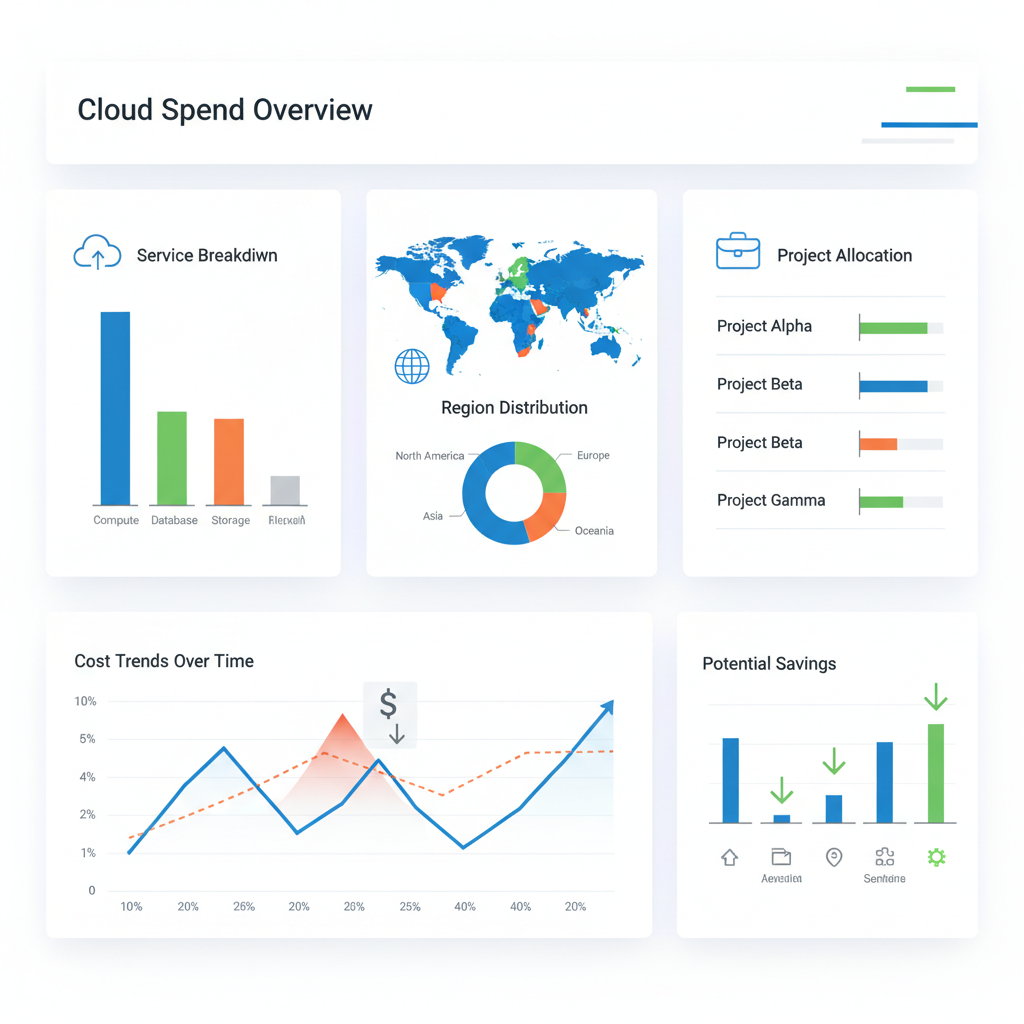
AWS Cost Explorer, Azure Cost Management and Billing, and GCP Cost Management are prime examples of these invaluable platforms. They allow users to visualize spend trends, set budgets, create alerts, and analyze costs by service, region, or custom tags. Effective use of these tools is a cornerstone of managing public cloud expenses.
Implementing a robust tagging strategy is equally critical for attributing costs to specific projects, departments, or environments. Consistent tagging allows you to accurately allocate resources and understand spending patterns across different business units, making public cloud budgeting much more precise. Without proper tagging, gaining granular insights into your cloud spend becomes significantly more challenging.
RECOMMENDED FOR YOU
Connect With Opsio
Tell us about your business requirement and let Opsio take care of the rest.
✓ No commitment required
✓ Trusted by experts
Core Strategies for Effective Public Cloud Cost Optimization
Once you have a clear understanding of your cloud spend, you can begin to implement targeted optimization strategies. These approaches encompass a range of technical and operational adjustments designed to reduce waste and enhance efficiency. Applying these public cloud cost optimization tips can yield substantial savings.
The best public cloud cost optimization combines several techniques rather than relying on a single approach. A multi-faceted strategy ensures comprehensive coverage and maximizes potential savings across your entire cloud environment. It's about making smart choices for your specific workloads.
Right-Sizing and De-Provisioning
One of the most impactful strategies for public cloud cost optimization is ensuring your resources are appropriately sized for their actual workloads. Many instances are over-provisioned during deployment, leading to significant waste. Regularly reviewing and right-sizing virtual machines, databases, and other services is essential.
Regularly analyze resource utilization metrics like CPU, memory, and network I/O to identify instances that consistently run below optimal levels. Downsizing these resources to a more appropriate tier can lead to immediate and substantial AWS cost savings, Azure spending optimization, and GCP cost reduction strategies. This process ensures you only pay for what you truly need.
Furthermore, identifying and de-provisioning idle or unused resources is equally crucial. Orphaned storage volumes, stopped instances that are still incurring charges, and old snapshots all contribute to unnecessary public cloud expenses. Implementing automated clean-up routines can significantly reduce this silent drain on your budget.
Utilizing Discount Programs: Reserved Instances and Savings Plans
Cloud providers offer significant discounts for customers willing to commit to a certain level of usage over a period. Reserved Instances (RIs) and Savings Plans (SPs) are excellent examples of these commitment-based pricing models. They offer substantial savings compared to on-demand pricing.
Reserved Instances allow you to reserve compute capacity for 1 or 3 years, offering discounts typically between 30% and 70%. These are ideal for steady-state workloads with predictable resource requirements. Understanding the various RI types and their flexibility is key to maximizing their value.
Savings Plans, introduced by AWS and now with similar offerings from Azure and GCP, provide even greater flexibility. They allow you to commit to a consistent spend amount per hour for 1 or 3 years, covering a broader range of compute services. This approach often simplifies managing public cloud expenses across diverse workloads.
Embracing Spot Instances for Flexible Workloads
For fault-tolerant, flexible, and stateless workloads, Spot Instances (AWS), Azure Spot Virtual Machines, and GCP Spot VMs offer deep discounts on unused cloud capacity. These instances can be significantly cheaper than on-demand instances, sometimes up to 90% less.
The trade-off is that these instances can be interrupted by the cloud provider with short notice if the capacity is needed elsewhere. Therefore, they are best suited for batch processing, rendering, testing environments, and other workloads that can tolerate interruptions. Leveraging Spot Instances is a prime example of advanced public cloud cost optimization examples.
Successfully integrating Spot Instances requires careful architectural design to ensure your applications can gracefully handle interruptions. Tools and services exist to help manage Spot Instance fleets, making them a viable and cost-effective option for specific use cases. This can lead to substantial AWS cost savings.
Optimizing Data Storage and Networking
Data storage and network egress charges can become surprisingly significant components of your cloud bill. Optimizing these areas is another vital aspect of effective public cloud cost optimization. Tiering your data and carefully managing data transfer are key strategies.
Cloud providers offer various storage classes, from "hot" storage for frequently accessed data to "cold" or archival storage for rarely accessed information. Implement data lifecycle policies to automatically move data to less expensive storage tiers as it ages or its access patterns change. This strategy can dramatically reduce storage costs over time.
Network egress, or data transferred out of the cloud provider's network, often incurs higher charges than ingress. Minimize unnecessary data transfers between regions, availability zones, or to the public internet where possible. Utilize Content Delivery Networks (CDNs) for static content to reduce egress charges and improve performance. Carefully planning your network architecture is essential for managing public cloud expenses related to data transfer.
Implementing FinOps for Sustainable Cost Management
FinOps, or Cloud Financial Operations, is an evolving cultural practice that brings financial accountability to the variable spend model of the cloud. It is a collaborative approach that unites finance, technology, and business teams to make data-driven spending decisions. Implementing FinOps is recognized as the best public cloud cost optimization methodology for long-term success.
The FinOps framework emphasizes understanding cloud costs, allocating them appropriately, and continuously optimizing resource usage. It moves beyond simple cost cutting to fostering a culture of ownership and collaboration around cloud spending. This integrated approach is critical for effective public cloud budgeting.
A successful FinOps implementation ensures that everyone in the organization understands the financial impact of their cloud decisions. This collective awareness empowers teams to manage public cloud expenses more effectively and contribute to overall AWS cost savings, Azure spending optimization, and GCP cost reduction strategies. It transforms cloud cost management from a reactive task to a proactive, continuous improvement process.
Establishing Public Cloud Budgeting and Governance
Robust budgeting and governance policies are indispensable for controlling cloud spend. Without clear guidelines and monitoring, costs can easily spiral out of control, even with optimization efforts. Setting boundaries and ensuring compliance are key elements of sustainable public cloud cost optimization.
Implement strict budget alerts and thresholds within your cloud provider's cost management tools. These notifications can proactively warn teams when spending approaches predefined limits, allowing for timely intervention. This proactive approach helps to prevent unexpected spikes in public cloud expenses.
Define and enforce clear policies for resource provisioning, tagging, and de-provisioning. Automation can play a significant role in enforcing these policies, such as automatically shutting down un-tagged resources or flagging non-compliant environments. Strong governance is the backbone of any public cloud cost optimization guide.

Continuous Monitoring and Reporting
Cloud environments are dynamic, with workloads and requirements constantly evolving. Therefore, public cloud cost optimization is not a one-time project but an ongoing process that requires continuous monitoring and regular reporting. Consistent oversight is crucial for identifying new optimization opportunities and ensuring sustained savings.
Establish a cadence for reviewing cost reports and key performance indicators (KPIs) related to cloud spend. These reviews should involve relevant stakeholders from engineering, finance, and business teams. Regular reporting ensures transparency and accountability across the organization.
Leverage advanced analytics and anomaly detection tools to quickly identify unexpected cost spikes or inefficient resource usage. Proactive identification of these issues allows for rapid investigation and remediation, preventing minor problems from escalating into significant public cloud expenses. Benchmarking your cloud spending against industry standards can also provide valuable insights.
Navigating Multi-Cloud Cost Management Challenges
Many enterprises today operate in multi-cloud environments, utilizing services from more than one public cloud provider. While this strategy offers benefits like vendor lock-in avoidance and access to best-of-breed services, it introduces additional complexity to public cloud cost optimization. Multi-cloud cost management requires a unified strategy.
Each cloud provider has its own unique billing models, discount programs, and cost management tools. Juggling these disparate systems can be challenging, making it difficult to gain a holistic view of total cloud spend. This fragmentation often hinders efforts to achieve comprehensive AWS cost savings, Azure spending optimization, or GCP cost reduction strategies.
To effectively manage multi-cloud expenses, organizations often turn to third-party cloud cost management platforms. These tools aggregate data from multiple providers, offering a centralized dashboard for monitoring, reporting, and optimization across your entire multi-cloud footprint. They are indispensable for achieving robust multi-cloud cost management.
Standardizing resource tagging, governance policies, and financial reporting across all cloud providers is paramount. Consistency enables better visibility and control, simplifying the process of attributing costs and optimizing spend across diverse environments. A unified approach is the best public cloud cost optimization strategy for multi-cloud users.
Real-World Public Cloud Cost Optimization Examples
Let's consider a few practical public cloud cost optimization examples that illustrate the impact of these strategies. Many companies have achieved significant savings by applying these public cloud cost optimization tips. These examples highlight the power of proactive management.
One common example involves a software company that reduced its AWS EC2 costs by 40% through aggressive right-sizing and converting suitable workloads to Savings Plans. By analyzing CPU utilization, they identified dozens of instances that could be downgraded without impacting performance, leading to substantial AWS cost savings. This data-driven approach allowed them to precisely match resources to demand.
Another instance involved an organization leveraging Azure spending optimization by implementing automated shutdown schedules for non-production environments. Their development and testing VMs were automatically powered off overnight and on weekends, cutting compute costs by nearly 50% for those specific environments. This simple automation yielded impressive results, significantly reducing their overall public cloud expenses.
A large media firm achieved substantial GCP cost reduction strategies by migrating vast amounts of infrequently accessed archival data from standard storage to cheaper cold storage tiers in Google Cloud Storage. Implementing lifecycle policies automatically moved older files, resulting in a 30% reduction in their monthly storage bill. These real-world examples demonstrate the tangible benefits of diligent public cloud cost optimization.
RECOMMENDED FOR YOU
Connect With Opsio
Tell us about your business requirement and let Opsio take care of the rest.
✓ No commitment required
✓ Trusted by experts
Conclusion: Embracing a Culture of Cloud Cost Efficiency
Achieving effective public cloud cost optimization is an ongoing journey that requires continuous effort, specialized knowledge, and a collaborative organizational culture. It moves beyond simple cost-cutting to intelligent resource management that maximizes value from every cloud dollar spent. By adopting the strategies outlined in this public cloud cost optimization guide, organizations can unlock significant savings and improve their financial agility.
Implementing best public cloud cost optimization practices, from diligent public cloud budgeting to strategic multi-cloud cost management, is crucial for long-term success. Embrace tools, processes, and a FinOps mindset to transform how you manage public cloud expenses. Start your optimization journey today to ensure your cloud investment truly drives innovation and growth, securing substantial AWS cost savings, Azure spending optimization, and GCP cost reduction strategies for years to come.
Opsio provides cloud consulting and managed services to help organizations implement and manage their technology infrastructure effectively.