

Custom computer vision systems bridge the gap between benchmark performance and real-world results by aligning model design with your actual operating conditions. Off-the-shelf solutions rarely account for the lighting variation, occlusion, and image quality challenges that define production environments in logistics, retail, healthcare, and manufacturing.
At Opsio, we build practical vision systems that start with your business metrics and work backward to the right architecture, training strategy, and deployment model. Our team handles everything from feasibility assessment through production support, so you get a partner who owns the full lifecycle rather than a handoff between disconnected vendors.
Our capabilities span object detection, image segmentation, OCR, pose estimation, video analytics, and anomaly detection, deployed on edge devices, cloud infrastructure, or on-premises hardware depending on your latency, privacy, and cost requirements.
Key Takeaways
- We design vision systems around measurable business outcomes, not just model accuracy scores.
- Projects typically start from $15,000 and scale with data complexity, integration scope, and deployment targets.
- Data readiness assessment and privacy-first architecture reduce risk before model training begins.
- Deployment options include edge inference, cloud-based processing, and hybrid configurations.
- Post-launch monitoring, retraining, and drift detection keep systems accurate as conditions change.
Why businesses choose Opsio for vision projects
Choosing the right development partner determines whether a vision project delivers ROI or stalls after the proof of concept. Opsio combines deep technical capability with managed service experience, which means we understand both the model engineering and the operational infrastructure that keeps systems running in production.
We focus on practical wins: preventing forklift collisions with real-time alerts in warehouses, automating analog meter reads to reduce fraud, and shortening equipment downtime through image-based parts search. These are measurable outcomes tied to specific cost reductions, not theoretical capabilities.
Our approach aligns with your compliance requirements and IT standards from day one. We combine edge responsiveness for immediate on-site decisions with cloud elasticity for analytics and centralized oversight. Security controls and data governance are established early, enabling local processing when data sensitivity demands it.
Full-spectrum computer vision development services
From initial feasibility through production integration, every technical decision maps directly to your operational targets and budget constraints. We do not build models in isolation; we build systems that work within your existing workflows and scale with your business.
Consulting, architecture, and build
Every engagement starts with feasibility studies, performance benchmarks, and architecture design before iterative development begins. We use transfer learning, model compression, and quantization during the build phase to hit latency and cost targets on your actual hardware, not just in a development environment.
Integration and measurable outcomes
Integration is pragmatic and secure, with APIs, microservices, and connectors designed to fit your existing workflows and scale with demand. We define success in concrete terms: target accuracy thresholds, latency budgets, throughput requirements, and unit economics that tie model performance to business impact.
- Robust data pipelines for collection, annotation, augmentation, and governance.
- Environment-specific tuning for lighting variation, occlusion, and image quality to validate performance in your actual conditions.
- Clear ROI and cost-to-serve metrics for long-term value tracking and maintainability.
Consulting and feasibility assessment
A structured discovery phase turns ideas into clear success criteria and practical next steps before any model training begins. This front-loaded investment in understanding your use case, data landscape, and operational constraints is what separates projects that deliver from those that stall.
Use-case discovery and success criteria
We run structured workshops to define the use case, identify stakeholders, and map the operational context. The output is a set of codified success metrics that your business teams actually care about, not just abstract accuracy numbers.
Data, timeline, and ROI feasibility mapping
We assess data readiness across volume, variety, label quality, and gaps, then outline the data strategy required to reach target performance levels.
- Feasibility modeling: map time, budget, and ROI with staged milestones that reduce risk incrementally.
- Benchmarking: compare expected accuracy against real-world constraints including lighting, motion blur, and occlusion.
- Architecture recommendations: hardware and deployment profiles matched to integration needs and scale targets.
| Assessment Item | Outcome | Typical Timeline |
|---|---|---|
| Use-case clarity | Documented success criteria and KPIs | 1-2 weeks |
| Data readiness | Gap analysis and collection plan | 1-3 weeks |
| Feasibility model | ROI, budget, and milestone roadmap | 2-4 weeks |
| Technical recommendation | Architecture, hardware, and pilot scope | 1-2 weeks |
Custom application development
End-to-end applications connect automated detection with the specific alerts, dashboards, and reports your teams need to act immediately. We build bespoke solutions matched to industry requirements, from retail shelf monitoring and cashierless checkout concepts to forklift collision alerts in logistics and high-speed defect detection in manufacturing.
Deployments span web dashboards, mobile apps, edge appliances, and desktop clients, so insights reach operators, managers, and associates wherever they work. Our AI development approach emphasizes modular architecture that supports iterative improvement.
How we deliver custom vision applications
- Map user journeys for associates, operators, and managers to streamline exception handling, reporting, and escalations.
- Optimize inference pipelines for throughput and latency with hardware-appropriate accelerators.
- Embed compliance, privacy, and local processing options to protect sensitive data and meet regulatory requirements.
- Integrate visual insights into business workflows so alerts feed the right systems and people in real time.
- Engineer maintainable, modular products with telemetry, update strategies, and scale-up plans tied to ROI milestones.
Model design, optimization, and real-world accuracy
Model architecture decisions determine whether your system performs reliably in production or only works in controlled test environments. We craft model blueprints that prioritize operational metrics you can act on, under real lighting, motion, and occlusion conditions.

Deep learning architectures for detection, segmentation, and recognition
We select architectures matched to task demands, balancing accuracy with inference latency and operational cost. For visual inspection tasks, this often means comparing transformer-based models against efficient CNN architectures to find the right trade-off for your hardware constraints.
Performance tuning with transfer learning and compression
Transfer learning and pre-trained backbones accelerate training, reduce data requirements, and improve generalization to your specific domain. We then apply pruning, compression, and quantization so models run within latency budgets on edge and embedded hardware.
Bridging benchmark scores and field performance
Published benchmarks can exceed 90% on controlled datasets, but real scenes vary significantly. We build evaluation suites that mirror your actual operating conditions, so accuracy numbers map to operational outcomes rather than lab results.
- Iterate on data quality, labels, and augmentation to close the gap between lab and field performance.
- Benchmark algorithm and hardware combinations against your SLAs and budgets.
- Document limitations and set clear expectations for all stakeholders.
| Optimization Focus | Key Measure | Typical Outcome |
|---|---|---|
| Architecture selection | Accuracy vs. latency trade-off | Balanced models for target hardware |
| Transfer learning | Training time and data requirements | Reduced sample needs by 40-70% |
| Inference optimization | Throughput and power consumption | Compressed, quantized models for edge |
System integration and deployment
Interoperable systems that connect field capture, local inference, and enterprise workflows ensure insights flow where decisions happen. We design deployment topologies across edge, on-premises, and cloud to balance latency, bandwidth, and cost while maintaining reliability.
Edge appliances use hardware accelerators for on-site inference, while cloud APIs on AWS, Azure, or Google Cloud handle scalable analytics and long-term model updates. We containerize components with Docker and orchestrate with Kubernetes to ensure resilient rollouts.
- Robust ingest from cameras, IoT sensors, and controllers for synchronized video and image processing.
- Observability with metrics, logs, and traces to track uptime, throughput, and model drift.
- CI/CD pipelines, canary releases, and runbooks to reduce downtime during updates.
Data preparation and governance
Treating data as a product, shaped for field resilience while protecting privacy and compliance, is what separates durable vision systems from fragile prototypes. Our data practices tie collection strategy and governance directly to business outcomes.
Collection, preprocessing, annotation, and augmentation
We architect pipelines that capture diverse examples across lighting conditions, camera angles, motion scenarios, and occlusion patterns to surface hard edge cases early in the development cycle.
Preprocessing standardizes denoising, normalization, and quality checks to raise signal-to-noise ratios and accelerate training cycles. Annotation is managed with clear guidelines, audits, and active learning to focus labeling effort where it improves model accuracy fastest.
We expand rare-event coverage using augmentation and synthetic data generation, so machine learning models generalize effectively where real samples are scarce.
Privacy-first architecture: we do not retain your data
Privacy-first practices keep captures local when required and avoid long-term retention beyond project needs. Governance covers data lineage, access control, and compliance. Datasets are versioned with changelogs for reproducibility and rollback.
| Stage | Purpose | Outcome | Typical Timeline |
|---|---|---|---|
| Collection | Capture diverse real-world scenarios | Representative dataset for field conditions | 2-6 weeks |
| Preprocessing | Improve signal quality | Faster training, fewer pipeline failures | 1-3 weeks |
| Annotation and augmentation | Label and expand coverage | Higher accuracy on rare and edge cases | 2-8 weeks |
| Governance | Control, compliance, and audit | Reproducible, auditable data assets | Ongoing |
Vision solutions by capability
Each capability maps specific operational problems to image-based solutions that deliver measurable gains in safety, speed, and cost control. We match algorithms, models, and deployment configurations to your real constraints so performance holds up in production.
Object detection and recognition
We implement detection and recognition pipelines to classify and localize items, people, and assets, enabling automation across retail inventory management, logistics tracking, and manufacturing quality control.
Image segmentation and visual search
Pixel-level segmentation supports precise region understanding for medical imaging, industrial inspection, and visual search experiences that speed triage and reduce manual review.
OCR and automated data capture
Automated optical character recognition extracts structured fields from documents, labels, and displays, lowering manual entry costs and improving throughput for back-office workflows.
Pose estimation for safety and motion analysis
Pose estimation models analyze human movement for ergonomics monitoring, virtual coaching, and workplace safety, helping teams prevent injuries and optimize physical processes.
Video analytics and real-time tracking
Real-time video analytics monitor live streams for object tracking, behavior detection, and automated alerts, helping security and operations teams respond faster in high-value environments.
GAN-powered enhancement and synthetic data
Generative adversarial network models enable image denoising, super-resolution, and style transfer, accelerating creative workflows and improving training data quality for downstream models.
| Capability | Primary Use Cases | Business Outcome |
|---|---|---|
| Object detection | Inventory monitoring, safety zones, asset tracking | Fewer stockouts, reduced incidents |
| Image segmentation | Medical imaging, defect inspection, visual search | Higher diagnostic consistency |
| OCR | Document processing, meter reading, label scanning | Lower manual entry costs |
| Pose estimation | Ergonomics, coaching, safety compliance | Reduced workplace injuries |
| Video analytics | Surveillance, traffic analysis, crowd monitoring | Faster incident response |
Industry-specific implementations
We translate industry-specific constraints into practical system designs that deliver measurable gains in safety, throughput, and cost control.
Retail and eCommerce
Planogram compliance monitoring and shelf analytics keep stock visible and sales steady. Smart checkout and visual search capabilities speed the purchasing process and improve conversion rates.
Logistics and supply chain
Forklift collision prevention, cargo integrity monitoring, and license plate recognition combine on-site detection with centralized analytics to reduce incidents and accelerate audits.
Healthcare
Medical image analysis and patient monitoring tools support diagnostic workflows and safety protocols, built with privacy-first architecture and clinical reliability standards.
Manufacturing
Edge-deployed inspection systems detect defects in real time, feed quality reports into ERP systems, and reduce scrap rates through automated anomaly detection on production lines.
Automotive, sports, and financial services
Automotive applications cover ADAS testing, traffic flow analysis, and vehicle damage assessment. Sports solutions provide motion tracking and pose correction for coaching. Financial services use KYC automation, fraud detection, and biometric security aligned with compliance requirements.
Development process: discovery through production
Our phased development process prioritizes early wins and measurable ROI at each stage, giving stakeholders clarity on scope, timeline, and budget.
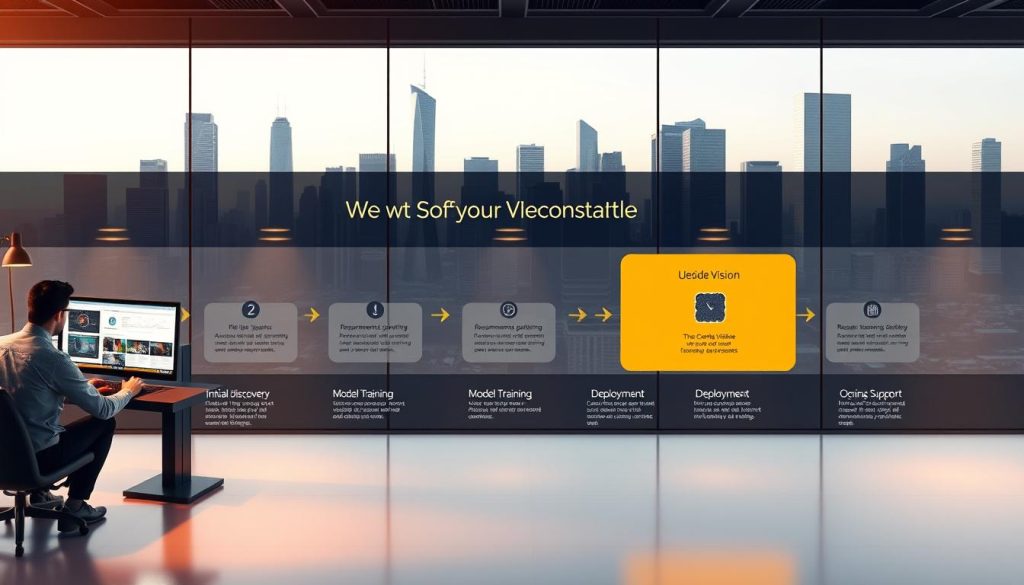
Requirements analysis and team assembly
We begin with focused analysis to align use cases, acceptance criteria, and timelines. We then estimate effort, map costs, and assemble a cross-disciplinary team including data scientists, ML engineers, and product owners.
Agile iterations with continuous validation
Development proceeds in short sprints with automated testing and regular stakeholder demos, so quality and progress are visible throughout. Transparent reporting and backlog refinement keep priorities aligned as data insights and findings evolve.
Validation, integration, and ongoing support
Before rollout, we validate models and features in your actual field environment, capture operator feedback, and refine behavior. We handle integration with existing systems, deliver operator and admin training, and provide full documentation. Post-launch, we monitor performance and model drift, offering ongoing maintenance and feature enhancements to protect long-term ROI.
Technology stack for production-grade vision
Our stack combines proven frameworks with optimized runtimes so models run reliably from prototype through fleet-wide deployment. We match tools to platform targets, trading flexibility for performance where needed, and maintain full reproducibility.
Frameworks and libraries
We build and train models with PyTorch and TensorFlow, optimizing for Apple devices with CoreML. Classical image processing and 3D operations use OpenCV, scikit-image, Open3D, and OpenCL.
Infrastructure and deployment
We containerize with Docker and orchestrate via Kubernetes for portable, repeatable builds. Edge accelerators and optimized runtimes meet strict latency targets on embedded and industrial hardware, while cloud platforms provide elastic scale.
- Deployments on AWS, Azure, and Google Cloud for resilient management and centralized updates.
- MLOps practices including versioning, model registries, and CI/CD for safe, predictable rollouts.
- APIs and open standards that simplify integration with your product and data ecosystems.
| Layer | Tools | Primary Benefit |
|---|---|---|
| Model training | PyTorch, TensorFlow, CoreML | Fast iteration, native device support |
| Image processing | OpenCV, scikit-image, Open3D, OpenCL | Efficient image and 3D operations |
| Infrastructure | Docker, Kubernetes, edge accelerators | Portability, scale, low-latency inference |
| Cloud | AWS, Azure, Google Cloud | Elastic compute, centralized telemetry |
Measuring business impact
We convert model performance metrics into financial metrics, demonstrating clear ROI from reduced error rates and faster workflows. By tying detection accuracy to operational KPIs, we show how fewer false positives and false negatives translate to lower labor costs, less rework, and improved customer outcomes.
Real deployments deliver safer workplaces through real-time monitoring, lower manual entry costs with OCR automation, and faster defect detection on inspection lines. These gains translate into measurable reductions in downtime, shrinkage, and compliance risk as models mature and data coverage improves.
- Cost savings: fewer errors, optimized inventory, and shorter repair cycles that reduce operating expense.
- Time recovered: automation frees staff for higher-value work and speeds customer response times.
- Safety improvements: proactive detection and real-time alerts reduce incidents and associated losses.
- Better decisions: timely insights from layered edge-plus-cloud systems improve forecasting and quality control.
Pricing, timelines, and engagement models
We scope projects so budget, calendar, and deliverables align from the start, mapping pilot, expansion, and scale phases to clear acceptance criteria.
Projects typically start around $15,000 and range to $50,000-$100,000+ depending on scope, data readiness, domain complexity, and target timeline. We begin with a fixed-fee discovery phase when uncertainty is high, then move to agile build and iteration so value appears early and risks decrease incrementally.
Pricing aligns to workstreams: data preparation, model development, integration, and user enablement. Transparent reporting lets stakeholders track burn rate, milestones, and ROI drivers throughout the engagement.
| Engagement Phase | Typical Timeline | Core Deliverables |
|---|---|---|
| Discovery (fixed fee) | 1-3 weeks | Use-case definition, data gaps, ROI model |
| Pilot (agile) | 4-12 weeks | Working prototype, integration, field test |
| Scale and support | Ongoing | Production rollouts, monitoring, retraining |
Project examples with measurable results
Three representative engagements show how tailored imaging systems and disciplined data practices translate into measurable improvements for customers.
Cargo security with object capture and 3D calibration
We improved cargo security by implementing object capture, 3D camera calibration, and dense point cloud processing for reliable segmentation and tracking in logistics yards. The result was higher detection rates, faster processing, and significantly fewer manual checks.
Race performance prediction with image capture
We delivered a tablet application that captures image streams from multiple cameras and transforms frames into features for predictive models. This gave trainers actionable insights, faster analysis cycles, and a repeatable product for scaling to additional events.
Face ID proof of concept for secure authentication
We built a deep learning face identification proof of concept matching still photos to live video streams for secure authentication flows. Algorithms were tuned per task and validated under realistic lighting, motion, and device constraints.
Getting started with Opsio
The fastest path from idea to working vision system starts with a focused discovery engagement. Provide your objectives, sample imagery or video, existing system diagrams, and the KPIs you want to impact. This information lets us scope data collection, annotation needs, and integration points to produce an accurate proposal.
Whether you need to map feasibility, run a pilot, or build a full production roadmap, our team partners with you to turn visual data into lasting competitive advantage. Contact us to discuss your use case and next steps.
FAQ
What does a computer vision development engagement include?
A typical engagement covers consulting and feasibility assessment, data preparation and annotation, model design and training, application development, system integration, deployment, and ongoing monitoring and maintenance. The scope scales based on your use case complexity and data readiness.
How long does a computer vision project take from discovery to production?
Pilot proofs of concept typically run 6 to 12 weeks, while full production systems take 3 to 9 months depending on data readiness, integration complexity, and regulatory requirements. Agile iterations deliver usable increments throughout the process rather than a single final delivery.
What industries benefit most from custom vision solutions?
Retail, logistics, healthcare, manufacturing, automotive, financial services, and sports all benefit from tailored vision systems. The common factor is operational processes that involve visual inspection, tracking, or classification where automation reduces cost and improves consistency.
How do you handle data privacy in vision projects?
We design privacy-first architectures that keep captures and processing local when required. We do not retain raw customer data beyond project needs unless explicitly agreed. Governance covers data lineage, access control, and compliance with applicable regulations.
What deployment options are available for vision models?
We deploy on edge devices and embedded systems for low-latency on-site inference, on-premises servers for data-sensitive environments, and cloud platforms including AWS, Azure, and Google Cloud for scalable analytics. Hybrid configurations combine edge inference with cloud-based monitoring and model updates.
How do you ensure models perform accurately in real-world conditions?
We build evaluation suites that mirror your actual operating conditions, including lighting variation, occlusion, and motion. Continuous improvement loops retrain models based on new field data, and we monitor for drift to trigger updates when performance degrades.
What is the typical cost for a computer vision development project?
Projects typically start around $15,000 for a discovery and feasibility phase, with full pilot builds ranging from $50,000 to $100,000 or more depending on scope, data complexity, and integration requirements. We provide transparent estimates after requirements analysis.
Do you provide post-deployment support and model retraining?
Yes, we offer continuous monitoring, periodic retraining, performance audits, and incident response. This ensures models remain accurate as operating conditions change and that infrastructure stays secure and current.