What if your technology infrastructure could become your company’s most powerful strategic asset, rather than a constant source of complexity? Many leaders view their IT landscape as a necessary cost center, but we see it differently. We believe your technology should actively drive growth and create competitive advantages.

Modern organizations face unprecedented challenges in managing their technological foundations. We provide expert solutions that fundamentally transform how your company leverages its digital tools. Our comprehensive approach combines deep industry experience with cutting-edge strategies designed to streamline your entire infrastructure.
This enhances service delivery and drives measurable outcomes across your organization. We work alongside your teams to implement strategies that reduce complexity and minimize costly downtime. This collaborative partnership positions your business for sustained growth in a competitive marketplace.
When you contact us today at https://opsiocloud.com/contact-us/, you connect with specialists who understand the intricate link between technology and success. This guide shares our expertise on best practices and the transformative potential of modern solutions for businesses of all sizes.
Key Takeaways
- Technology infrastructure should be a strategic asset, not just a cost center.
- Expert solutions can transform how your business leverages its digital tools.
- A comprehensive approach streamlines infrastructure and enhances service delivery.
- Collaborative partnerships implement strategies that reduce complexity and downtime.
- Connecting with the right specialists is crucial for aligning technology with business success.
- Modern solutions offer transformative potential for organizations of all sizes.
Introduction to Operations Management IT
The seamless technology experiences your users enjoy depend on complex operational frameworks working tirelessly behind the scenes. We believe understanding these foundational elements is crucial for any organization seeking to optimize their digital capabilities.
What is Operations Management IT?
Operations Management IT represents the comprehensive approach to overseeing day-to-day technological functions that keep your organization running smoothly. At its core, this discipline focuses on the operational aspects of the service lifecycle, handling behind-the-scenes activities that ensure consistent, reliable performance.
Effective operational oversight encompasses three primary areas: network infrastructure management, where teams oversee hardware, software, and network services; help desk operations including incident response and disaster recovery; and server and device management covering endpoints from servers to mobile devices.
Guide Overview and Objectives
This guide provides business leaders and IT professionals with actionable insights into best practices and implementation strategies. We’ve structured this resource to address both strategic and tactical dimensions, ensuring you gain complete understanding of how proper implementation can drive efficiency and reduce costs.
Through our experience with diverse organizations, we’ve witnessed how solid operational foundations create service excellence while maintaining agility. Our objective is to demonstrate how these frameworks position your infrastructure to support long-term business growth.
The Evolution of IT Operations Management
Digital landscapes have evolved dramatically, and so have the approaches to managing their operational foundations. We’ve witnessed this discipline transform from reactive maintenance to proactive strategy.
Early approaches were characterized by fragmented oversight and siloed systems. Organizations often addressed problems only after significant disruption occurred.
Historical Perspectives and Recent Trends
The key to balanced effectiveness lies not in technology alone but in methodology. Understanding which best practices to apply creates sustainable frameworks.
Recent trends have accelerated this transformation significantly. Cloud computing and hybrid infrastructure require new monitoring approaches across complex environments.
Over time, we’ve seen this function evolve into a strategic business partnership. Decisions now directly influence customer experience and competitive positioning.
This evolution represents a fundamental shift in how organizations approach their technological foundations. The focus has moved from maintenance to innovation.
Core Principles & Benefits of Operations Management IT
Organizations that master their operational foundations gain competitive advantages that extend far beyond technical performance. We’ve built our approach on principles that prioritize reliability and strategic alignment, ensuring every aspect of your infrastructure contributes directly to business success.
The fundamental principle requires all business services and systems to remain available and functioning properly. This demands robust processes for deployment, implementation, and support throughout complete lifecycles.
Enhanced Efficiency and Reduced Downtime
Enhanced efficiency represents one of the most compelling benefits, enabling organizations to streamline workflows and automate routine tasks. This reduces manual effort and frees teams to focus on strategic initiatives that drive innovation.
We emphasize that reduced downtime is a business imperative, not just a technical achievement. Through proactive monitoring and standardized practices, effective oversight helps minimize outages and ensures uninterrupted service delivery.
Optimizing Business Processes
Optimizing business processes creates measurable value by improving the performance of service operations. This increases application availability and establishes clear accountability for how technology resources support organizational objectives.
Cost management emerges as a significant benefit when organizations implement comprehensive strategies. Effective capacity planning and resource optimization lead to reduced expenses while maintaining service quality standards.
The solution we advocate establishes standard processes that create foundations for continuous improvement. This enables your business to adapt quickly to changing market demands and technological opportunities.
Key Technologies Driving IT Operations
Today’s digital environments demand advanced technological solutions that can anticipate challenges before they impact business continuity. We’ve witnessed how modern tools transform traditional approaches into intelligent, predictive systems.

Automation, AI, and AIOps Integration
Automation stands at the forefront of operational excellence, eliminating repetitive tasks and reducing human error. Our approach leverages configuration management tools and orchestration software to accelerate service delivery.
The integration of artificial intelligence represents a paradigm shift in infrastructure oversight. AIOps combines advanced analytics with machine learning to proactively identify emerging problems across diverse environments.
According to industry research, AIOps delivers exceptional value relative to cost in most implementations. This technology assigns incidents appropriately before they affect business systems.
ITOM Tools and Software
Modern ITOM software forms the foundation of effective infrastructure oversight. Configuration Management Databases provide centralized visibility into all technology assets and configurations.
Container orchestration tools automate deployment and scaling processes for cloud-native applications. Monitoring platforms deliver deeper insights into system performance, enabling faster responses.
These comprehensive solutions support teams through low-code service management and proactive incident resolution. The right tools empower organizations to make data-driven decisions that align with business priorities.
Comparing IT Operations Management with ITSM and ITIL>
Many organizations struggle to distinguish between related technology frameworks that govern their digital environments. We frequently observe confusion around ITOM, ITSM, and ITIL terminology, though understanding their unique roles proves essential for optimizing service delivery capabilities.
These frameworks work together to create comprehensive technology governance. Their complementary nature ensures both strategic vision and daily execution align with business objectives.
Role Differences and Strategic Approaches
IT service management represents the overarching approach to delivering technology services to users. This discipline takes a long-term view of the service lifecycle, focusing on strategic development of infrastructure and computing resources.
In contrast, ITOM concentrates specifically on day-to-day activities that keep systems running smoothly. While ITSM addresses service delivery strategy, operations management focuses on administration and provision.
We view ITIL as the comprehensive framework providing guidelines from planning to daily operations. This establishes the strategic foundation that guides implementation of operational processes and practices.
Integration and Operational Challenges
Integration challenges often emerge when aligning these different frameworks. Legacy systems, siloed teams, or inconsistent processes can create friction between strategic objectives and operational realities.
We recommend adopting a holistic perspective that recognizes ITOM as the tactical component within broader service management. This approach maintains focus on immediate requirements while ensuring alignment with long-term goals.
The distinction between service provision and administration remains crucial for successful implementation. Coordinated processes must bridge both strategic and operational dimensions to achieve optimal performance.
ITOM Best Practices for Modern Organizations
We’ve observed that companies embracing comprehensive ITOM strategies consistently outperform their competitors. These proven approaches create frameworks that align technological foundations with business objectives, ensuring consistent quality and continuous improvement across all service delivery channels.
Streamlining Infrastructure and Resource Management
Effective ITOM practices begin with centralized visibility into all technological assets. Implementing a Configuration Management Database provides unified oversight of hardware, applications, and their relationships to business services.
This approach enables better tracking of changes across your entire network while integrating analytics with real-time monitoring capabilities. Teams gain comprehensive control over resources, reducing vulnerabilities from outdated systems.
Implementing Automated Processes
Automation represents one of the most impactful improvements organizations can make. We recommend eliminating time-consuming tasks like user provisioning, software updates, and backup scheduling through configuration management tools.
This strategic automation frees teams to focus on innovation rather than routine maintenance. The result is enhanced workflows and reduced incident response times across all service management functions.
Capacity Planning and Performance Monitoring
Proactive capacity planning ensures your infrastructure can scale to meet evolving business demands. Establishing metrics for incident resolution time and service availability provides clear performance benchmarks.
Continuous monitoring and data analysis help identify trends before they become problems. This approach optimizes resource allocation while maintaining strong security through role-based access controls.
Overcoming Common IT Operations Challenges
Modern organizations face unprecedented complexity in their technological environments that demands sophisticated solutions. We understand these hurdles intimately and have developed comprehensive approaches to address them effectively.
Managing Complexity and Integration Issues
Contemporary infrastructure sprawl creates significant challenges for teams. According to recent industry surveys, many organizations manage up to 1,000 applications across hybrid environments.
This scale creates integration problems that complicate critical tasks. Systems struggle to communicate effectively, hampering performance monitoring and cybersecurity efforts.
Visibility becomes particularly difficult with mixed legacy and modern systems. Without clear oversight, resource allocation becomes problematic and costs can escalate unexpectedly.
Ensuring Security and Compliance
Security threats evolve constantly, requiring vigilant protection measures. We implement robust controls that safeguard assets while maintaining regulatory compliance.
Zero trust models demand strict access control across all systems. These practices help prevent sophisticated attacks that target distributed infrastructure.
Our approach combines advanced monitoring tools with clear integration standards. This helps organizations adapt to changing requirements without compromising service quality.
Optimizing Service Delivery & Performance with ITOM
Achieving peak digital performance requires more than just technology—it demands a holistic approach to service optimization. We help organizations transform their service delivery through comprehensive ITOM practices that balance technical excellence with user-centric outcomes.
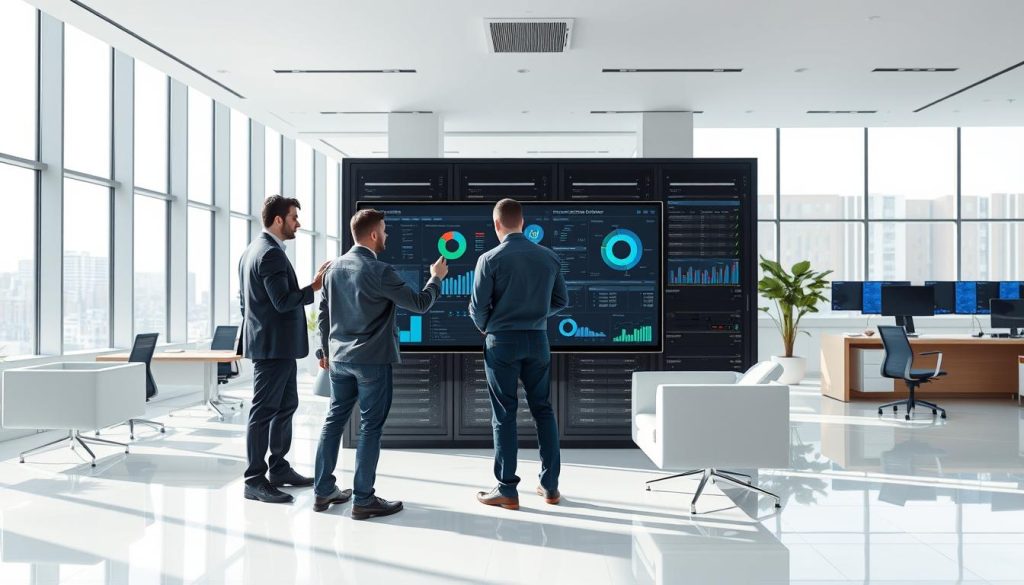
Network Infrastructure and Incident Management
Strong network infrastructure forms the backbone of reliable service delivery. Our approach ensures hardware and software components work together seamlessly. This creates stable foundations for mission-critical applications.
Effective incident management protocols quickly address technical issues before they escalate. We implement structured workflows that classify and prioritize problems based on business impact. This reduces resolution times and minimizes service disruptions.
| Incident Type |
Response Time |
Resolution Target |
Business Impact |
| Critical System Failure |
Under 15 minutes |
2 hours maximum |
High – Revenue affecting |
| Performance Degradation |
Within 30 minutes |
4 business hours |
Medium – User productivity |
| Minor Technical Issues |
Next business day |
24-hour window |
Low – Individual users |
Enhancing User Experience and Availability
Proactive monitoring provides real-time visibility into system performance and application responsiveness. This enables teams to detect anomalies before they affect users. Maintaining high availability standards becomes achievable through continuous assessment.
We integrate security considerations directly into service delivery optimization. Access controls and monitoring solutions protect infrastructure while maintaining performance. This balanced approach ensures users receive exceptional service that supports business objectives.
Through careful attention to user experience metrics, organizations leverage ITOM practices to create environments that exceed expectations. The result is consistent service delivery that drives competitive advantage.
Aligning IT Operations with Business Strategy
Strategic alignment transforms technology from a support function into a competitive driver that directly supports business objectives. We approach this integration as a collaborative process that begins with deep understanding of your organization’s unique requirements and growth priorities.
Through active engagement with stakeholders across departments, our teams develop tailored solutions that address specific business challenges. This partnership ensures that technological frameworks support rather than constrain strategic initiatives.
Measuring Impact and ROI
Effective measurement requires establishing key performance indicators that track how technological solutions contribute to business outcomes. We move beyond traditional technical metrics to include user adoption rates, service level compliance, and system availability.
Advanced analytics provide data-driven insights into how operational practices affect revenue generation and customer satisfaction. This approach demonstrates the tangible value of technology investments.
Continuous monitoring allows teams to refine resource allocation and adjust workflows as business needs evolve. This ongoing assessment ensures that technological capabilities remain aligned with changing market conditions.
The benefits extend beyond technical improvements to include measurable cost reductions and enhanced operational efficiency. Organizations that successfully integrate their technological foundations with business strategy achieve sustainable competitive advantages.
Future Trends in IT Operations Management
We stand at the threshold of a technological revolution where artificial intelligence and machine learning are fundamentally redefining operational excellence. The landscape of digital oversight is shifting from reactive maintenance to proactive optimization.
Organizations increasingly redirect staff from routine tasks to strategic initiatives that drive innovation. This transformation creates unprecedented opportunities for optimizing infrastructure.
Emerging Technologies and AI/ML Innovations
Advanced automation handles repetitive processes, reducing errors and inconsistencies. This approach enables comprehensive visibility across diverse environments.
Intelligent systems collect operational data and generate predictive insights. These tools help prevent issues before they impact business continuity.
Security protocols automatically activate when threats emerge. This proactive monitoring safeguards critical applications and network resources.
Future practices will support complex deployment pipelines efficiently. Teams gain deeper analytics to optimize performance across hybrid environments.
Contact Expert ITOM Solutions – Reach Out Today
Your journey toward optimized IT operations begins with a conversation with our specialist team. We invite you to connect and explore how our comprehensive solutions can transform your organization’s technology infrastructure.
Our approach delivers measurable business results tailored to your unique requirements. We bring decades of experience helping companies implement best practices that drive efficiency and enhance service delivery.
Schedule Your Demo
When you contact us today at https://opsiocloud.com/contact-us/, you’ll discuss current challenges with specialists who understand modern technology environments. They provide actionable recommendations for optimizing your operational approach.
Schedule your demonstration to see firsthand how our solutions address the full spectrum of ITOM requirements. This includes infrastructure oversight, automation, monitoring, and strategic alignment with business goals.
Learn More at https://opsiocloud.com/contact-us/
Our team provides guidance and support to navigate the evolving technology landscape. We help build capabilities that serve as competitive advantages rather than cost centers.
Learn more about partnering with our teams by visiting https://opsiocloud.com/contact-us/ today. We develop customized solutions that address specific operational challenges and position your organization for sustained growth.
Conclusion
Transforming your technological foundation from a cost center to a strategic driver requires a disciplined, forward-thinking approach. Throughout this guide, we’ve demonstrated how effective operations management serves as the critical bridge between technical execution and business success.
Modern ITOM represents more than just maintaining systems. It embodies a strategic capability that balances daily operational excellence with long-term alignment. This ensures your teams have access to the right tools and processes.
The evolution toward proactive practices, powered by automation and AI, creates resilient service delivery frameworks. These solutions enhance user experience while demonstrating clear business value through measurable outcomes.
We invite you to begin your transformation journey. Contact our specialists today at https://opsiocloud.com/contact-us/ to discuss customized approaches that position your organization for sustained growth.
FAQ
How does operations management IT improve our service delivery?
We enhance service delivery by providing comprehensive visibility into your entire infrastructure. This allows for proactive incident management, automated workflows, and optimized resource allocation, which directly increases availability and improves the end-user experience.
What is the difference between ITOM tools and traditional monitoring software?
Traditional monitoring often focuses on individual systems like hardware or a network. Our ITOM solutions offer a holistic view, integrating data from applications, security assets, and business services. This provides deeper analytics for problem resolution and strategic capacity planning, moving beyond simple alerts.
Can you help reduce the complexity of managing our hybrid cloud environment?
Absolutely. We specialize in unifying control across on-premises and cloud resources. Our platforms streamline access, automate repetitive tasks, and deliver consistent performance monitoring. This reduces operational complexity, cuts costs, and mitigates security challenges associated with fragmented environments.
How do you measure the return on investment for implementing ITOM practices?
We measure ROI through key performance indicators like reduced system downtime, faster incident resolution times, and improved team efficiency. By automating manual processes, organizations see significant cost savings and can reallocate resources to innovation-focused projects, demonstrating clear business value.
What role does automation play in modern IT operations management?
Automation is central to achieving efficiency and scalability. We implement intelligent automation for tasks like provisioning, patching, and compliance checks. This minimizes human error, frees up your teams for more strategic work, and ensures consistent application of best practices across the organization.
Author
Praveena Shenoy
-
Country Manager
Praveena Shenoy is the Country Manager for Opsio India and a recognized expert in DevOps, Managed Cloud Services, and AI/ML solutions. With deep experience in 24/7 cloud operations, digital transformation, and intelligent automation, he leads high-performing teams that deliver resilience, scalability, and operational excellence. Praveena is dedicated to helping enterprises modernize their technology landscape and accelerate growth through cloud-native methodologies and AI-driven innovations, enabling smarter decision-making and enhanced business agility.