Condition monitoring is the continuous measurement and analysis of equipment health data to detect faults before they cause unplanned downtime. For asset-intensive industries, it is the foundation of every successful predictive maintenance program. Organizations that adopt a structured monitoring approach typically see 35-45% reductions in unplanned outages and 25-30% lower total maintenance costs, according to a McKinsey analysis of maintenance optimization.
This guide covers the core techniques, system architecture, implementation steps, and business value of this maintenance strategy, along with how it connects to broader Industry 4.0 strategies such as AI-driven predictive maintenance and digital twin modeling.
Take the first step toward optimized maintenance
Discover how a structured equipment health monitoring program can transform your maintenance operations and reduce unplanned downtime.
Talk to our maintenance strategy team
What Is Condition Monitoring?
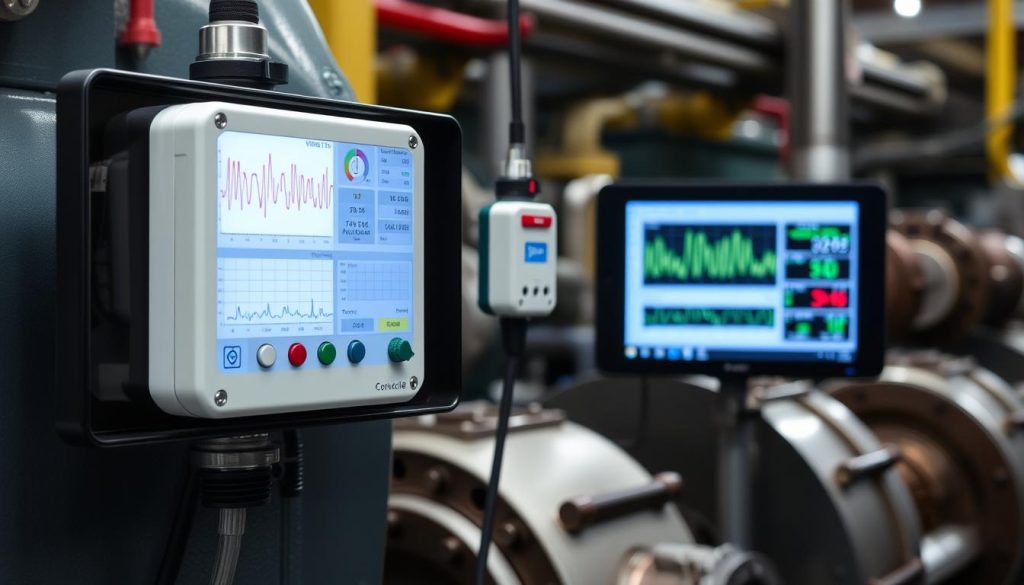
This proactive maintenance strategy uses sensors and data analysis to track equipment health in real time, replacing calendar-based service schedules with evidence-based decisions. Instead of waiting for a machine to break or servicing it on a fixed calendar, maintenance teams monitor parameters such as vibration amplitude, bearing temperature, lubricant particle counts, and electrical current signatures to identify the earliest signs of degradation.
The concept has existed since the 1960s when vibration analysis was first applied to rotating machinery in the aerospace sector. Today, wireless IoT sensors, edge computing, and cloud analytics have made this technology accessible to organizations of every size, from single-plant manufacturers to global energy producers.
The primary goals of an equipment health monitoring program include:
- Maximizing equipment uptime by catching faults weeks or months before failure
- Reducing unplanned downtime costs, which can exceed $260,000 per hour in automotive manufacturing according to Siemens industry research
- Extending asset lifespan by preventing cascading damage from undetected faults
- Improving workplace safety by eliminating catastrophic mechanical failures
- Optimizing spare-parts inventory by ordering components only when data indicates need
When an organization monitors asset health continuously, it shifts from time-based maintenance to condition based maintenance, where every service action is justified by measured evidence rather than an arbitrary calendar interval.
Core Condition Monitoring Techniques
Effective programs combine multiple measurement techniques because no single sensor type can detect every failure mode. The table below summarizes the five techniques most widely deployed in industrial settings.
| Technique | What It Measures | Best For | Detection Lead Time |
|---|
| Vibration analysis | Displacement, velocity, acceleration spectra | Rotating equipment: motors, pumps, fans, gearboxes | 1-6 months before failure |
| Thermal imaging | Surface temperature distribution via infrared | Electrical panels, bearings, refractory linings | Days to weeks |
| Oil analysis | Particle counts, viscosity, moisture, wear metals | Engines, gearboxes, hydraulic systems | Weeks to months |
| Ultrasonic testing | High-frequency acoustic emissions | Compressed-air leaks, steam traps, early bearing faults | Days to weeks |
| Motor current analysis | Electrical current waveform signatures | Broken rotor bars, air-gap eccentricity, power quality | Weeks to months |
Vibration Analysis
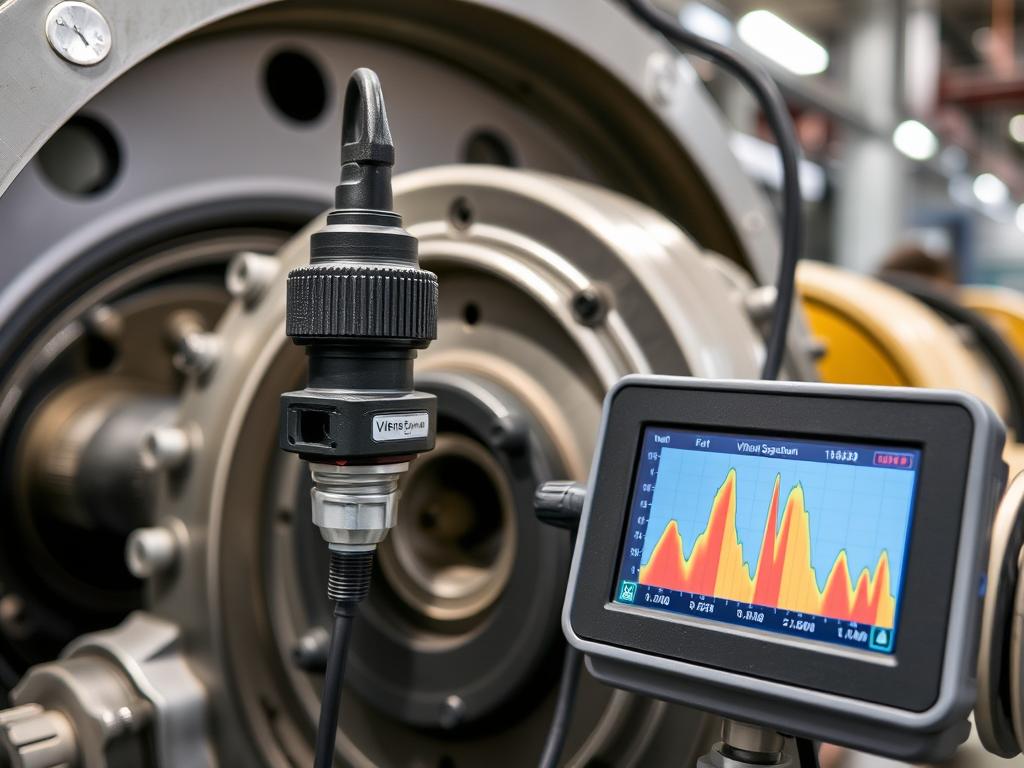
Vibration analysis is the most mature and widely used vibration-based monitoring technique for rotating machinery. Accelerometers mounted on bearing housings capture vibration spectra that reveal imbalance, misalignment, looseness, gear-mesh defects, and bearing-race wear long before an operator would notice anything unusual. Modern systems perform fast Fourier transform (FFT) analysis automatically, comparing measured spectra against baseline signatures and ISO 10816 severity thresholds.
Wireless vibration sensors now cost a fraction of what hardwired systems did a decade ago, making it practical to instrument hundreds of assets across a facility. When combined with cloud-based analytics, these sensors deliver continuous monitoring rather than periodic walk-around routes, closing the gap between data collection intervals where faults previously went undetected.
Thermal Imaging
Infrared thermography detects abnormal heat patterns that signal electrical resistance, friction, or cooling-system failures. A trained thermographer can scan an entire electrical distribution panel in minutes, spotting loose connections, overloaded circuits, or phase imbalances that would otherwise remain invisible until they cause a trip or fire. Thermal cameras are also valuable for inspecting refractory linings, steam systems, and building envelopes.
Handheld thermal cameras remain the primary tool, but fixed-mount infrared sensors are increasingly deployed in critical switchgear and data-center environments for 24/7 surveillance.
Oil Analysis, Ultrasonic Testing, and Motor Current Analysis

Oil analysis reveals internal wear that vibration sensors cannot always detect, especially in slow-speed equipment. Spectrometric analysis identifies wear metals (iron, copper, chromium) that point to specific component degradation. Particle counting and ferrography show the size and shape of debris, distinguishing normal wear from abnormal failure progression. Regular sampling at 30-day intervals creates trend data that maintenance planners use to schedule overhauls during planned outages.
Ultrasonic testing fills another gap by detecting compressed-air leaks, failed steam traps, and the very earliest stages of bearing degradation, often before vibration levels rise above baseline. Motor current analysis completes the picture for electric motors by reading electrical waveform anomalies that indicate broken rotor bars, stator faults, or supply-side power quality issues without requiring physical access to the machine.
Monitoring-Based vs. Reactive Maintenance
Reactive maintenance costs two to five times more than planned maintenance on a per-incident basis, primarily because of emergency labor premiums, expedited parts shipping, and cascading production losses. The comparison below highlights why organizations move toward monitoring-driven strategies.
Reactive Maintenance
- Addresses equipment only after a failure occurs
- Causes unplanned production stoppages
- Requires emergency-rate labor and expedited parts
- Shortens asset lifespan through cascading damage
- Creates unpredictable maintenance budgets
- Increases safety risk from catastrophic breakdowns
Condition Based Maintenance
- Detects developing faults weeks or months in advance
- Schedules repairs during planned downtime windows
- Allows standard labor rates and normal parts ordering
- Extends equipment life by preventing secondary damage
- Produces predictable, data-driven maintenance budgets
- Improves workplace safety through early intervention
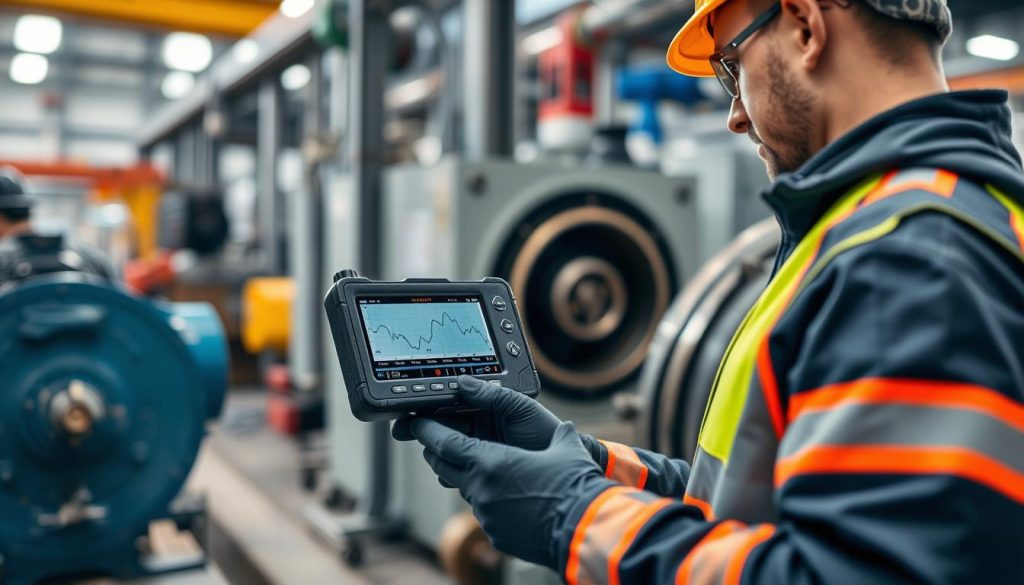
While reactive maintenance avoids upfront sensor and software investment, the long-term total cost of ownership is significantly higher. A U.S. Department of Energy best-practices guide found that facilities relying primarily on run-to-failure maintenance spend 30-40% more on maintenance over a ten-year period compared to those using monitoring-driven approaches.
Condition Monitoring System Architecture
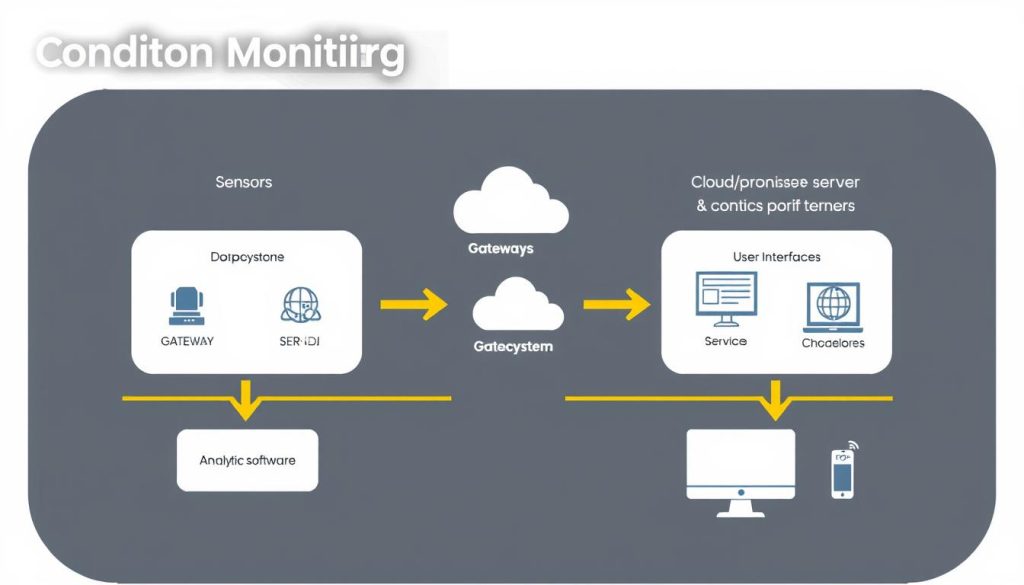
A modern monitoring system consists of four layers: sensors, edge gateways, a cloud or on-premises data platform, and analytics dashboards integrated with CMMS/EAM work-order systems.
Sensors and Edge Gateways
Accelerometers, RTDs, current transformers, and ultrasonic probes convert physical parameters into digital signals. Edge gateways aggregate data from dozens of sensors, apply initial filtering, and transmit compressed payloads over Wi-Fi, cellular, or LoRaWAN to the data platform. Edge processing reduces bandwidth costs and enables sub-second alerting at the machine level.
Data Platform and Storage
Time-series databases (such as InfluxDB or AWS Timestream) store high-frequency sensor data efficiently. Managed cloud infrastructure lets organizations scale storage and compute on demand without maintaining physical servers. Data retention policies balance analytical depth with storage cost, typically keeping raw data for 90 days and aggregated trends for years.
Analytics, Alerts, and CMMS Integration
Machine-learning models trained on historical failure data score each asset's health in real time. When a threshold is crossed, the system generates a prioritized alert and can automatically create a work order in the CMMS. Dashboard visualizations let reliability engineers drill from fleet-level health maps down to individual bearing spectra in seconds.
Organizations that already use cloud infrastructure services can deploy asset monitoring platforms faster because networking, identity management, and data governance are already in place. This reduces time-to-value from months to weeks.
How to Implement Condition Monitoring in Four Steps
A phased rollout starting with the highest-risk assets lets organizations prove value quickly, build internal expertise, and fund expansion from documented savings.

Step 1: Asset Criticality Assessment
Rank every asset by the consequence of its failure across four dimensions: safety impact, production loss, environmental risk, and repair cost. Focus first on the top 10-20% of assets that drive the majority of downtime risk. A simple criticality matrix (likelihood x consequence) is usually sufficient to set priorities.
Step 2: Technology Selection and Baseline Measurement
Match sensor types to each asset's dominant failure modes. For a centrifugal pump, vibration and temperature sensors cover most risks. For a hydraulic press, oil analysis and pressure monitoring are more relevant. Once sensors are installed, collect at least 30 days of baseline data under normal operating conditions to establish reference signatures.
Step 3: Pilot Deployment on Critical Assets
Instrument 5-15 critical assets and operate the full monitoring loop: collect data, analyze trends, generate alerts, and execute condition-based work orders. Track every prevented failure and avoided production loss to build the ROI case. Refine alarm thresholds to reduce false positives, which are the leading cause of operator distrust in early deployments.
Step 4: Scale and Integrate
Use documented pilot results to secure funding for plant-wide or fleet-wide expansion. Integrate the monitoring platform with your CMMS so that work orders are generated automatically. Establish a reliability engineering function that reviews trends weekly and feeds insights back into design and procurement decisions.
Need help planning your monitoring rollout?
Our team can assess your asset portfolio, recommend sensor configurations, and design a cloud-hosted monitoring architecture tailored to your operations.
Schedule a asset health monitoring consultation
Business Value and ROI of Condition Monitoring
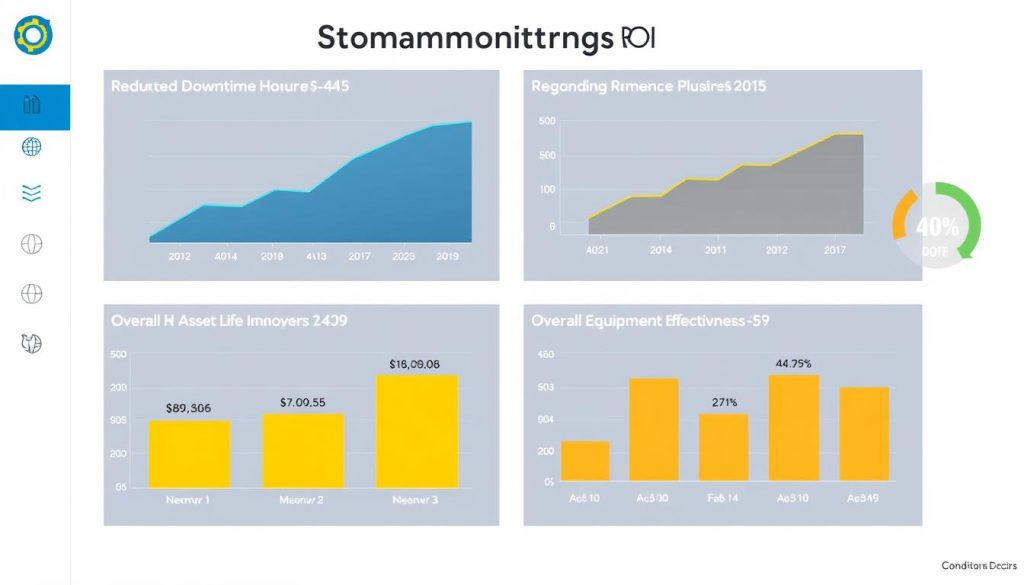
This monitoring strategy delivers measurable returns through five value streams: downtime reduction, maintenance cost savings, extended asset life, improved safety, and better capital planning.
Reduced Unplanned Downtime
Monitoring-based programs typically cut unplanned downtime by 35-45%. For a manufacturing line running at $10,000 per hour in lost output, eliminating even a handful of unplanned stops per year delivers six-figure savings. Most organizations recover their monitoring investment within the first avoided incident.
Lower Total Maintenance Cost
By replacing calendar-based overhauls with data-driven interventions, organizations reduce total maintenance spend by 25-30%. Parts are ordered at standard lead times instead of expedited rates, technicians work during normal shifts instead of overtime callouts, and secondary damage from neglected faults is eliminated.
Extended Asset Life
Early fault correction prevents the cascading damage that shortens equipment life. Organizations commonly report 20-40% longer service intervals for monitored assets. For capital equipment costing hundreds of thousands of dollars, even a one-year life extension represents significant capital deferral.
Beyond direct savings, proactive asset monitoring improves workplace safety by eliminating catastrophic mechanical failures that endanger personnel, and it strengthens capital planning by giving finance teams data-driven visibility into when major assets will actually need replacement rather than relying on depreciation schedules.
Regulatory Compliance and Safety Standards
Documented documented monitoring data strengthens an organization's compliance posture by providing auditable evidence of proactive maintenance and risk management.

Relevant standards and frameworks include:
- ISO 17359 (Condition monitoring and diagnostics of machines -- General guidelines)
- ISO 13373 (Condition monitoring and diagnostics of machines -- Vibration condition monitoring)
- ISO 55001 (Asset management system requirements)
- OSHA General Duty Clause, which requires employers to maintain safe equipment
- API 670 (Machinery protection systems for petroleum and chemical plants)
During audits, inspectors increasingly expect to see data-driven maintenance records rather than simple time-based checklists. A well-maintained monitoring archive demonstrates due diligence and can reduce insurance premiums by documenting lower operational risk.
Asset Health Monitoring as a Foundation for Industry 4.0
Equipment health data is the raw material for predictive maintenance, digital twins, and operational intelligence -- the pillars of Industry 4.0 manufacturing.
Predictive Maintenance
Machine-learning models consume historical vibration, temperature, and oil-analysis data to forecast remaining useful life. As the dataset grows, predictions become more accurate, shifting maintenance from condition-based ("something looks wrong") to predictive ("this bearing will reach end-of-life in 47 days"). Read our complete guide to AI-driven predictive maintenance for a deeper look at the algorithms and architecture involved.
Digital Twins
A digital twin is a virtual replica of a physical asset that updates in real time from sensor data. Engineers can simulate operating scenarios, test failure hypotheses, and optimize process parameters without touching the physical machine. The value of a digital twin is directly proportional to the richness of the sensor data feeding it.
Operational Intelligence
When condition data is correlated with production metrics, energy consumption, and quality inspection results, organizations gain a holistic view of how equipment health affects business outcomes. This cross-domain analysis reveals optimization opportunities that no single data source can surface alone.
Organizations investing in monitoring infrastructure today are building the data asset that will power these advanced capabilities for years. The marginal cost of adding predictive models on top of an existing sensor and data-platform investment is far lower than starting from scratch.
Common Challenges and How to Overcome Them
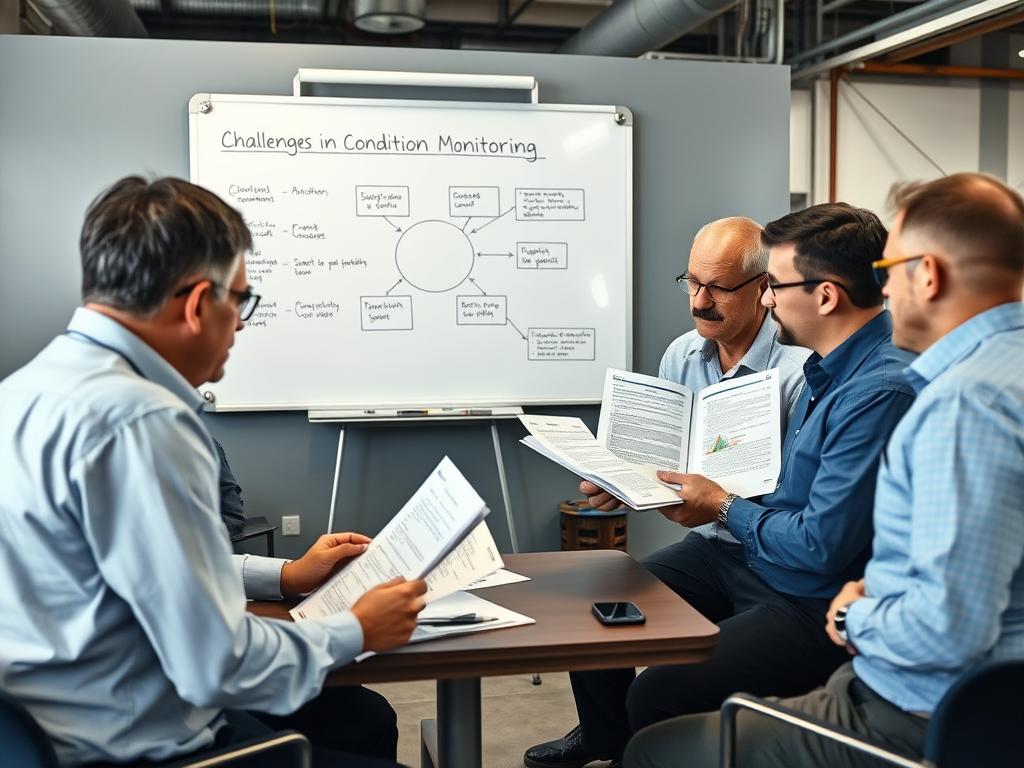
Most implementation failures stem from organizational resistance and data overload, not technology limitations.
Initial Cost Justification
Sensor hardware and software licenses require upfront capital. Mitigation: Start with a focused pilot on the five highest-consequence assets, document every avoided failure, and use those numbers to build the expansion business case. Many sensor vendors now offer subscription pricing that shifts cost from capex to opex.
Skills Gap
Vibration analysis and data interpretation require specialized training. Mitigation: Invest in ISO 18436 vibration analyst certification for key staff, partner with a managed service provider for initial analysis support, and select platforms with built-in diagnostic guidance that reduces the expertise barrier.
Data Overload and False Alarms
A single vibration sensor can produce gigabytes of spectral data per month. Without proper filtering, alert fatigue erodes trust in the system. Mitigation: Tune alarm thresholds during the pilot phase, use machine-learning anomaly detection to reduce false positives, and assign a reliability engineer to review and refine alert logic monthly.
CMMS Integration Complexity
Legacy maintenance systems may lack APIs for automated work-order creation. Mitigation: Evaluate integration capabilities during vendor selection, consider middleware such as cloud migration strategies to modernize legacy systems, and involve IT stakeholders early in the architecture design.
Frequently Asked Questions About Condition Monitoring
What is the typical ROI timeline for condition monitoring?
Most organizations achieve ROI within 3 to 18 months. The primary value drivers are reduced unplanned downtime, lower emergency repair costs, extended asset life, and improved workplace safety. For critical rotating equipment, preventing a single catastrophic failure can cover the full cost of a monitoring system.
Can condition monitoring be retrofitted to older equipment?
Yes. While newer machines may include embedded sensors, older equipment can be retrofitted with external accelerometers, temperature probes, and wireless IoT sensors. Older assets often benefit the most because they carry higher failure risk and replacement parts may be scarce or expensive.
How does condition monitoring differ from predictive maintenance?
This practice involves measuring equipment parameters such as vibration, temperature, and oil quality to detect developing faults. Predictive maintenance builds on that data by applying machine learning and statistical models to forecast when a failure will occur and what maintenance action is needed. This data foundation makes predictive maintenance possible.
Which industries benefit most from condition monitoring?
Any industry with rotating or critical mechanical equipment benefits, but the highest adoption is in manufacturing, oil and gas, power generation, mining, transportation, and water treatment. These sectors operate expensive capital equipment where unplanned downtime carries severe financial and safety consequences.
Is cloud-based condition monitoring secure enough for industrial use?
Modern cloud platforms use end-to-end encryption, role-based access controls, and meet standards such as ISO 27001 and SOC 2. Many cloud solutions exceed what a single plant can deploy on-premises. Organizations should verify that any provider meets their industry-specific compliance requirements before deployment.
Getting Started with Condition Monitoring
The fastest path to results is a narrow pilot on your highest-risk assets, expanded methodically as documented savings fund the next phase.
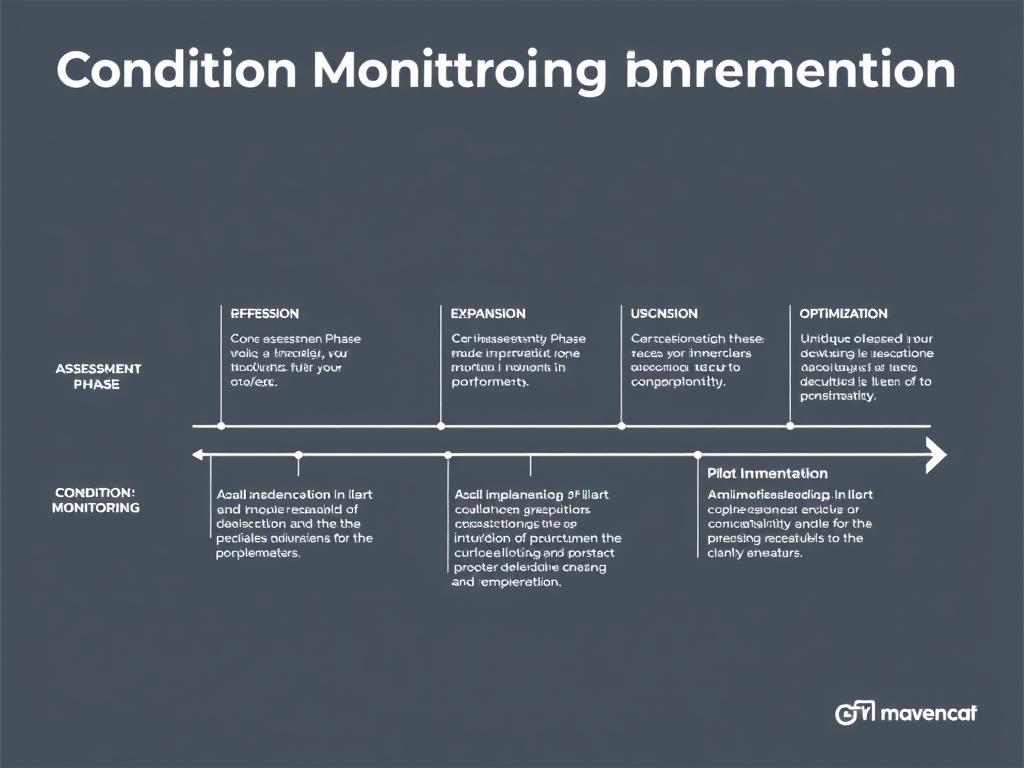
- Define measurable objectives -- Set specific targets such as "reduce unplanned downtime by 30% within 12 months" or "extend pump overhaul intervals from 12 to 18 months."
- Run a criticality assessment -- Score every asset on safety, production, environmental, and cost impact. Prioritize the top tier for monitoring.
- Select sensors and platform -- Match measurement techniques to dominant failure modes. Evaluate cloud platforms against your cloud cost optimization requirements.
- Deploy a pilot and measure results -- Instrument 5-15 assets, run for 90 days, and document every avoided failure, false alarm, and process improvement.
- Scale and integrate -- Use pilot ROI data to fund plant-wide expansion. Connect the platform to your CMMS for automated work-order generation.
This approach is not only a technology project but an operational transformation. Involve maintenance technicians, reliability engineers, operations managers, and IT from the start to ensure adoption and sustained value.
Start your equipment monitoring program today
Our team can help you assess your assets, select the right sensor and platform strategy, and design a monitoring program that delivers measurable results.
Schedule a free consultation