

Sweden has become one of Europe's strongest hubs for computer vision research and commercial deployment, powered by institutions like WASP, Linkoeping University, and a growing ecosystem of AI startups. For organizations looking to implement visual intelligence solutions, understanding Sweden's visual AI landscape helps identify the right technology partners, research collaborations, and cloud deployment strategies.
This guide covers Sweden's academic research programs, leading companies, practical industry applications, cloud deployment models, and emerging trends shaping the future of visual AI in Scandinavia and beyond.
Key Takeaways
- Sweden's WASP program invests SEK 5.5 billion in AI research, making it one of the largest AI initiatives in Europe.
- Linkoeping University's CV Laboratory leads globally recognized research in dynamic visual learning and uncertainty-aware neural networks.
- Swedish visual intelligence companies like Univrses, Gimic, and Tobii specialize in 3D mapping, quality inspection, and eye tracking respectively.
- Cloud-native deployment on AWS, Azure, or GCP eliminates upfront infrastructure costs and enables on-demand scaling for visual AI workloads.
- Key application sectors include healthcare diagnostics, autonomous vehicles, manufacturing quality control, and smart city infrastructure.
- A managed service provider can bridge the gap between research-grade vision models and production-ready cloud deployments.
Why Sweden Leads in Computer Vision Research
Sweden consistently ranks among the top countries in Europe for AI and computer vision research output, driven by massive public-private investment and a culture of academic-industry collaboration. Three factors set Sweden apart from other markets.
First, the Wallenberg AI, Autonomous Systems and Software Program (WASP) represents Sweden's single largest individual research program, with a total budget of SEK 5.5 billion. WASP funds doctoral positions, postdoc fellowships, and large-scale research projects across visual perception, machine learning, and autonomous systems at universities including Linkoeping, KTH, Chalmers, Lund, and Umea.
Second, Sweden's research institutions produce work with real commercial impact. The CV Lab at Linkoeping University, led by Professor Michael Felsberg, focuses on areas directly relevant to industry: dynamic visual learning, uncertainty-aware neural networks, convolution operators, and visual tracking. These are not purely theoretical pursues; they feed directly into autonomous driving, industrial inspection, and medical imaging products.
Third, computing infrastructure supports ambition. The Berzelius supercomputer at Linkoeping, one of the most powerful AI research systems in Europe, provides the GPU capacity needed for training large-scale vision models that would be prohibitively expensive for individual organizations.
| Research Program | Host Institution | Focus Area | Industry Application |
|---|---|---|---|
| WASP CV Program | Linkoeping University | Core perception algorithms | Quality control, surveillance |
| WASP Sensor Fusion | Multiple universities | Multi-source data integration | Autonomous vehicles |
| WASP Vehicular Systems | Chalmers, KTH | Transportation automation | Logistics, public safety |
| ELLIIT | Linkoeping, Lund | IT and mobile communications | IoT, smart infrastructure |
Leading Computer Vision Companies in Sweden
Sweden's visual AI industry spans from venture-backed startups to established technology firms, each addressing different segments of the visual AI market. The following companies represent the breadth of Swedish expertise.
Univrses
Stockholm-based Univrses develops 3D visual intelligence solutions through its proprietary 3DAI Engine. The platform processes visual data from cameras and LiDAR sensors to create real-time 3D maps for autonomous systems, smart city infrastructure, and road condition assessment. Univrses partners with municipalities and automotive OEMs to deploy spatial intelligence at scale.
Tobii
Tobii is a global leader in eye-tracking technology headquartered in Stockholm. Their vision-based systems track eye movement and gaze direction for applications in automotive driver monitoring, gaming, accessibility tools, and behavioral research. Tobii's technology is integrated into laptops, VR headsets, and medical devices worldwide.
Gimic
Founded in 2017, Gimic builds AI-powered visual inspection systems for manufacturing. Their AI-powered platforms detect defects on production lines with higher consistency than manual inspection, reducing defect rates and improving workplace safety in factories across Scandinavia.
Axis Communications
Based in Lund, Axis Communications pioneered network video surveillance and continues to develop advanced video analytics powered by visual AI. Their cameras and software use deep learning to detect objects, recognize patterns, and trigger automated responses across security, retail, and transportation environments.
Computer Vision Applications Across Industries
Computer vision delivers measurable business value in healthcare, manufacturing, automotive, and retail, with Swedish companies and research groups active in all four sectors. Each application area has distinct requirements for accuracy, latency, and regulatory compliance.
Healthcare and Medical Imaging
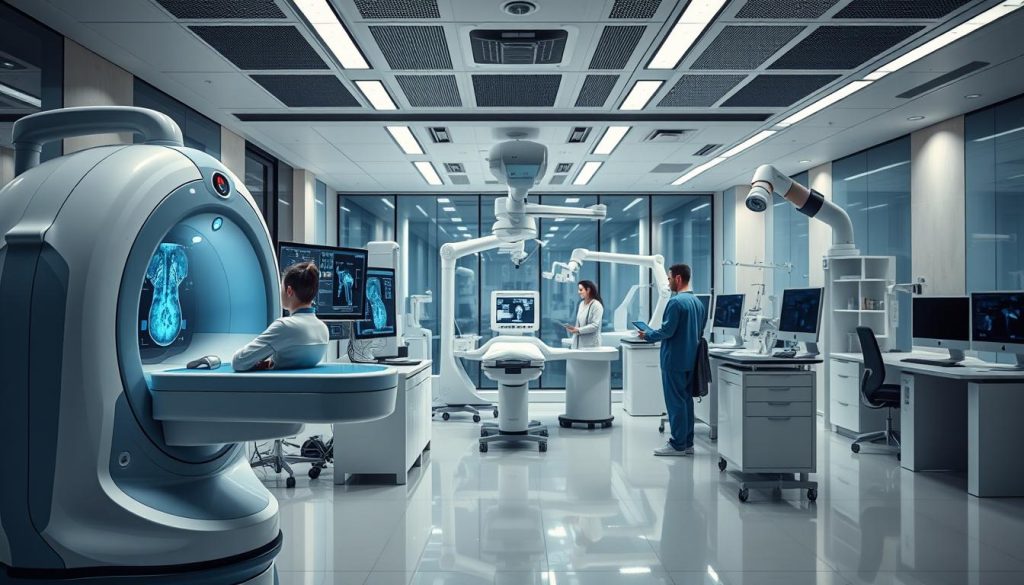
In healthcare, visual AI systems analyze medical images including X-rays, MRI scans, and pathology slides to assist clinicians with diagnosis. Swedish research groups have developed AI models that detect conditions like diabetic retinopathy and skin cancer with accuracy comparable to specialist physicians. These tools do not replace doctors but serve as a second opinion, flagging abnormalities that might otherwise be missed during high-volume screening.
Regulatory requirements under the EU Medical Device Regulation (MDR) mean that healthcare imaging systems require rigorous clinical validation before deployment. This is an area where Sweden's strong regulatory framework provides an advantage for companies developing compliant solutions.
Manufacturing and Visual Inspection
Manufacturing facilities use automated image analysis for automated quality control, replacing manual visual inspection on production lines. Camera systems capture images of every product, and AI models identify surface defects, dimensional deviations, and assembly errors in real time. Swedish companies like Gimic report that their clients achieve defect detection rates above 95%, operating continuously without the fatigue-related inconsistencies of human inspectors.
For organizations evaluating visual inspection AI, cloud-connected systems offer the additional benefit of centralized model updates across multiple factory locations.
Autonomous Vehicles and Sensor Fusion
Visual perception technology is the foundation of autonomous driving perception systems. Swedish companies including Volvo, Scania, and Zenseact develop vision-based systems that detect pedestrians, vehicles, lane markings, and traffic signs. Modern autonomous platforms combine camera data with LiDAR and radar through sensor fusion, creating robust environmental models that function in rain, snow, and low-light conditions common in Scandinavian climates.
Retail and Customer Analytics
Retail applications include shelf monitoring, customer flow analysis, and self-checkout verification. Visual analytics systems track product placement and inventory levels, reducing out-of-stock incidents. Privacy-preserving approaches, where the system analyzes movement patterns without identifying individuals, address GDPR compliance requirements that are particularly stringent in the EU market.
| Industry | Application | Key Benefit | Deployment Model |
|---|---|---|---|
| Healthcare | Medical image analysis | Faster, more consistent diagnoses | Hybrid cloud |
| Manufacturing | Automated visual inspection | Defect detection above 95% | Edge + cloud |
| Automotive | Perception for autonomous driving | 360-degree environmental awareness | Edge computing |
| Retail | Inventory and customer analytics | Reduced out-of-stock incidents | Cloud-native |
Cloud Deployment for Computer Vision Workloads
Cloud platforms have eliminated the largest barrier to visual AI adoption: the upfront cost of GPU infrastructure for model training and inference. Organizations no longer need to purchase and maintain expensive hardware to run vision workloads.
The three major cloud providers each offer specialized services for image and video analysis:
- AWS provides Amazon Rekognition for image and video analysis, SageMaker for custom model training, and Panorama for edge deployment. AWS has data center regions in Stockholm (eu-north-1), ensuring low-latency processing for Swedish organizations.
- Microsoft Azure offers Azure AI Vision, Custom Vision for domain-specific models, and Azure Video Indexer. Azure's partnership with OpenAI extends capabilities into multimodal AI that combines vision with language understanding.
- Google Cloud provides Vision AI, AutoML Vision for custom classifiers, and Vertex AI for end-to-end ML pipelines. Google's research contributions to transformer architectures have direct benefits for vision model performance.
Choosing the right deployment model depends on latency requirements, data sensitivity, and scale. Real-time applications like autonomous driving require edge processing, while batch analysis of medical images can run efficiently in the cloud. Many organizations adopt a hybrid approach, processing time-sensitive inference at the edge while using cloud resources for model training and less urgent workloads.
A managed cloud services provider can handle the infrastructure complexity, including GPU provisioning, auto-scaling, model versioning, and monitoring, so engineering teams focus on improving model accuracy rather than managing servers.
Machine Learning Advances Driving Visual AI
Recent advances in deep learning architectures have dramatically improved the accuracy and efficiency of visual AI systems, with Swedish researchers contributing to several key breakthroughs.
Vision transformers (ViTs) have challenged the dominance of convolutional neural networks (CNNs) that defined the field for the past decade. Transformers process images as sequences of patches, capturing long-range dependencies that CNNs handle less effectively. Foundation models like Meta's SAM (Segment Anything Model) and Google's PaLI demonstrate that a single pre-trained model can perform multiple vision tasks with minimal fine-tuning.
Swedish research groups at Linkoeping University have advanced uncertainty-aware neural networks, which are critical for safety-sensitive applications. Unlike standard models that simply output a prediction, uncertainty-aware systems also report their confidence level. When confidence drops below a threshold, the system escalates the decision to a human operator. This capability is essential for medical diagnostics and autonomous driving, where incorrect automated decisions can have serious consequences.
Self-supervised and few-shot learning approaches are reducing the data requirements for training custom vision models. Traditional supervised learning demands thousands of labeled images per category. Modern techniques can achieve usable accuracy with as few as 50 to 100 labeled examples, making visual AI practical for niche industrial applications where large labeled datasets do not exist.
Emerging Trends in Swedish Computer Vision
Several trends are reshaping how organizations adopt and deploy visual intelligence, with the Swedish ecosystem positioned at the forefront of each.
Multimodal AI
The convergence of vision and language models enables systems that can describe what they see in natural language, answer questions about images, and follow visual instructions. This unlocks applications like automated report generation from inspection images and conversational interfaces for video analytics platforms.
Edge AI and On-Device Processing
Advances in model compression and specialized hardware (NVIDIA Jetson, Intel Movidius, Google Coral) allow sophisticated vision models to run directly on cameras and edge devices. This reduces latency, lowers bandwidth costs, and addresses data privacy concerns by processing sensitive images locally rather than sending them to the cloud.
Sustainability Applications
Swedish researchers are applying visual AI to environmental monitoring, including satellite image analysis for deforestation tracking, ocean plastic detection, and precision agriculture. The ELLIIT research network has explored how visual analysis contributes to climate science, reflecting Sweden's broader commitment to sustainability technology.
Ethical AI and Regulation
The EU AI Act classifies certain visual AI applications, particularly biometric identification and surveillance, as high-risk, requiring conformity assessments, transparency obligations, and human oversight mechanisms. Swedish companies developing these systems for the European market must factor regulatory compliance into their product roadmaps from the outset.
How to Evaluate Computer Vision Partners
Selecting the right technology partner for a visual AI project requires evaluating technical capabilities, deployment experience, and ongoing support capacity. The following criteria help organizations make informed decisions.
- Domain expertise: Does the partner have proven experience in your specific industry? A model trained for manufacturing defect detection will not transfer directly to medical imaging without significant adaptation.
- Data pipeline maturity: Can the partner handle data collection, annotation, augmentation, and versioning? Model accuracy depends more on data quality than algorithm selection.
- Cloud and infrastructure capability: Does the partner operate on your preferred cloud platform? Can they manage GPU resources, auto-scaling, and cost optimization for inference workloads?
- MLOps and monitoring: Does the partner provide model performance monitoring, drift detection, and automated retraining pipelines? Vision models degrade over time as real-world conditions change.
- Regulatory awareness: For healthcare, automotive, or public-sector applications, the partner must understand relevant compliance frameworks including EU AI Act, MDR, and GDPR.
For organizations that need visual intelligence capabilities but lack the in-house infrastructure team to support production deployments, a managed IT services approach provides the operational foundation. This allows data science teams to focus on model development while infrastructure management, security, and scaling are handled by specialists.
Getting Started with Computer Vision on Cloud Infrastructure
A structured approach to visual AI adoption reduces risk and accelerates time to value, starting with a focused proof of concept before scaling to production.
- Define the business problem: Identify a specific, measurable challenge where visual analysis can improve outcomes. Avoid starting with the technology and searching for applications.
- Assess data availability: Determine what image or video data exists, how it is stored, and what labeling effort is required. Data gaps are the most common reason vision projects stall.
- Run a proof of concept: Build a minimal model using a representative subset of data. Target 2 to 4 weeks for initial results that demonstrate feasibility and inform accuracy expectations.
- Choose the deployment model: Based on latency, privacy, and scale requirements, select between cloud, edge, or hybrid deployment. Provision cloud resources through a cloud consultant to avoid over-provisioning.
- Build the MLOps pipeline: Establish automated training, testing, deployment, and monitoring workflows before moving to production. Manual model management does not scale.
- Scale and iterate: Expand to additional use cases, locations, or camera feeds. Continuously improve model accuracy with new labeled data from production environments.
Opsio provides the cloud infrastructure management and operational support that visual AI projects require for production deployment, including GPU provisioning, container orchestration, and cost-optimized scaling across AWS, Azure, and GCP.
FAQ
What makes Sweden a strong market for visual intelligence technology?
Sweden combines large-scale research funding through programs like WASP (SEK 5.5 billion total budget), world-class academic institutions including Linkoeping University and KTH, high-performance computing infrastructure like the Berzelius supercomputer, and a commercial ecosystem of specialized AI companies. This combination accelerates the path from research to commercially deployed vision solutions.
Which cloud platform is best for computer vision workloads?
The best platform depends on your requirements. AWS offers the broadest set of pre-built vision services and has a Stockholm data center region for low latency. Azure integrates well with Microsoft enterprise tools and offers strong OpenAI integration. Google Cloud provides advanced AutoML capabilities and benefits from Google's vision research. A managed service provider can help evaluate which platform fits your specific workload, data residency, and cost requirements.
How much does it cost to deploy computer vision in production?
Costs vary significantly by use case. Cloud GPU instances for model training range from USD 1 to 30 per hour depending on GPU type. Inference costs depend on volume, typically USD 0.001 to 0.01 per image for cloud APIs. Custom model training projects require 2 to 6 months of data science effort. Edge deployment adds hardware costs but reduces ongoing cloud spending. A proof of concept typically requires USD 10,000 to 50,000 before scaling to production.
What are the main challenges in computer vision implementation?
The most common challenges are insufficient labeled training data, performance degradation when models encounter conditions not represented in training data (domain shift), integration with existing enterprise systems, and managing the ongoing operational overhead of model monitoring and retraining. Organizations that underestimate data preparation effort and MLOps requirements frequently see projects stall between proof of concept and production deployment.
Does the EU AI Act affect computer vision deployments?
Yes. The EU AI Act classifies certain visual AI applications as high-risk, particularly biometric identification, emotion recognition, and real-time remote surveillance in public spaces. High-risk systems require conformity assessments, technical documentation, transparency to users, human oversight mechanisms, and registration in an EU database. Organizations deploying vision systems in EU markets should assess their regulatory obligations early in the development process.