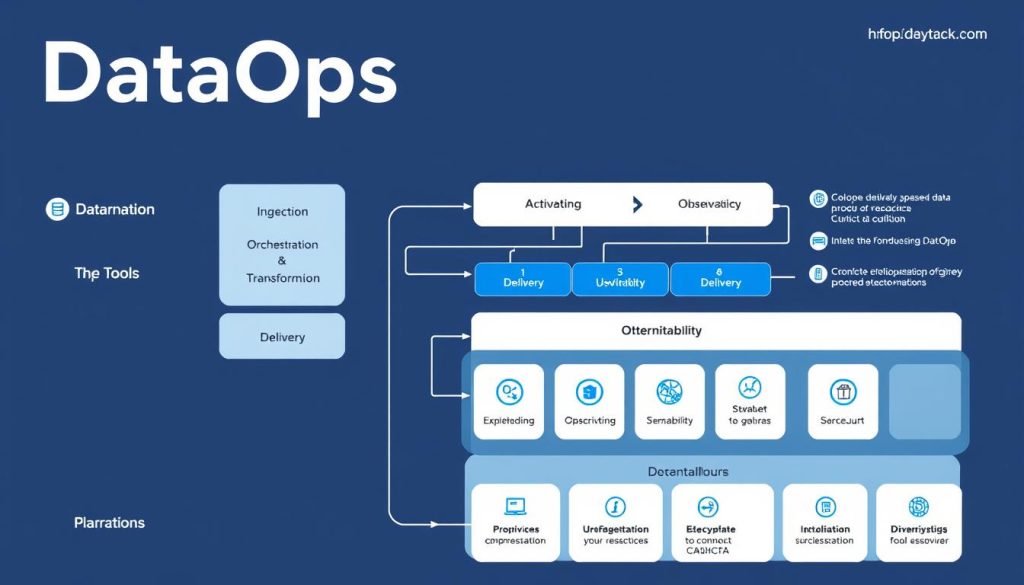
In today’s data-driven world, organizations face mounting challenges with managing, processing, and extracting value from their ever-growing data assets. Data silos, slow analytics cycles, poor data quality, and lack of collaboration between teams create significant barriers to achieving true data-driven decision making. DataOps has emerged as a transformative approach that addresses these pain points by bringing together people, processes, and technology to streamline data workflows and deliver reliable insights faster.As data volumes continue to expand exponentially and business demands for insights become more urgent, traditional approaches to data management simply can’t keep pace. DataOps offers a solution by applying proven methodologies from software development and manufacturing to the data lifecycle, creating a more agile, collaborative, and efficient data ecosystem that drives business value.
What is DataOps?
DataOps is a collection of technical practices, workflows, cultural norms, and architectural patterns that enable rapid innovation and experimentation in data analytics while maintaining high data quality and fostering collaboration across teams. It applies the principles of DevOps, Agile development, and lean manufacturing to data analytics development and operations.
At its core, DataOps aims to break down silos between data producers and consumers, automate data pipelines, implement continuous testing and monitoring, and create a culture of collaboration that accelerates the delivery of trusted data insights to business stakeholders.
Unlike traditional data management approaches that often involve lengthy development cycles and manual processes, DataOps emphasizes automation, continuous delivery, and quality controls throughout the data lifecycle. This enables organizations to respond quickly to changing business requirements while maintaining data integrity and reliability.
Ready to Transform Your Data Operations?
Discover how Opsio Cloud can help you implement DataOps practices tailored to your organization’s unique needs.
Schedule a Consultation
Why is DataOps Important?
The exponential growth of data in today’s business environment has created both opportunities and challenges. Organizations now have access to more data than ever before, but turning that data into actionable insights quickly and reliably has become increasingly difficult.
The Data Integration Challenge
Companies generate massive amounts of data in various formats (structured, unstructured, semi-structured) from multiple sources. This data often becomes fragmented across systems, losing quality, context, or getting lost entirely in the complexity of the data architecture.
Traditional data pipelines involve moving vast sets of raw data from siloed environments into data lakes for transformation, then into data warehouses for analytics. At enterprise scale, these processes become complex and inefficient, with simple requests taking days or weeks instead of hours or minutes.
Removing Data Pipeline Bottlenecks
Business demands for data analytics are often urgent and unforeseen, occurring in an environment where data volume, velocity, and variety are growing exponentially. Data engineers frequently create ad-hoc pipelines in response, often hand-coding without proper documentation or using non-compatible tools just to get data moving.
This results in duplication of workflows, poor documentation, lack of version control, and other challenges that impact data quality, governance, budgets, and project timelines. As data management becomes overwhelming, data pipelines get clogged and become major bottlenecks for analytics workflows.
“DataOps is to data analytics what DevOps is to software development. It’s about removing the friction between data teams and business users to deliver trusted insights at the speed of business.”
By implementing DataOps, organizations can address these challenges through automated workflows, improved collaboration, and continuous quality controls that ensure data reliability while accelerating time to insight.
How Does DataOps Work?
The DataOps Lifecycle
DataOps implements a continuous feedback loop that enables faster and more reliable insights from data. This lifecycle takes inspiration from the DevOps lifecycle but incorporates different technologies and processes given the ever-changing nature of data.
Planning
Partnering with product, engineering, and business teams to set KPIs, SLAs, and SLIs for the quality and availability of data. This collaborative approach ensures alignment between technical capabilities and business needs.
Development
Building the data products and machine learning models that will power your data applications. This involves creating transformations, analytics models, and visualizations that turn raw data into actionable insights.
Integration
Integrating code and data products within your existing tech and data stack. For example, integrating a dbt model with Airflow so the dbt module can automatically run as part of a larger data pipeline.
Testing
Testing data to ensure it matches business logic and meets basic operational thresholds, such as uniqueness or the absence of null values. Automated testing helps catch issues before they impact downstream systems.
Release
Releasing data into a test environment where it can be validated without affecting production systems. This stage allows for final verification before deployment.
Deployment
Merging data products into production where they become available to end users. Automated deployment processes minimize the risk of errors during this critical stage.
Operation
Running data through applications such as dashboards and data loaders that feed machine learning models. This is where data delivers value to the business through insights and automated decisions.
Monitoring
Continuously monitoring and alerting for any anomalies in the data. This proactive approach helps identify and resolve issues before they impact business users.
The Four Core DataOps Processes
DataOps comprises four core processes that work in tandem to deliver a better data experience for all stakeholders:
- Data Integration: Creating a unified view of fragmented and distributed organizational data with seamless, automated, and scalable data pipelines. The goal is to efficiently find and integrate the right data without any loss in context or fidelity.
- Data Management: Automating and streamlining data processes and workflows throughout the data lifecycle – from creation to distribution. Agility and responsiveness during the data lifecycle are key to effective DataOps.
- Data Analytics Development: Enabling data insights at speed and scale with optimal, reusable analytics models, user-centric data visualization, and ongoing innovation to continuously improve data models.
- Data Delivery: Ensuring all business users can use data when it is most needed. This is not just about efficient storage, but also timely data access with democratized self-service options.
What Challenges Do Businesses Face with DataOps Implementation?
While DataOps offers significant benefits, implementing it effectively comes with several challenges that organizations must navigate:
Common Implementation Challenges
- Cultural Resistance: Shifting from traditional data management approaches to a more collaborative, agile methodology often faces resistance from teams accustomed to established workflows.
- Technical Complexity: Integrating diverse data sources, tools, and platforms into a cohesive, automated pipeline requires significant technical expertise and planning.
- Skills Gap: Many organizations lack personnel with the combined expertise in data engineering, DevOps practices, and business domain knowledge needed for effective DataOps.
- Legacy Systems: Existing data infrastructure may not easily support automation, continuous integration, or the rapid deployment cycles that DataOps requires.
- Governance and Compliance: Balancing the need for agility with regulatory requirements and data governance policies presents ongoing challenges.
- Tool Proliferation: The growing ecosystem of DataOps tools can lead to fragmentation and integration difficulties if not carefully managed.
Struggling with DataOps Implementation?
Opsio Cloud’s expert team can help you overcome common implementation challenges with tailored solutions and proven methodologies.
Get Expert Guidance
What are the Benefits of Adopting DataOps?
Implementing DataOps delivers numerous benefits that directly address the data challenges organizations face today:
Faster Time to Insight
DataOps automates engineering tasks such as testing and anomaly detection that typically take countless hours to perform manually. This automation brings speed to data teams, fostering faster collaboration between data engineering and data science teams.
Shorter development cycles for data products reduce costs and allow organizations to reach their goals faster, with multiple teams working side-by-side to deliver results simultaneously.
Improved Data Quality
By applying DataOps across pipelines with automated testing and end-to-end observability, organizations significantly improve data quality. Monitoring and alerting across every layer of the data stack reduces opportunities for human error.
Teams can proactively respond to data quality incidents quickly—often before stakeholders are aware anything’s gone wrong—building trust in data-driven decision-making across the organization.
Enhanced Team Productivity
Data engineers and scientists typically spend at least 30% of their time firefighting data quality issues. DataOps creates automated and repeatable processes that free up valuable engineering time for more strategic work.
This leads to happier team members who can focus on improving data products, building new features, and optimizing data pipelines to accelerate time to value for the organization’s data assets.
Greater Agility
DataOps makes data operations as agile as business needs demand. New data sources integrate in days, pipeline modifications deploy immediately, and when the business pivots, the data team pivots with them.
This agility becomes a competitive advantage, allowing organizations to understand changes first and respond faster than competitors.
Transparent Data Ecosystem
DataOps builds trust systematically through data lineage that shows exactly where numbers come from and quality metrics that prove data meets standards. When issues occur, they’re communicated immediately with clear resolution timelines.
This transparency leads to faster decisions, less duplicated effort, and more innovation as everyone trusts and uses the data available to them.
Reduced Operational Risk
As organizations democratize data access, ethical, technical, and legal challenges inevitably arise. DataOps—specifically data observability—helps address these concerns by providing visibility into what users are doing with data.
This transparency helps organizations maintain compliance with regulations like GDPR and CCPA while still making data accessible to those who need it.
How Can Companies Overcome DataOps Challenges?
Successfully implementing DataOps requires a strategic approach that addresses common challenges while leveraging proven best practices:
- Assess Your Current State
Begin by evaluating your existing data infrastructure, processes, and team capabilities. Identify pain points, bottlenecks, and areas where DataOps can deliver the most immediate value. This assessment provides a baseline for measuring improvement and helps prioritize implementation efforts.
- Secure Leadership Buy-In
DataOps requires organizational commitment and cultural change. Secure executive sponsorship by demonstrating how DataOps aligns with business objectives and quantifying potential ROI through metrics like reduced time to insight, improved data quality, and increased team productivity.
- Build a Cross-Functional Team
Form a dedicated DataOps team that brings together diverse skills including data engineering, analytics, quality assurance, and business domain expertise. This cross-functional approach ensures all perspectives are considered in designing and implementing DataOps processes.
- Start Small with a Pilot Project
Begin with a well-defined, high-value use case rather than attempting to transform your entire data ecosystem at once. This approach allows you to demonstrate value quickly, refine your approach based on lessons learned, and build momentum for broader adoption.
- Implement Automation Incrementally
Identify manual, repetitive tasks in your data workflows and prioritize them for automation. Focus initially on high-impact areas like data testing, pipeline orchestration, and monitoring. As you build confidence and capabilities, expand automation to additional processes.
- Establish Quality Controls
Implement automated testing and validation throughout your data pipelines to ensure data quality at every stage. Define clear quality metrics and SLAs that align with business requirements, and establish monitoring to detect and address issues proactively.
- Foster a Collaborative Culture
Break down silos between data teams and business stakeholders through shared tools, regular communication, and collaborative processes. Implement feedback loops that enable continuous improvement based on user experiences and changing business needs.
- Scale Gradually
As your pilot projects demonstrate success, gradually expand DataOps practices across additional data domains and use cases. Document and share best practices, templates, and reusable components to accelerate adoption while maintaining consistency.
How Opsio Cloud Enables Successful DataOps Implementation
Opsio Cloud provides a comprehensive platform that addresses the key challenges of DataOps implementation while accelerating time to value:
Unified Data Orchestration
Opsio Cloud’s orchestration capabilities enable seamless integration of diverse data sources and tools into cohesive, automated pipelines. Our platform supports both batch and real-time processing, with built-in scheduling, dependency management, and error handling.
This unified approach eliminates the need for custom scripts and manual interventions, reducing complexity and accelerating development cycles.
End-to-End Data Observability
Our comprehensive observability solution monitors data quality, freshness, volume, schema changes, and lineage across your entire data ecosystem. Automated anomaly detection with machine learning identifies issues before they impact downstream systems.
Detailed lineage tracking enables rapid root cause analysis when problems occur, minimizing downtime and maintaining trust in your data assets.
Collaborative Workspace
Opsio Cloud provides a unified environment where data engineers, analysts, and business stakeholders can collaborate effectively. Shared dashboards, documentation, and workflow visibility break down silos and foster a culture of shared ownership.
Role-based access controls ensure appropriate governance while enabling self-service capabilities that empower business users.
Automated Quality Controls
Our platform includes built-in testing frameworks that validate data quality at every stage of the pipeline. Pre-built test templates for common scenarios accelerate implementation, while custom rules enable validation against specific business requirements.
Continuous testing ensures issues are caught early, preventing poor-quality data from propagating through your systems.
Governance Integration
Opsio Cloud seamlessly integrates with your existing governance frameworks, embedding compliance into automated workflows. Data access controls, audit logging, and privacy protections are built into the platform.
This integration ensures you can maintain regulatory compliance while still benefiting from the agility and efficiency of DataOps practices.
Scalable Architecture
Built on cloud-native technologies, Opsio Cloud scales effortlessly to handle growing data volumes and increasing complexity. Our containerized architecture adapts to your workloads, optimizing resource utilization while maintaining performance.
This scalability ensures your DataOps practice can grow alongside your business without requiring architectural redesigns.
Ready to Accelerate Your DataOps Journey?
Discover how Opsio Cloud’s comprehensive platform can help you implement DataOps practices that deliver reliable data insights at the speed of business.
Request a Demo
DataOps Best Practices for Success
Implementing these proven best practices will help ensure your DataOps initiative delivers maximum value:
1. Gain Stakeholder Alignment on KPIs Early
Since you are treating data like a product, internal stakeholders are your customers. Align early with key data stakeholders and agree on who uses data, how they use it, and for what purposes. Develop Service Level Agreements (SLAs) for key datasets and periodically check in with stakeholders to ensure priorities remain aligned.
This alignment helps you avoid spinning cycles on KPIs or measurements that don’t matter to the business, ensuring your DataOps efforts deliver meaningful value.
2. Automate as Many Tasks as Possible
One of the primary focuses of DataOps is data engineering automation. Identify and automate rote tasks that typically take hours to complete, such as unit testing, ingestion pipeline coding, and workflow orchestration.
By using automated solutions, your team reduces the likelihood of human errors entering data pipelines and improves reliability while aiding organizations in making better and faster data-driven decisions.
3. Embrace a “Ship and Iterate” Culture
Speed is essential for data-driven organizations, and your data products don’t need to be perfect to add value. Build a basic MVP, test it out, evaluate your learnings, and revise as necessary.
Successful data products can be built faster by testing and iterating in production with live data. Teams can collaborate with stakeholders to monitor, test, and analyze patterns to address issues and improve outcomes, reducing errors and decreasing the likelihood of bugs entering data pipelines.
4. Invest in Self-Service Tooling
A key benefit of DataOps is removing the silos that separate business stakeholders from data engineers. To accomplish this, business users need the ability to self-serve their own data needs rather than relying on data teams to fulfill ad hoc requests.
Central data teams should make sure the right self-serve infrastructure and tooling are available to both producers and consumers of data. Equip them with the right tools, let them interact directly, and get out of the way to enable faster decision-making.
5. Prioritize Data Quality, Then Scale
Maintaining high data quality while scaling is challenging. Start with your most important data assets—the information your stakeholders rely on to make critical decisions. If inaccurate data in a given asset could mean lost time, resources, and revenue, focus your quality efforts there first.
Pay close attention to these critical data assets and the pipelines that fuel decisions, implementing data quality capabilities like testing, monitoring, and alerting. Then, continue to build out your capabilities to cover more of the data lifecycle, keeping in mind that data monitoring at scale will usually involve automation.
Essential DataOps Tools and Technologies
A successful DataOps implementation relies on the right combination of tools and technologies across the data lifecycle:
Data Orchestration
Accurate and reliable scheduling is critical to the success of your data pipelines. As your data needs grow, manual management becomes increasingly difficult. Data orchestration tools organize multiple pipeline tasks into a single end-to-end process, ensuring that data flows predictably through your platform at the right time and in the right order.
Popular orchestration tools include Apache Airflow, Dagster, and Prefect, which provide workflow management, dependency handling, and monitoring capabilities.
Data Observability
Data observability is essential for ensuring the health of your data ecosystem. It enables teams to monitor data quality, freshness, volume, schema changes, and lineage across the entire data lifecycle. Effective observability solutions provide automated anomaly detection and alerting, helping teams identify and resolve issues before they impact business users.
Comprehensive observability platforms include automated lineage tracking to help DataOps engineers understand data health at every point in the lifecycle and efficiently root-cause incidents as they arise.
Data Ingestion
As the first step in your data pipeline, reliable data ingestion is critical. As data sources scale, leveraging efficient automated or semi-automated solutions for data ingestion becomes paramount to the success of your DataOps platform.
Batch ingestion tools like Fivetran and Airbyte manage data delivery from source to destination, while streaming solutions like Confluent (supporting Apache Kafka) handle real-time data flows.
Data Transformation
Modern transformation tools like dbt (data build tool) have become the de facto standard for managing data transformations. These tools apply software engineering best practices to data transformations, enabling version control, testing, and documentation of transformation logic.
By using modular SQL and engineering best practices, tools like dbt make data transforms more accessible to a wider range of team members, not just specialized data engineers.
Integrated DataOps Platforms
While individual tools can address specific aspects of the DataOps lifecycle, integrated platforms like Opsio Cloud provide comprehensive capabilities across orchestration, observability, quality control, and governance. These platforms reduce integration complexity and provide a unified experience for DataOps teams.
The ideal DataOps platform should support your current tools and workflows while providing the automation, monitoring, and collaboration capabilities needed to scale your data operations effectively.
Streamline Your DataOps Toolchain
Opsio Cloud integrates with your existing tools while providing the comprehensive capabilities you need to implement DataOps at scale.
Explore Our Platform
Conclusion: The Future of DataOps
DataOps has emerged as a critical discipline for organizations seeking to derive maximum value from their data assets in today’s fast-paced business environment. By bringing together the best practices from DevOps, Agile development, and lean manufacturing, DataOps enables data teams to deliver trusted insights faster while maintaining high quality standards.
As data volumes continue to grow exponentially and business demands for insights become increasingly urgent, traditional approaches to data management simply cannot keep pace. DataOps provides the framework, processes, and tools needed to transform data operations from a bottleneck into a strategic advantage.
Looking ahead, we can expect DataOps to evolve alongside complementary disciplines like MLOps and ModelOps, with increasing alignment and interoperability between these practices. Artificial intelligence will play a growing role in augmenting DataOps capabilities, from automated anomaly detection to intelligent workflow optimization.
Organizations that successfully implement DataOps will gain significant competitive advantages through faster time to insight, improved data quality, enhanced team productivity, and greater business agility. Those that fail to adopt these practices risk falling behind as data-driven decision making becomes the norm rather than the exception.
The journey to DataOps maturity is not without challenges, but with the right approach, team structure, and technology platform, organizations of all sizes can transform their data operations to meet the demands of today’s data-intensive business environment.
Begin Your DataOps Transformation Today
Discover how Opsio Cloud can help you implement DataOps practices that deliver reliable data insights at the speed of business.
Schedule a Consultation