More than 73% of German companies face big IT problems when they start in Nordic markets. This shows a big gap between what they want to do and what they can actually do. They struggle with different rules, time zones, and tech standards.
Setting up in Sweden is more than just getting a place and hiring locals. Your business needs reliable IT infrastructure that works across distances. Sweden is known for its digital skills, but you need partners who know both markets well.

Our Managed Services Schweden solutions turn these challenges into chances for German businesses. We offer top-notch IT support Sweden and understand what your business needs. This makes technology a key part of your strategy, not just a cost.
We handle accounting, payroll, and IT for you. This makes working across borders easier. You get security, cloud services, hosting, and advice that fits your size and needs in the Nordic market.
Key Takeaways
- German businesses face significant IT infrastructure challenges when expanding into Nordic markets, with over 73% reporting operational difficulties in their first year
- Comprehensive managed services bridge geographical and operational complexities between Germany and Sweden through localized expertise
- Nordic technology partnerships provide access to world-class digital infrastructure and cutting-edge IT capabilities unavailable through traditional internal departments
- Integrated solutions covering accounting, payroll, security, cloud services, and consulting streamline cross-border business processes
- Strategic IT partnerships transform technology from a cost center into a competitive advantage for market expansion
- Understanding both German business requirements and Swedish technological capabilities creates seamless operational efficiency
Understanding Managed Services and Their Importance
Today’s businesses face big tech challenges. Managed services offer a proactive way to handle IT, unlike old support models. With today’s tech complexity, cybersecurity threats, and skill shortages, it’s hard for companies to keep up.
This makes it a good time for businesses to team up with experts. They can get consistent, high-quality support. This lets internal teams focus on growth strategies.
What Managed Services Mean for Your Business
Managed services mean a comprehensive approach to technology management. External providers take care of your IT infrastructure and applications. They work proactively to prevent issues and optimize performance.
This makes IT a strategic enabler of business success. It’s not just about fixing problems when they happen.
The model focuses on ongoing partnerships with tailored solutions. It helps overcome skills shortages and IT demands. Managed services offer predictable support that boosts productivity and scalability.
For German businesses looking to grow or needing specialized expertise, Swedish IT outsourcing is beneficial. Providers understand local rules, keep data in Swedish centers, and support German and Swedish languages. This creates valuable partnerships across borders.
The role of business IT management Sweden providers is crucial in today’s tech world. Cybersecurity threats, cloud complexities, and regulatory needs demand specialized knowledge. In-house expertise is hard to maintain, requiring big investments in recruitment and training.
Managed services change how businesses relate to their technology. They offer access to teams of specialists, improving quality and reducing risks. This approach also provides financial stability with fixed monthly prices.
Core Advantages for Modern Companies
Partnering with managed service providers offers many benefits. These partnerships are valued for their strategic advantages and operational resilience. The following benefits are key to successful managed services relationships.
Concentration on core business activities is a major benefit. Internal teams can focus on differentiators instead of IT issues. This allows for innovation and customer improvements.
Access to enterprise-grade technology and expertise is available to all sizes of businesses. Business IT management Sweden providers offer sophisticated capabilities without the need for huge investments. This levels the playing field for mid-sized companies.
Financial predictability makes IT budgeting easier. Fixed monthly fees replace unpredictable costs. This allows for better planning and strategic capital allocation.
The following comparison shows the differences between traditional IT and managed services:
| Aspect |
Traditional IT Support |
Managed Services |
Business Impact |
| Service Model |
Reactive break-fix response |
Proactive monitoring and prevention |
Reduced downtime and disruptions |
| Cost Structure |
Unpredictable variable expenses |
Fixed monthly subscription fees |
Improved budget planning and cash flow |
| Expertise Access |
Limited to in-house staff skills |
Comprehensive team of specialists |
Enhanced capabilities across all technology domains |
| Scalability |
Requires hiring and infrastructure investment |
Flexible resource adjustment on demand |
Faster response to business growth or contraction |
Risk mitigation through security, disaster recovery, and compliance is another big benefit. Swedish IT outsourcing partners offer sophisticated security without the need for a large security team.
Scalability and flexibility allow for quick adjustments to technology resources. This agility is crucial in fast-changing markets where quick responses are key to success.
The Growth of Managed Services in Sweden
Sweden’s managed services market has grown a lot. This is because old ways of managing IT are no longer practical for today’s businesses. Sweden is now a top place in Europe for technology services Stockholm and other big cities offer to clients worldwide. German companies see the value in working with Swedish providers who offer top-notch service and strong data protection.
The IT infrastructure Sweden has is key to this growth. It includes top data centers that use green energy and are connected by fast fiber networks. This setup lets Swedish providers offer services that meet high standards for performance, security, and being green. This foundation helps Swedish providers stand out to German businesses looking for reliable tech partners.
Several trends have made managed services more popular in the Nordic region. This has opened up new chances for businesses to make the most of their tech investments. The move from owning IT to using services has changed how companies think about tech. Swedish providers have the skills and knowledge gained from years of tech innovation.
Market Forces Reshaping Technology Service Delivery
The fast pace of digital transformation is driving the growth of managed services in Sweden and Europe. Companies need to use cloud tech, AI, and other new tools quickly. This demand for fast access to these technologies is why managed service providers are so important.
The global shortage of IT professionals is also playing a big role. This shortage is worst in areas like cybersecurity and cloud architecture. German companies, like others in Europe, can’t afford to keep up with the need for skilled workers. Managed service providers can offer a solution by sharing their expertise with many clients.
Today’s IT environments are very complex. Companies use many different systems and technologies together. This complexity means they need help managing and securing their systems. Technology services Stockholm providers can handle this complexity, making systems more reliable and easier to manage.
The COVID-19 pandemic has also helped managed services grow. Companies had to quickly move to remote work, needing help with cloud tools and secure access. This showed the value of having experts who can quickly adapt to new situations. This experience has changed how German businesses see the need for flexible tech services.
There’s also a big push for automation and standardization in IT. Businesses see that using automated, standardized processes is better than custom, manual ones. Swedish providers have invested in automation and standardization, making their services more cost-effective and reliable.
Quantifying the Swedish Managed Services Expansion
There’s clear evidence of the growth of managed services in Sweden. This growth is good news for German businesses looking for tech partners. We’ve gathered data that shows how the market is growing, with more contracts and services being offered.
Research shows that Swedish managed services providers have grown by average annual growth rates exceeding 15% over the last five years. This growth is due to more clients wanting these services and new clients joining. The IT infrastructure Sweden has is attracting more investment, making the ecosystem stronger for managed services.
| Growth Metric |
2021 Baseline |
2023 Performance |
2025 Projection |
| Market Value (EUR Millions) |
1,850 |
2,420 |
3,100 |
| Businesses Using Managed Services |
42% |
58% |
71% |
| Average Contract Value (EUR) |
78,000 |
96,000 |
115,000 |
| Cross-Border Clients (German) |
23% |
34% |
45% |
More top leaders now see the value in managed services. Surveys show that over 70% of business leaders think these partnerships are key to staying competitive. This is a big change from seeing outsourcing just as a way to save money. German executives value the tech skills and business understanding that technology services Stockholm providers offer, making partnerships more than just about getting services.
The scope of services offered by managed service providers has also grown. Companies are now trusting them with critical tasks like cybersecurity and disaster recovery. This shows that businesses are more confident in the managed services model and see it as a way to get better results than trying to do it all themselves.
Key Features of Managed Services
Effective managed services have key features that offer more than just IT support. They give businesses a competitive edge. These features work together to provide complete technology support for both now and the future.
Successful providers focus on six key areas. They aim for volume, standardization, automation, centralized monitoring, scalability, and marketing support. Knowing what enterprise tech support Scandinavia offers helps German businesses set the right expectations and choose the right partners.
Comprehensive IT Support
Quality managed services cover all technology areas, not just parts. This includes devices, networks, servers, apps, cloud services, and security. It’s all managed under one umbrella.
Having one point of contact makes things simpler. It means no more dealing with many vendors who don’t work well together. When problems cross technology lines, comprehensive support solves them smoothly.
This approach also includes strategic guidance. We help businesses make smart tech choices. We plan tech roadmaps, evaluate solutions, manage vendors, and ensure tech investments meet business goals.
- Unified infrastructure management across all technology domains with coordinated support delivery
- Strategic technology planning that connects IT decisions to business growth objectives
- Vendor relationship coordination that simplifies procurement and eliminates management overhead
- Compliance and governance support ensuring technology practices meet regulatory requirements
- Technology roadmap development providing clear direction for future investments and initiatives
Proactive Monitoring and Maintenance
Proactive monitoring and maintenance set managed services apart. They don’t wait for problems to be reported. Instead, they watch technology health and performance all the time.
We use advanced tools for real-time monitoring. They alert us to issues before they cause trouble. This way, we catch problems early and fix them before they affect business.
Predictive analytics help us see future issues. This lets us take action before problems happen. We update systems during planned times, keep them running well, and fix small issues before they get big.
Scalability and Flexibility
Scalability and flexibility let businesses grow without technology holding them back. Cloud solutions Nordic countries make it easy to add resources as needed. This means fast growth without the usual delays.
Adding users, opening new places, or introducing new features is easy. It doesn’t take a long time or a lot of money. This is great for businesses that grow fast or change a lot.
Our services grow with clients because we use standard platforms and tools. This means we can support more without spending more on staff or costs. Clients get predictable prices that don’t go up too fast as they grow.
Benefits of Managed Services for German Enterprises
German companies gain big when they team up with managed service providers in Sweden. This partnership changes how tech supports business growth and keeps them ahead in the market. It’s key for leaders to see the real value before agreeing to services.
The perks of Managed Services Schweden touch on money, operations, and strategy. They bring clear wins that boost the bottom line.
German businesses need to make the most of their tech spending. Managed services turn IT from a cost center to a strategic asset. This shift lets companies focus on what they do best.
The mix of predictable costs, expert help, and reliable operations is very appealing. It works for companies of all sizes.
Transforming IT Spending Through Predictable Models
Cost savings are a big reason German companies choose managed services. Old IT ways lead to unpredictable costs that mess with budgets. Our services offer fixed monthly fees for all you need, from support to strategy.
This change makes budgeting easier and gets rid of surprise IT costs. It’s a big win for cash flow and financial flexibility.
Our clear pricing means you know what you’re getting. Service level agreements outline what’s included, like response times and support scope. This clarity helps avoid billing confusion and boosts service quality.
Many German companies find managed services cheaper than keeping IT in-house. This is true when you look at all costs, not just the obvious ones.
| Cost Component |
Traditional IT Model |
Managed Services Model |
Financial Impact |
| Staffing Expenses |
Salaries, benefits, training for multiple specialists |
Fixed monthly fee covering entire team |
30-40% reduction in personnel costs |
| Infrastructure Investment |
Large capital expenditures every 3-5 years |
Operational expense with continuous updates |
Improved cash flow, reduced capital requirements |
| Emergency Repairs |
Unpredictable costs during system failures |
Included in monthly fee with proactive prevention |
Elimination of budget surprises |
| Downtime Costs |
High productivity losses during outages |
Minimized through monitoring and rapid response |
Productivity preservation worth thousands hourly |
Managed services offer more than just cost savings. They help keep employees productive and prevent lost revenue from system downtime. They also improve security, avoiding costly data breaches and regulatory fines.
By optimizing infrastructure, companies avoid wasteful spending. This saves money and boosts efficiency, making IT a strategic asset.
Accessing Specialized Expertise Across Technology Domains
Finding skilled IT staff is hard and expensive in Germany and Europe. We have a team with deep knowledge in many areas, like network engineering and cybersecurity. This expertise is hard for most companies to match, even with big budgets.
Our team is always up-to-date with the latest tech trends. This means clients get access to cutting-edge solutions, no matter their size or budget. Keeping skills sharp is a big investment for any company.
For German businesses in or expanding to the Nordic markets, Swedish managed security services are very valuable. They offer deep cybersecurity knowledge and know both German and Swedish laws. This helps companies meet strict data protection rules while working across borders.
Having access to expert knowledge helps companies plan and innovate strategically. Our approach helps identify new tech opportunities and improve existing systems. This turns IT from a support role to a driver of success.
- Cybersecurity specialists who monitor threats, implement defenses, and respond to incidents with enterprise-grade capabilities
- Cloud architects experienced in designing scalable infrastructure that supports business growth and operational flexibility
- Network engineers who optimize connectivity, ensure reliability, and troubleshoot complex infrastructure issues
- Compliance experts knowledgeable in German and Swedish regulations who ensure technology practices meet legal requirements
- Application specialists who support business-critical software, integrate systems, and develop custom solutions when needed
Managed services offer a strong value proposition. They help German businesses focus on what they do best while we handle tech. This lets leaders focus on growth and innovation, not IT problems.
Quality improvements are another big plus. We prevent problems before they happen and make systems run better. This approach delivers reliability and efficiency, creating a solid base for growth.
Comparison of Managed Services and Traditional IT Support
Managed services and traditional IT support have big differences. These differences affect how technology services are delivered and maintained. Understanding these differences is key for making the right choice.
The traditional break-fix model has been around for a long time. It shapes how people think about technology support and costs. Knowing both models helps businesses choose what fits their needs best.
Fundamental Differences in Service Delivery Models
Managed services focus on preventing problems, not just fixing them. They use proactive monitoring to find issues early. This approach makes systems more reliable and users happier.
Swedish IT outsourcing through managed services changes how problems are solved. It focuses on preventing issues before they happen. This makes systems more reliable and saves time and money.
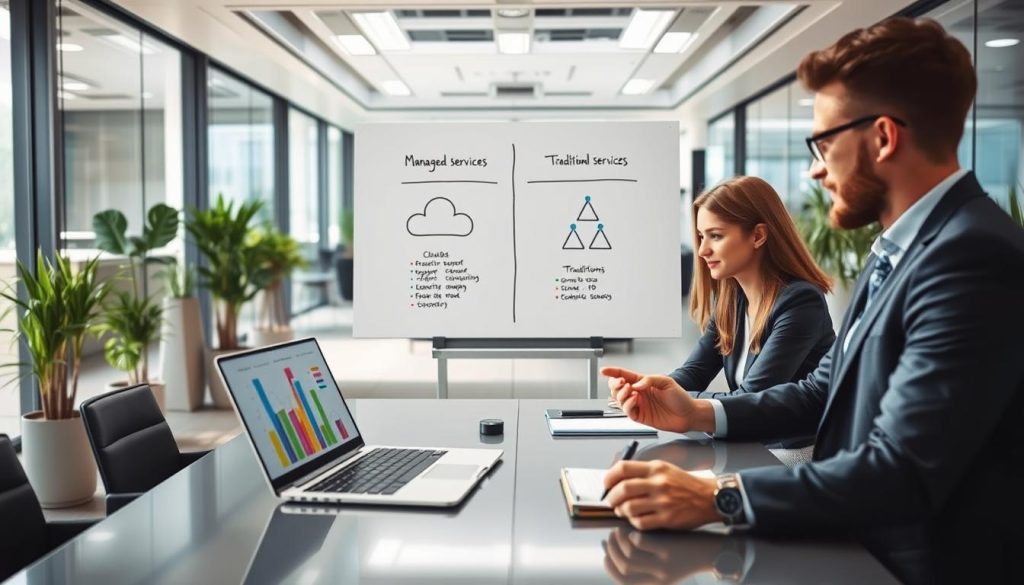
Traditional IT support often involves many vendors. This makes managing IT complex and can lead to finger-pointing. It also takes a lot of time and effort to manage.
Managed services bring all these vendors together under one roof. This makes managing IT simpler and ensures all technology areas work together smoothly. It also makes it easier to find who is responsible for what.
| Aspect |
Traditional IT Support |
Managed Services |
| Service Approach |
Reactive problem resolution after failures occur |
Proactive monitoring and preventive maintenance |
| Vendor Structure |
Multiple specialized providers requiring coordination |
Single comprehensive partnership across all domains |
| Service Scope |
Technical troubleshooting and break-fix repairs |
Strategic planning, optimization, and business alignment |
| Cost Model |
Variable expenses based on incidents and emergencies |
Predictable monthly fees covering comprehensive support |
| Provider Knowledge |
Limited familiarity with specific environment details |
Deep understanding of systems, processes, and business needs |
Managed services do more than just fix problems. They help plan technology to meet business goals. They also manage vendors and ensure technology fits business needs.
Analyzing Long-Term vs. Short-Term Costs
Traditional IT support seems cheap at first because you only pay when problems happen. But, it’s actually more expensive when you consider downtime and lost productivity. It also leads to more problems because it doesn’t prevent them.
Managed services have a fixed cost that includes regular checks and planning. This makes it easier to budget and avoid surprise costs. It also helps businesses save money in the long run by preventing problems.
Managed services offer more than just cost savings. They also reduce downtime and improve productivity. This helps businesses stay competitive and keep customers happy.
Working with a managed service provider for a long time adds value. They learn about your business and can support you better over time. This is important during big changes or when growing fast.
Selecting the Right Managed Services Provider
Finding the right managed services provider is crucial. It requires looking at technical skills, cultural fit, and industry knowledge. These factors help decide if the partnership will be beneficial or frustrating.
German businesses need to carefully choose their IT management in Sweden. The right provider can greatly improve IT reliability and security. It can also boost innovation and help businesses stay competitive.
Providers in Sweden vary a lot in quality and service. It’s important to evaluate them based on clear criteria. This ensures a successful partnership in the long run, not just based on price or marketing.
Choosing a managed service provider is a strategic decision for German businesses. It involves deep integration with critical systems. This makes the selection process complex and important.
We help businesses evaluate providers using proven frameworks. These frameworks look at both technical skills and intangible factors like communication and culture. Switching providers later can be risky and disruptive.
Essential Standards for Assessment
When evaluating providers, consider several key areas. Technical expertise and certifications are foundational. Providers should have current credentials and support your business’s technology.
The provider’s service delivery infrastructure is also important. Look at their monitoring tools, support availability, and escalation procedures. Make sure they have robust service level agreements and support in German.
Cultural fit and communication effectiveness are crucial for a successful partnership. Providers and clients should share values and communicate well. Assess chemistry during initial discussions and check if their communication style matches yours.
Financial stability is another key factor. Managed service partnerships last many years. Providers should be financially stable to avoid disruptions and ensure continuity.
Technology services in Stockholm and other Swedish cities vary. Providers range from small firms to large corporations. Each has its own strengths and weaknesses, depending on your business needs.
| Evaluation Criterion |
Key Indicators |
Assessment Method |
Risk if Inadequate |
| Technical Expertise |
Vendor certifications, staff credentials, technology breadth, innovation capability |
Verify certifications, review case studies, assess thought leadership content |
Limited problem-solving ability, outdated approaches, security vulnerabilities |
| Service Delivery Model |
Monitoring tools, SLA guarantees, response times, escalation processes |
Review service agreements, test support responsiveness, examine infrastructure |
Slow issue resolution, system downtime, business disruption |
| Cultural Compatibility |
Communication style, business values, relationship approach, language capabilities |
Assess initial interactions, check client references, evaluate engagement model |
Miscommunication, unmet expectations, partnership friction |
| Financial Stability |
Company longevity, client retention, growth trajectory, market reputation |
Research financial health, verify client tenure, assess market position |
Service discontinuity, forced provider changes, knowledge loss |
| Industry Knowledge |
Sector experience, regulatory understanding, specialized solutions, relevant case studies |
Review industry-specific credentials, examine similar client outcomes, validate compliance expertise |
Generic solutions, compliance gaps, inefficient implementations |
We use detailed evaluation frameworks to assess providers. This helps German businesses find the right partner. It reduces the risk of a bad partnership and increases the chance of success.
The Value of Sector-Specific Knowledge
Industry experience is very important. Providers with deep sector knowledge can offer better solutions. They understand the specific challenges and requirements of your industry.
Sector-specialized providers can implement solutions faster and anticipate your needs. They bring insights from similar clients, which helps solve problems and innovate. Different industries have different technology needs, and specialized providers can offer advantages.
Regulatory compliance is another area where sector knowledge is crucial. Providers familiar with regulations can help avoid costly mistakes. German businesses in regulated industries like healthcare or finance benefit from providers with GDPR expertise.
Providers with industry experience can improve operational efficiency. They understand typical workflows and pain points. For example, a provider with manufacturing experience can integrate production systems better than a generic provider.
The provider’s track record with similar clients is important. Request case studies and speak with reference clients. This helps verify the provider’s ability to deliver results in your specific context.
The Role of Cybersecurity in Managed Services
Cyber threats are getting more complex every day. Businesses must choose between reacting to threats or preventing them. Cybersecurity is now a key part of managed services, crucial for German businesses in the Nordic markets.
Security is integrated into all managed services. This creates a strong shield for your business, protecting assets and data. It keeps your operations running smoothly, even with many threats.
Traditional security methods often treat security as separate. But we make security a core part of everything we do. Swedish managed security services use advanced tech and expert oversight to protect against threats.
The threat landscape has changed a lot. Old security tools are not enough to protect against today’s threats. Businesses face attacks from nation-states and cybercriminals using new techniques.
Understanding Modern Cyber Threats
Today’s threats are diverse and can hit from many angles. Ransomware attacks have become more complex, stealing data before encrypting it. These double extortion tactics are very dangerous.
Phishing attacks are now very sophisticated. They use AI to create fake emails that seem real. These emails trick employees into giving away sensitive information.
Supply chain attacks are also a big concern. They target software or service providers to get into many organizations at once. These attacks use trust to spread malware.
Modern threats are getting more advanced. Advanced persistent threats can stay hidden for years, causing a lot of damage. These threats are hard to detect.
Consider the evolving nature of these threats:
- Zero-day exploits: Attackers find and use software vulnerabilities before patches are available
- Living-off-the-land attacks: Criminals use system tools to do malicious activities, making detection hard
- Encryption evasion: Malware hides its communications to avoid detection
- Social engineering: Tactics that exploit human trust and decision-making
- Mobile device targeting: Attacks on smartphones and tablets used for business
The battle between attackers and defenders is getting faster. Criminals are coming up with new ways to attack faster than most IT teams can keep up. This makes it hard for businesses to protect themselves.
Comprehensive Cybersecurity Through Managed Services
Managed services can help bridge the security gap. They provide advanced security without the high costs of building it yourself. Our services include continuous monitoring and rapid threat detection.
Our Swedish managed security services start with a thorough security assessment. We check your current security against industry standards. This helps us identify vulnerabilities and plan how to fix them.
Understanding your IT infrastructure Sweden is key. We analyze your systems and data flows to find weaknesses. This helps us create a plan to improve your security over time.
The implementation phase builds multiple layers of defense. These layers work together to protect your business:
| Security Layer |
Primary Function |
Key Benefits |
| Managed Endpoint Security |
Protects desktops, laptops, and mobile devices with advanced threat detection |
Automated response to threats, continuous monitoring, minimal user disruption |
| Managed Firewall Services |
Controls network traffic and prevents unauthorized access attempts |
Real-time traffic analysis, intrusion prevention, policy enforcement |
| Email Security Solutions |
Blocks phishing attempts, malicious attachments, and suspicious links |
Reduces human error risk, protects against social engineering, maintains productivity |
| Security Information and Event Management |
Correlates security data from across your environment |
Identifies sophisticated attacks, provides comprehensive visibility, enables rapid response |
Employees are both a risk and a defense. Our security awareness training teaches them to spot and respond to threats. This human firewall approach strengthens your security.
Regular security audits and vulnerability assessments are crucial. They help your security keep up with changes in your IT infrastructure Sweden. This ensures your defenses stay strong as your operations grow.
Incident response planning is also key. Even with the best prevention, security incidents can still happen. Our services help minimize damage and speed up recovery.
Managed security services offer more than just protection. They give you access to the latest threat intelligence. You also get regular reports and help with compliance.
We offer these services through a partnership model. Our security operations centers watch your systems 24/7. This provides protection that internal teams can’t match, against threats from anywhere.
Our advanced tech, expert team, and proven processes deliver strong security outcomes. This is better than what most businesses can do on their own. It’s a way for growing businesses to get top-level security without the high costs.
Improving Operational Efficiency with Managed Services
Managed services do more than just fix tech problems. They make businesses run better every day. In Germany, leaders look at tech investments by how they improve operations. Our goal is to remove tech issues that waste time and resources.
Managed services turn IT into a tool that helps businesses grow. They make things run smoother by automating tasks and using resources wisely.
Businesses see improvements in many areas. Tech problems that used to take up a lot of time are now caught and fixed before they cause trouble. Employees can focus on their jobs, not tech issues. Standard processes replace old ways that often led to mistakes.
Streamlining Business Processes
Improving how things get done is key to what managed services offer. We look at your current ways of working to find ways to make them better. We use our experience to quickly spot and fix problems.
Automation makes tasks that used to take a lot of time much faster. It handles tasks that used to take hours, freeing up employees to do more important work. Workflow automation makes things move faster by not needing people to do everything manually.
Connecting different systems together helps avoid mistakes that happen when they’re not talking to each other. This makes information flow smoothly, without needing people to act as middlemen.
Cloud solutions in the Nordic countries are key to making things better. They let people work from anywhere without losing performance or security. They also grow or shrink as needed, keeping things running smoothly.
Cloud tools make it easier for teams to work together, no matter where they are. We help German businesses use these tools to their fullest potential. This keeps them in line with rules and makes things run better.
Enhancing Employee Productivity
Managed services also make employees more productive. Reliable tech means less time lost to problems. Quick support means less time waiting for help.
Easy-to-use systems mean less time spent learning how to use them. This lets employees get things done faster. Self-service options mean people can solve simple problems on their own, saving time.
We measure success by how much we improve things. Fewer tech problems mean less disruption. Happy users mean they can do their jobs better.
Quick fixes mean less time lost to problems. These improvements make technology a help, not a hindrance.
| Efficiency Metric |
Before Managed Services |
After Implementation |
Impact on Operations |
| Average Helpdesk Tickets per Month |
450 tickets |
180 tickets |
60% reduction in disruptions |
| Mean Time to Resolution |
4.5 hours |
1.2 hours |
73% faster problem resolution |
| Employee Technology Downtime |
12 hours per year |
3 hours per year |
75% more productive time |
| Process Automation Coverage |
15% of routine tasks |
65% of routine tasks |
Major resource reallocation |
Less time spent on managing tech vendors is another big win. Having one service to handle everything makes things simpler. This means less time wasted on arguing over who’s responsible for what.
Leaders can focus on big decisions, not tech details. Time saved from dealing with vendors can be used for things that really matter. This benefit is as valuable as the tech improvements, for businesses in Germany without big IT teams.
Improving infrastructure means better performance and happier customers. We keep an eye on how systems are doing and fix problems before they cause trouble. This way, businesses can grow without the usual IT headaches.
Customization of Managed Services for Specific Needs
Your business needs technology that fits your industry and goals, not generic packages. German companies face unique tech needs, rules, and workflows. Our Managed Services Schweden are tailored to meet your exact needs, not the other way around.
We start by learning about your business before we begin. This way, our business IT management Sweden services match your priorities. We make sure you get what you need, without missing out on important functions.
Tailoring Solutions to Industry Requirements
Different industries need different tech approaches. For example, manufacturing focuses on keeping production going. Retail aims to improve customer experience and sales. Professional services need tools for teamwork and client service.
For manufacturing clients, we focus on security and supply chain integration. We know production systems need special IT support. Our solutions help keep industrial systems safe and running smoothly.
With retail businesses, we focus on reliable point-of-sale systems and data protection. We also look at e-commerce performance and how it connects with physical stores. Fast and reliable tech is key to avoid losing sales.
Professional services firms need tools for teamwork and document management. We also focus on keeping client information safe and managing projects well. This helps consulting, legal, and accounting firms work efficiently.
| Industry Sector |
Primary Technology Focus |
Critical Success Factors |
Compliance Requirements |
| Manufacturing |
Industrial control systems, MES integration, supply chain connectivity |
Production continuity, minimal operational disruption, OT/IT convergence |
Industrial safety standards, environmental regulations, quality certifications |
| Retail |
POS systems, e-commerce platforms, inventory management |
System reliability, payment security, customer experience optimization |
PCI DSS, consumer data protection, transaction security |
| Professional Services |
Collaboration tools, document management, project platforms |
Client confidentiality, mobile access, workflow efficiency |
Client data protection, professional liability, confidentiality agreements |
| Financial Services |
Transaction processing, data analytics, security infrastructure |
Regulatory compliance, audit readiness, fraud prevention |
Financial regulations, data sovereignty, audit trail requirements |
Case Studies of Customized Managed Services
Customization adds real value, as shown by our case studies. We start with your goals and understand your operations. Then, we design solutions that meet your specific needs and adapt as your business grows.
Manufacturing Expansion Case Study: A German company expanding in Sweden needed a strong IT setup. We provided Managed Services Schweden that connected their German and Swedish sites securely. Our solution included support for both German and Swedish teams, meeting their needs.
Our solution also met data protection laws in both countries. We integrated production systems with ERP, giving visibility into production while keeping it secure. Our team knew manufacturing systems well, ensuring quick help when needed.
Retail Network Case Study: A Swedish retail business needed tech that grew with them. We set up cloud-based POS systems for consistency across locations. Inventory management and store connections gave real-time stock views.
Our business IT management Sweden solution also handled payments securely and fast. We provided analytics for sales and customer insights. This helped the business make smart decisions about products and pricing.
Both cases show our approach: understanding your business first, then designing solutions. We offer ongoing support that changes as your business does. This makes our services feel like a true partnership, supporting your goals and competitive edge.
Integration of Managed Services with Existing Systems
Switching to managed services while keeping current operations running smoothly needs a careful plan. German companies have invested a lot in their tech, including servers and workflows. How well you integrate new services with these systems can make or break your transition.
Connecting new managed services with your current IT in Sweden is a big task. You have custom apps, special equipment, and workflows that have been honed over years. These can’t just be thrown away when you start using managed services, so planning is key.
Technical and Organizational Obstacles
Integrating new services with your old systems comes with big challenges. Technical compatibility issues often pop up first. Old systems might not work with new management tools, and outdated equipment can be a security risk.
We tackle these problems by doing a deep dive into your current IT setup. This helps us figure out what needs to be done, what might cause problems, and how to update things gradually. We know that replacing everything at once is usually not the best idea.

Data migration complexity is another big hurdle. Your business can’t afford to lose data or have it corrupted during the transition. Moving data carefully is crucial to keep everything running smoothly.
Some of the main challenges include:
- Legacy system compatibility with modern management tools
- Data migration requirements to keep information safe
- User adoption barriers when workflows change
- Business continuity maintenance to keep things running smoothly
- Security considerations to protect systems during the transition
Changing how things work can be hard for users. They like what they know and don’t want to change. So, we help plan the change carefully, involve everyone, and train them well.
Proven Strategies for Seamless Transitions
We use proven methods to help German businesses adopt managed services. Phased implementations break big changes into smaller steps. This lets users get used to new things slowly and safely.
Good planning is the base of a successful integration. We make detailed plans, identify risks, and keep everyone informed. This way, we can track progress and solve problems as they come up.
Some key practices for a smooth integration are:
- Thorough testing in safe environments before changes go live
- Validation processes to check everything works right
- Security verification to make sure controls are effective
- User acceptance testing to make sure tasks are easy to do
- Rollback procedures for when things don’t go as planned
Working closely with your IT team and the service provider is key. Regular meetings help solve problems together. This way, everyone knows what’s going on and how to keep things running smoothly.
| Integration Approach |
Implementation Timeline |
Risk Level |
Business Disruption |
| Big Bang Transition |
1-2 weeks concentrated effort |
High risk exposure |
Significant temporary disruption |
| Phased Implementation |
2-4 months gradual rollout |
Moderate controlled risk |
Minimal ongoing impact |
| Parallel Operation |
3-6 months overlap period |
Low risk with redundancy |
Negligible operational effect |
| Hybrid Approach |
Customized timeframe |
Variable based on scope |
Tailored to business tolerance |
Investing in good planning and execution is worth it. It reduces disruption, speeds up adoption, and makes outcomes more predictable. We know your business relies on reliable technology, so choosing the right integration method is crucial.
Success Stories: German Companies Utilizing Managed Services
German companies have seen big improvements when they use technology services from Stockholm providers. They’ve cut costs, met strategic goals, and improved operations. This shows how managed services add real value, letting businesses focus on what they do best while keeping technology running smoothly.
German companies have seen many benefits from managed services. They’ve gotten better at running their operations, keeping data safe, managing costs, and being more agile. These improvements help them stay competitive and grow in their markets.
Manufacturing Excellence Through Strategic Technology Partnership
A German industrial equipment maker set up shop in Sweden to serve the Nordic market. But, they faced big tech challenges that hurt their efficiency and reliability. They had different IT systems in Germany and Sweden, making it hard to communicate and share information.
This manufacturer had to deal with network outages, security issues, and more. These problems took up a lot of management time and hurt their business. They were worried about cyber attacks and losing valuable data.
We started by checking their tech setup in both places. We found key problems and chances to improve:
- Security weaknesses that put their data at risk
- Network issues that slowed down data sharing
- Lack of backup systems that could cause long production stops
- Opportunities for better integration between Germany and Sweden
We fixed these problems with better technology. We upgraded their network and added security services. This made their systems safer and more reliable.
We also set up cloud tools for better communication between teams. This made it easier for them to work together, no matter where they were. Our team kept an eye on things to prevent problems before they started.
- Ninety-five percent less downtime thanks to better technology
- Forty percent less IT spending with better services
- Compliance with data laws in Germany and Sweden
- More time for the team to focus on making things better
The company grew their Swedish operations and saw more success. They now see technology as a tool to help them grow, not a problem to solve.
Retail Transformation Through Digital Infrastructure
A German retail chain had trouble with different systems for online and offline sales. This made it hard to give customers a unified experience. They also had trouble managing their stock because of these issues.
We helped them by connecting their systems through the cloud. This made sure their online and offline stores had the same stock. This reduced customer disappointment and helped them plan better.
In just one year, they saw big improvements. Customers were happier, with a thirty-two percent increase in satisfaction. They also saved money on inventory, with a twenty-eight percent reduction in costs.
Our services also let their IT team work on new projects. They launched a mobile app and started using advanced analytics. This would have been hard without our help.
These stories show how managed services can turn technology into a business strength. German companies get access to top-notch services and expertise. This helps them grow and stay strong in changing markets.
The Future of Managed Services in Germany and Sweden
Looking ahead, the managed services world is set for big changes. New technologies, changing business needs, and lessons from clients worldwide are shaping this future. We’re leading the way, helping German businesses stay ahead with the latest tech.
Managed services are moving beyond small updates. They’re changing how businesses use and manage technology. Analysts predict big growth in Germany and the Nordic countries, thanks to digital transformation. Cloud solutions Nordic countries are just part of this change, along with new approaches to automation and security.
Predictions for Growth and Innovation
Experts say managed services will grow fast in the coming years. This growth is because technology is getting more complex, and companies need more help. Cloud computing and a lack of skilled IT workers are also driving this change.
The way businesses use technology is changing. They’re moving from owning big systems to using services. This lets them use resources as needed, innovate without stopping, and focus on growth.
Artificial intelligence and machine learning are big changes in managed services. They help predict and fix problems before they happen. This changes how services are delivered and valued.
We’re investing in AI to learn from all our clients. Our systems find problems fast and fix them without people. This shift from fixing problems to preventing them is a big change in enterprise tech support Scandinavia.
The Evolving Landscape of Technology
New technologies need new skills in managed services. Edge computing and the Internet of Things are examples. They create new data needs and challenges.
Containerization and microservices are changing how we manage technology. They make systems more agile but also more complex. We’re always learning about these new technologies to stay ahead.
The table below shows how new technologies will change managed services and business outcomes:
| Technology Domain |
Current Integration Level |
Future Capabilities |
Primary Business Impact |
| Artificial Intelligence & Machine Learning |
Alert optimization and pattern recognition |
Predictive issue resolution, automated remediation, intelligent optimization |
Reduced downtime, lower operational costs, proactive maintenance |
| Edge Computing |
Limited deployment monitoring |
Distributed infrastructure management, latency optimization, local processing |
Enhanced performance for real-time applications, reduced bandwidth costs |
| Internet of Things |
Basic device connectivity support |
Comprehensive IoT platform management, data analytics, security orchestration |
Operational intelligence, asset optimization, predictive maintenance |
| Advanced Cloud Architectures |
Infrastructure migration and basic management |
Multi-cloud orchestration, serverless computing, cost optimization algorithms |
Greater flexibility, improved efficiency, strategic resource allocation |
Quantum computing is coming, and it will change how we solve problems. We’re watching this closely, ready for when it becomes a must-have. This way, German businesses can stay ahead of the curve.
New technologies and changing business models open up big opportunities. We work with German companies to prepare for the future. This approach to enterprise tech support Scandinavia helps them stay competitive and keep growing.
The Role of Cloud Computing in Managed Services
Cloud technologies have changed how German companies work. They now offer services that were once too expensive or hard to get. This change affects everything from how resources are used to how companies pay for technology.
Cloud platforms help German businesses get top-notch services without huge upfront costs. This makes advanced technology available to all, not just big companies. It levels the playing field, allowing smaller businesses to compete with the big guys.
Scalability and Infrastructure Advantages Through Cloud Platforms
Cloud solutions bring big changes to managed services. They offer scalable infrastructure that grows or shrinks as needed. This means businesses don’t waste money on unused resources.
We use cloud solutions Nordic countries to offer services that were too expensive before. This includes monitoring systems, huge storage for backups, and quick setup of new services. These are things that would take weeks or months with old methods.
Cloud computing makes Managed Services Schweden more efficient and affordable. It reduces the need for unique setups and automates many tasks. This makes things simpler, cuts down on mistakes, and fixes problems faster.
Cloud platforms change how companies spend on technology. They move from big upfront costs to monthly expenses. This makes it easier to manage money and plan for the future.
Operational and Strategic Benefits for German Enterprises
Cloud integration brings many benefits beyond saving money. It offers anywhere access for work, making remote work easier. This is key for businesses that want flexible work setups.
Automatic updates keep businesses running with the latest software. This means no more long downtime for updates. We handle these updates as part of our cloud solutions Nordic countries service, keeping everything running smoothly.
Cloud platforms also offer disaster recovery that’s better than what most businesses can do alone. They automatically copy data to different places, keeping it safe even during big problems. This helps businesses grow into new markets without huge IT costs.
We help German businesses use cloud benefits through Managed Services Schweden. We choose the right cloud platform, move services there, and keep things running well. We also help connect cloud services with what’s left on-premises.
Specific cloud-based managed services we provide cover all business technology needs:
| Service Type |
Primary Function |
Business Value |
Key Features |
| Managed Backup |
Data protection to secure cloud storage |
Business continuity with geographic redundancy |
Automated scheduling, encryption, rapid recovery |
| Cloud-to-Cloud Backup |
Protection of SaaS application data |
Safeguards Microsoft 365 and similar platforms |
Application-aware backup, granular recovery options |
| Managed Security Services |
Threat analysis from cloud platforms |
Faster attack identification across client base |
AI-driven detection, 24/7 monitoring, rapid response |
| Cloud Management Platforms |
Unified visibility and control |
Simplified management of distributed resources |
Single dashboard, automated workflows, comprehensive reporting |
These cloud services together create a strong technology base for businesses. They help companies achieve their goals without the hassle of managing IT. This makes cloud-based managed services key for success in today’s digital world.
Building a Strong Partnership with Managed Services Providers
When German companies work with business IT management Sweden providers, a good partnership is key to success. It’s not just about the tech skills. It’s about building a team that works together to meet business goals.
Successful partnerships share a few key traits. They have mutual commitment to getting better, a shared vision, and open communication. This helps avoid problems before they start.
Just having technical skills isn’t enough when IT support Sweden providers work with clients worldwide. The quality of the partnership is what makes the difference. It’s as important as managing your IT or keeping your data safe.
Establishing Effective Communication and Collaboration
Good communication is the base of a strong managed services partnership. It lets providers understand what’s important to your business. We set up communication frameworks early on to make sure everyone is on the same page.
We use different ways to talk, depending on what’s needed. Regular meetings help us check in and talk about big plans. This way, we can catch any problems early.
We make sure you can reach us easily:
- Direct phone access for urgent needs
- Email for detailed questions
- Web portals for self-service
- Chat for quick questions
We also work together on big plans. This helps us understand how technology can help your business grow. We look for ways tech can make things better or give you an edge over others.
We listen with genuine curiosity about your business. We know you know your business better than we do. This helps us give advice that really fits your needs.
Cultivating Long-Term Relationship Management
Good partnerships need effort to keep them strong over time. We have quarterly business reviews to check in and plan for the future. These reviews help us stay on track and celebrate our wins together.
These reviews do a lot for us. They let us share how we’re doing, compare to our goals, and celebrate our successes. It’s a chance to talk openly about what’s working and what’s not.
We also have ways to get feedback all the time:
- User satisfaction surveys
- Performance scorecards
- Regular check-ins
- Post-incident reviews
As we work together longer, we get to know your business better. We learn about your model, how you work, what you’re comfortable with, and your tech setup. This helps us help you even better over time.
This knowledge gives us an edge. We can anticipate your needs, spot problems fast, and offer advice that really fits your situation. This kind of knowledge is hard to get from just reading about your business.
We make sure to keep the same team working with you. We document everything about your business and preferences. This way, we can keep the relationship strong, even when team members change.
Final Thoughts on Managed Services Schweden for German Businesses
The digital world needs strong tech partnerships, not just support deals. German companies aiming to lead in Nordic markets face big hurdles. They need special skills, cultural know-how, and tech savvy across many rules.
Transforming Technology into Strategic Assets
Managed Services Schweden is more than just outsourcing IT. It turns tech into a growth engine. The right partner gives stable costs, keeps security ahead, and boosts work flow. This lets your team focus on what really matters.
Swedish IT outsourcing gives German firms access to top-notch tech and know-how. It’s a big help in dealing with global rules, managing cloud systems, or keeping data safe.
Taking the Next Step Forward
Business leaders should check if their tech management fits their goals. Moving to managed services starts with knowing what’s not working and what you want. Working with experts who get both German business and Swedish tech is key. It sets you up for success, growth, and staying ahead in the digital world.
FAQ
What exactly are Managed Services Schweden and how do they differ from traditional IT support?
Managed Services Schweden offer a deep partnership in technology. They take care of your IT needs, unlike traditional support. They focus on preventing problems, not just fixing them.
They monitor your IT and keep it running smoothly. This makes IT a reliable asset for your business. You get fixed costs and don’t have to deal with many vendors.
Why should German businesses choose IT support Sweden for their managed services needs?
German businesses benefit from IT support Sweden. They offer top-notch tech skills and strong data protection. They also understand German business needs well.
They provide multilingual support and follow European laws. Their tech infrastructure is advanced and cost-effective. This makes them a great choice for German businesses looking to expand in Sweden.
What are the typical costs associated with Swedish IT outsourcing through managed services?
The costs of Swedish IT outsourcing are predictable. They depend on the number of users and devices. Most German businesses find it cheaper than keeping IT in-house.
Prices are fixed, so you know what to expect. This makes budgeting easier. Many clients see a 20-40% reduction in IT costs.
How do technology services Stockholm and other Swedish cities provide compare to services available in Germany?
Technology services in Stockholm and other Swedish cities are top-notch. They offer advanced infrastructure and expertise. This makes them a great choice for businesses in both markets.
Sweden’s tech scene is known for innovation and quality. They have a highly educated workforce and invest heavily in tech. This creates a strong partnership for German businesses.
What security measures do Swedish managed security services provide to protect against cyber threats?
Swedish managed security services use multiple layers of defense. They start with security assessments and then protect endpoints and networks. They also monitor email and track security events.
They have 24/7 security centers with certified experts. This provides a level of security that’s hard to replicate internally. They also offer training and compliance management.
How do cloud solutions Nordic countries host enhance the managed services you deliver?
Cloud solutions in Nordic countries improve our managed services. They offer scalable infrastructure and high availability. This makes IT more efficient and cost-effective.
We use cloud platforms like Azure and AWS. This allows us to provide backup, security, and collaboration tools. Sweden’s green data centers are ideal for cloud services.
What industries do you specialize in for business IT management Sweden services?
We specialize in various industries, including manufacturing and retail. We also serve professional services and logistics. Our expertise helps German businesses in Sweden.
We understand the specific needs of each industry. This allows us to provide relevant solutions. We help German businesses expand in Sweden smoothly.
How does enterprise tech support Scandinavia you provide handle multilingual requirements for German businesses?
Our tech support in Scandinavia meets multilingual needs. We have teams fluent in German, Swedish, and English. We provide support in multiple languages.
We understand the importance of language in communication. Our team is trained to provide culturally competent support. This ensures effective communication across languages.
What service level agreements can German businesses expect from your IT infrastructure Sweden management?
We offer comprehensive service level agreements. They define response and resolution times. We guarantee high uptime and availability.
Our agreements are tailored to your needs. We provide proactive monitoring and maintenance. This ensures your IT runs smoothly.
How do you ensure regulatory compliance for German businesses operating in Sweden?
We ensure regulatory compliance through deep understanding of laws. We implement technical controls and processes. This meets regulatory requirements.
We conduct regular compliance audits. We provide guidance on data protection and cybersecurity. This helps German businesses in Sweden stay compliant.
What is your approach to integrating managed services with our existing IT infrastructure Sweden already hosts?
We integrate managed services with your existing IT infrastructure. We start with a comprehensive discovery. This identifies integration requirements and potential obstacles.
We design transition approaches that accommodate legacy systems. We prioritize compatibility and coexistence. This ensures a smooth integration process.
Can you provide examples of how your managed services have helped German manufacturing companies?
We’ve helped many German manufacturing companies. One example is a mid-sized industrial equipment manufacturer. They faced frequent network outages and disconnected systems.
Our managed services implementation improved their situation. We upgraded their network and implemented industrial firewall solutions. This reduced downtime and improved information flow.
How do you handle disaster recovery and business continuity for Swedish operations?
We handle disaster recovery and business continuity through comprehensive strategies. We start with regular backups and documented recovery procedures. We also have redundant infrastructure and failover capabilities.
We regularly test our recovery procedures. This ensures we meet your business’s recovery time objectives. We also provide incident response coordination and communication protocols.
What makes your approach to Managed Services Schweden unique compared to other providers?
Our approach to Managed Services Schweden is unique. We combine deep expertise in serving German businesses with a strong understanding of Swedish technology and regulations. This creates a bridge competency that other providers lack.
We offer a comprehensive service scope and a proactive approach. We focus on prevention and strategic guidance. Our partnership mentality ensures we understand your business needs and deliver relevant solutions.
How quickly can you implement managed services for a German business expanding to Sweden?
We can implement managed services quickly. The timeline depends on the scope of services and the complexity of your environment. We offer expedited implementation services for rapid deployment.
We also provide extended implementations for measured transitions. This allows for gradual change and minimal disruption. We maintain close communication throughout the implementation process.
What ongoing support and optimization do you provide after initial managed services implementation?
After implementation, we provide ongoing support and optimization. We monitor your IT 24/7 and respond to issues immediately. We also perform proactive maintenance and offer helpdesk support.
We conduct quarterly business reviews and provide continuous security monitoring. We help plan technology upgrades and ensure your IT aligns with business goals. Our approach focuses on continuous improvement.
How do you measure and report on the value your managed services deliver?
We measure and report on the value of our managed services through various metrics. We track operational performance, financial metrics, security metrics, and strategic metrics. This provides a comprehensive view of the value we deliver.
We present these metrics during quarterly business reviews. We use clear visualizations and trend analysis to show improvement. Our reporting emphasizes transparency and accountability, ensuring you understand the value we deliver.
Author
Johan Carlsson - Country Manager
Johan Carlsson is a cloud architecture specialist and frequent speaker focused on scalable workloads, AI/ML, and IoT innovation. At Opsio, he helps organizations harness cutting-edge technology, automation, and purpose-built services to drive efficiency and achieve sustainable growth. Johan is known for enabling enterprises to gain a competitive advantage by transforming complex technical challenges into powerful, future-ready cloud solutions.