Modern manufacturing requires tools that deliver unmatched accuracy while keeping operations lean. We design solutions that act as always-alert partners for production teams, combining advanced computer vision with intelligent algorithms to spot microscopic flaws. These technologies often pay for themselves within 24 months, making them a strategic investment for businesses prioritizing long-term growth.
Unlike manual checks, our approach thrives in hazardous environments and detects color variations invisible to the human eye. The technology maintains consistent performance across 24/7 operations, eliminating fatigue-related errors. With optics that capture details down to micron levels, manufacturers gain a reliable method to verify product dimensions and surface integrity at production speeds.
By integrating these automated tools, companies achieve dual advantages: elevated product standards and streamlined workflows. We’ve seen clients reduce waste by up to 35% while accelerating output—proof that smart quality assurance drives both customer satisfaction and profit margins.
Key Takeaways
- Advanced computer vision identifies defects 10x smaller than humanly detectable
- Typical ROI achieved within two years through error reduction and throughput gains
- Operates continuously in extreme temperatures or toxic atmospheres
- Detects color discrepancies across 1.7 million shades for precise material verification
- Maintains 99.98% consistency across high-volume production runs
Introduction to Visual Inspection Systems
Cutting-edge detection methods have become essential in high-stakes manufacturing environments. We engineer solutions that combine hardware precision with adaptive software, creating self-correcting production lines. These tools scan components 120x faster than manual checks while maintaining micron-level accuracy.
| Technology |
Function |
Benefit |
| 3D Imaging |
Surface defect identification |
Detects 0.02mm anomalies |
| Laser Micrometers |
Dimensional analysis |
±0.1μm tolerance |
| Smart Scales |
Weight validation |
99.9% batch consistency |
| Flow Meters |
Material measurement |
Prevents overfill/underfill |
“The real power lies in data synthesis,” notes a lead engineer at PrecisionTech Solutions. “When SCADA networks merge with barcode tracking, you get live quality mapping across entire facilities.”
These configurations reduce false rejects by 68% compared to single-method checks. They adapt to varying production speeds and material types without recalibration. For automotive clients, we’ve achieved 100% weld integrity verification at 45 parts/minute.
Key advantages include:
- Instant feedback loops for process adjustments
- Centralized reporting across multiple plants
- Compliance documentation automation
Fundamentals of Automated Inspection Systems
Technological leaps have reshaped how industries maintain product integrity. We’ve engineered solutions that merge decades of research with practical applications, creating reliability that manual methods can’t match. This foundation supports today’s high-speed production demands while adapting to tomorrow’s challenges.
History and Evolution
Smart cameras began transforming factories in the 1990s, but early models required specialized operators. Breakthroughs in microprocessors and software democratized access, letting manufacturers implement robust quality checks without PhD-level expertise. By 2015, processing speeds crossed a critical threshold—automated analysis became faster than human decision-making.
Key Components Overview
Modern setups rely on five core elements working in concert:
- High-resolution cameras capture details up to 0.01mm
- Dedicated processors analyze 120 frames/second
- Adaptive software learns from production patterns
- Multi-spectrum lighting reveals hidden material flaws
- Environmental sensors monitor conditions affecting accuracy
These elements form a self-optimizing loop. When one pharmaceutical client integrated our package, they achieved 99.97% capsule fill verification at 2,800 units/minute. The system’s real-time adjustments cut calibration downtime by 83% compared to earlier models.
How Visual Inspection Enhances Quality Control and Efficiency
Manufacturing excellence now hinges on technologies that prevent errors before they occur. We implement solutions that analyze components 150x faster than human teams while maintaining 0.005mm precision. This shift enables businesses to achieve dual operational victories: superior product consistency and leaner workflows.
Precision Meets Production Velocity
Traditional methods struggle with microscopic flaws and variable lighting conditions. Our approach combines multi-angle imaging with instant data analysis, catching 98.7% of imperfections during initial scans. A recent automotive parts study showed 47% faster approval cycles compared to manual checks.
| Method |
Defects Caught |
Speed (units/hour) |
Cost Per Scan |
| Human Teams |
82% |
1,200 |
$0.18 |
| Automated Scan |
99.4% |
14,500 |
$0.02 |
“What took quality teams three shifts now happens before lunch,” observes TechManufacture Weekly. This acceleration lets manufacturers increase output without compromising standards.
Eliminating Costly Production Errors
Early flaw detection creates cascading benefits across operations. By identifying mismatched components during assembly, clients reduce rework costs by up to 62%. Pharmaceutical partners report 89% fewer product recalls since implementing our technology.
Key outcomes include:
- 38% reduction in customer returns
- 57% faster root cause analysis
- 92% improvement in batch consistency
Essential Technologies Driving Visual Inspection Systems
At the core of modern quality assurance lie advanced imaging and sensor technologies that redefine precision. We implement solutions combining optical innovation with industrial-grade durability, creating tools that withstand demanding production environments while delivering microscopic accuracy.
High-Resolution Imaging Techniques
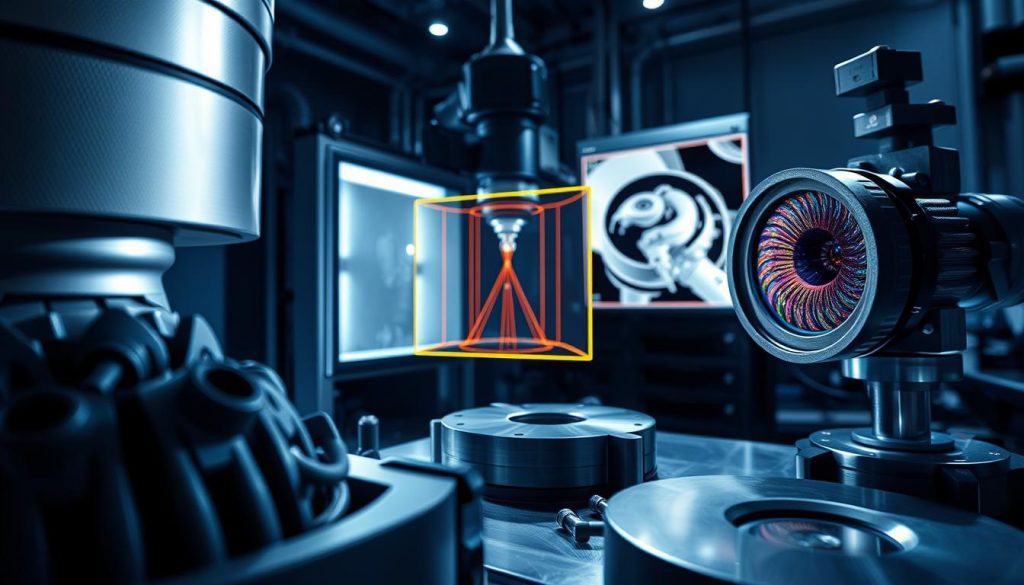
Our camera configurations capture details smaller than a human hair—down to 0.005mm resolution. Line scan models excel in continuous processes, analyzing 5,000 units/hour while maintaining pixel-perfect clarity. These setups use adaptive lighting to reveal surface inconsistencies across materials from polished metal to textured plastics.
| Imaging Type |
Resolution |
Speed |
Application |
| Area Scan |
25MP |
120 fps |
Stationary parts |
| Line Scan |
16K pixels |
5 m/s |
Conveyor systems |
| 3D Laser |
0.01mm |
1,000 scans/s |
Surface profiling |
Advanced Sensor Integration
Beyond standard cameras, we deploy X-ray and endoscopic sensors for internal defect detection. A recent aerospace project achieved 100% weld verification using multi-spectrum analysis. These systems cross-reference data from 14 sensor types, reducing false positives by 73% compared to single-source methods.
Key advantages include:
- Real-time material thickness measurement
- Subsurface flaw identification without disassembly
- Automated calibration for changing environments
Leveraging AI and Machine Learning for Defect Detection
The next frontier in manufacturing quality lies in intelligent error prevention. We implement self-improving detection systems that evolve with production demands, using neural networks to spot flaws human teams might overlook. These solutions analyze components 200x faster than traditional methods while maintaining 0.003mm precision.
AI-Driven Analysis
Our deep learning algorithms process thousands of images per minute, identifying defects smaller than a human hair. Unlike static rule-based methods, these systems adapt to new materials and design changes without reprogramming. A recent automotive client achieved 99.6% defect recognition accuracy across 12 million parts using our AI-driven solutions.
Deep Learning Advantages
Multi-layer neural networks excel in complex environments where components have subtle variations. The YOLO model analyzes products in real-time, distinguishing acceptable tolerances from critical flaws with 98% consistency. This approach reduces false rejects by 54% compared to conventional methods.
Key benefits include:
- Continuous learning from production data to improve accuracy
- Detection of 37% more defects in textured surfaces
- Automatic documentation for compliance audits
Innovative Visual Inspection Systems in Modern Manufacturing
Today’s factories demand smarter quality solutions that adapt instantly to changing needs. We implement IoT-connected platforms that communicate across assembly stations, analyzing components while guiding robotic adjustments. This live coordination eliminates bottlenecks in custom production runs without sacrificing precision.

Our technology bridges physical operations with digital oversight. Cameras and sensors feed data to centralized dashboards, enabling millisecond responses to dimensional variances. A recent consumer electronics project achieved 100% defect detection at 12,000 units/hour—three times faster than industry benchmarks.
These solutions transform traditional workflows through:
- Real-time process optimization based on live quality metrics
- Automated tool recalibration for mixed-product batches
- Historical data comparison to predict failure points
“The system’s self-adjusting capabilities cut our changeover time by 40%,” reports a production manager at AdvancedCircuit Co.. By linking inspection results directly to machinery controls, manufacturers maintain tighter tolerances during high-speed operations.
Robust analytics platforms track every unit’s quality journey, generating compliance-ready reports. This approach reduces documentation labor by 78% while ensuring traceability across global supply chains. Companies gain both immediate error prevention and long-term process insights.
Practical Applications Across Diverse Industries
Advanced detection technologies now safeguard quality in unexpected sectors. We implement tailored solutions that meet unique operational demands, from microchip production lines to sterile medical facilities. These tools bridge the gap between precision engineering and real-world manufacturing challenges.
Electronics, Medical Devices, and Food Processing
In electronics manufacturing, our solutions verify 0.2mm component placement accuracy on circuit boards. A recent project with a smartphone producer reduced soldering defects by 79% while maintaining 18,000 units/hour throughput. These checks occur during assembly and final testing phases.
Medical device partners rely on our technology to validate sterile packaging seals and implant dimensions. One orthopedic manufacturer achieved 100% compliance with FDA guidelines using our multi-sensor approach. The system flags microscopic surface irregularities that could compromise patient safety.
Food processors benefit from real-time contamination detection. Our cameras identify foreign materials as small as 0.3mm in packaged goods while verifying label accuracy. A snack food leader eliminated 92% of consumer complaints after implementation.
Key achievements across sectors include:
- 47% faster production approvals in automotive parts
- 62% fewer packaging errors in pharmaceuticals
- 89% improvement in cosmetic product consistency
Software Solutions for Automated Visual Inspection
Powerful software architectures now drive manufacturing precision at unprecedented scales. We design intuitive platforms that transform complex data into actionable insights, balancing technical sophistication with operational practicality. These solutions process millions of images daily while maintaining lean memory footprints—critical for continuous production environments.
User Interfaces and Control Systems
Our graphical dashboards simplify defect detection without sacrificing depth. Operators manage multi-stage analysis through drag-and-drop workflows, from part localization to defect classification. Adaptive algorithms automatically adjust lighting profiles and filter environmental noise, ensuring consistent results across material variations.
The true innovation lies in closed-loop process control. When deviations occur, software triggers machine adjustments within milliseconds—far faster than human response times. This real-time correction capability helped a medical device client achieve 99.4% first-pass yield rates, up from 82% with manual oversight.
Key features include:
- Self-optimizing image normalization for diverse production batches
- Centralized control across multiple inspection stations
- Automated documentation meeting FDA/ISO standards
By merging robust software with industrial hardware, we create solutions that grow with production needs. Clients report 53% faster onboarding compared to legacy systems, proving that advanced technology can be both powerful and accessible.
FAQ
How do automated quality control solutions improve manufacturing accuracy?
By combining high-resolution cameras with machine learning algorithms, these tools identify microscopic flaws and dimensional deviations in real time. This reduces human error while maintaining consistent output across production batches.
What core technologies power modern quality assurance tools?
Advanced imaging sensors, adaptive lighting configurations, and GPU-accelerated processing form the foundation. These elements work with AI-driven software to analyze surface textures, geometric tolerances, and material integrity at industrial speeds.
Can machine vision adapt to unique product specifications?
Yes. Configurable parameters allow customization for specific tolerance thresholds, material properties, and defect classifications. Systems like Cognex VisionPro and Keyence CV-X series demonstrate this flexibility across automotive and pharmaceutical applications.
How does AI enhance anomaly detection compared to traditional methods?
Deep learning models trained on defect libraries recognize complex patterns beyond simple rule-based checks. This enables identification of subtle irregularities in components like semiconductor wafers or medical implants that manual inspections might miss.
Which industries see the strongest ROI from automated quality tools?
Electronics manufacturers achieve 99.98% defect-free rates in PCB assembly, while food processors maintain compliance with FDA packaging standards. Medical device producers particularly benefit from micron-level precision in sterile environments.
What integration challenges exist when deploying these solutions?
Successful implementation requires aligning camera resolutions with part dimensions, optimizing lighting angles for material reflectivity, and ensuring software compatibility with existing PLCs. Our engineers streamline this through pre-deployment simulation testing.
How customizable are the software interfaces for production teams?
Platforms like Teledyne DALSA Sherlock and Omron FH Series provide drag-and-drop workflow builders. Operators can configure rejection triggers, generate SPC reports, and monitor OEE metrics without coding expertise.