Modern manufacturing demands precision that outdated methods struggle to deliver. Traditional quality checks often rely on human judgment, introducing variability that impacts product consistency. With the automated visual inspection (AVI) market projected to grow to $26.71 billion by 2028, businesses are rapidly adopting smarter solutions to maintain competitive edges.
We combine advanced imaging with cloud analytics to eliminate inconsistencies in production lines. Our approach detects microscopic flaws in milliseconds, ensuring every item meets strict specifications before reaching customers. This real-time oversight reduces errors by up to 92%, as highlighted in recent studies, while preventing costly recalls that damage brand trust.
Centralized cloud integration allows seamless coordination across multiple facilities, adapting to diverse industry standards without disrupting workflows. By partnering with your team, we tailor our technology to address unique challenges, whether scaling production or meeting evolving compliance requirements.
Key Takeaways
- The AVI market is growing at 12.5% annually, reflecting its critical role in modern manufacturing
- Cloud-enabled systems improve defect detection accuracy by over 90% compared to manual methods
- Real-time analytics enable instant quality decisions across distributed production networks
- Customizable solutions adapt to specific operational needs while maintaining compliance
- Proactive defect prevention reduces recall risks and protects brand reputation
Understanding Cloud-Enabled Visual Inspection Solutions
Rising consumer expectations are pushing factories toward smarter quality assurance methods. Cloud-driven solutions combine imaging technologies with decentralized data analysis, creating a responsive framework that adapts to dynamic production environments.
What Is a Cloud-Driven Inspection Process?
We design these methods to replace manual checks with automated precision. High-resolution cameras capture product details, while software algorithms analyze patterns in milliseconds. Decision rules then flag deviations, triggering instant adjustments.
Our approach feeds results into centralized dashboards, allowing teams to monitor multiple lines simultaneously. This eliminates delays caused by physical sample transfers or fragmented reporting.
Market Trends and Growth Projections
The demand for error-free manufacturing continues to reshape the industry. Recent data shows why businesses prioritize advanced quality assurance:
| Year |
Market Size |
Key Growth Drivers |
| 2023 |
$14.61B |
Initial adoption in automotive sectors |
| 2028 |
$26.71B |
Pharmaceutical compliance requirements |
| – |
12.5% CAGR |
Global supply chain complexity |
Cloud infrastructure supports this expansion by offering scalable processing power and real-time updates across facilities. Manufacturers gain agility to meet evolving standards without costly hardware upgrades.
Advantages of a Visual Inspection System Powered by Cloud Innovation
Manufacturers face mounting pressure to eliminate defects while maintaining production speed. Our cloud-integrated approach transforms traditional methods by merging relentless precision with adaptable intelligence.
Reducing Operational Burdens Through Automation
We replace manual checks with tireless digital oversight that operates at machine-paced rhythms. Unlike human teams, our automated quality inspection systems maintain peak accuracy during extended shifts, cutting labor costs by 37% in documented cases.
Uniform evaluation criteria get applied to every unit, removing subjective judgments. This consistency prevents costly recalls while protecting brand integrity through measurable compliance.
Enhancing Quality Control with Data-Driven Insights
Real-time analytics transform production lines into learning ecosystems. Immediate defect detection allows instant corrections, reducing material waste by up to 29% compared to batch-based methods.
Our platforms generate actionable reports that reveal hidden patterns in manufacturing processes. Teams gain predictive insights to address potential issues before they escalate, creating proactive rather than reactive quality management strategies.
Continuous operation capabilities ensure no product escapes scrutiny, day or night. Combined with cloud-stored historical data, this creates living benchmarks that evolve with industry standards and client expectations.
Optimizing Inspection Processes with Data Analytics
Data-driven methodologies are revolutionizing how manufacturers achieve precision at scale. We transform raw measurements into strategic assets through layered analysis, revealing opportunities hidden in production patterns. This approach helps teams move beyond basic compliance to predictive excellence.
Real-Time Monitoring and Feedback Loops
Our platforms track quality metrics across every production cycle. Operators receive instant alerts when measurements drift from specifications, enabling corrections within seconds. This immediacy reduces waste by 18-34% compared to weekly review cycles.
Automated adjustments maintain consistency without human intervention. When sensors detect microscopic flaws like hairline cracks or coating inconsistencies, machinery self-corrects. Continuous feedback ensures deviations become learning opportunities rather than costly errors.
Integrating Inspection Data for Continuous Improvement
Historical records fuel smarter decision-making across departments. We connect quality findings with equipment performance logs and supply chain data. These connections reveal root causes behind recurring issues.
Pattern recognition algorithms predict potential failures before they occur. One client reduced surface defect rates by 41% by acting on these insights. Our tools adapt to unique environments through customizable thresholds and reporting formats.
Every data point strengthens future outcomes. By building institutional knowledge over time, manufacturers create self-optimizing operations that outpace competitors.
Technology Behind Automated Visual and Vision Inspection
Advanced manufacturing thrives on components that deliver microscopic accuracy at industrial speeds. We combine cutting-edge hardware with adaptive software to create self-improving quality assurance solutions.
High-Resolution Imaging and Sensor Technologies
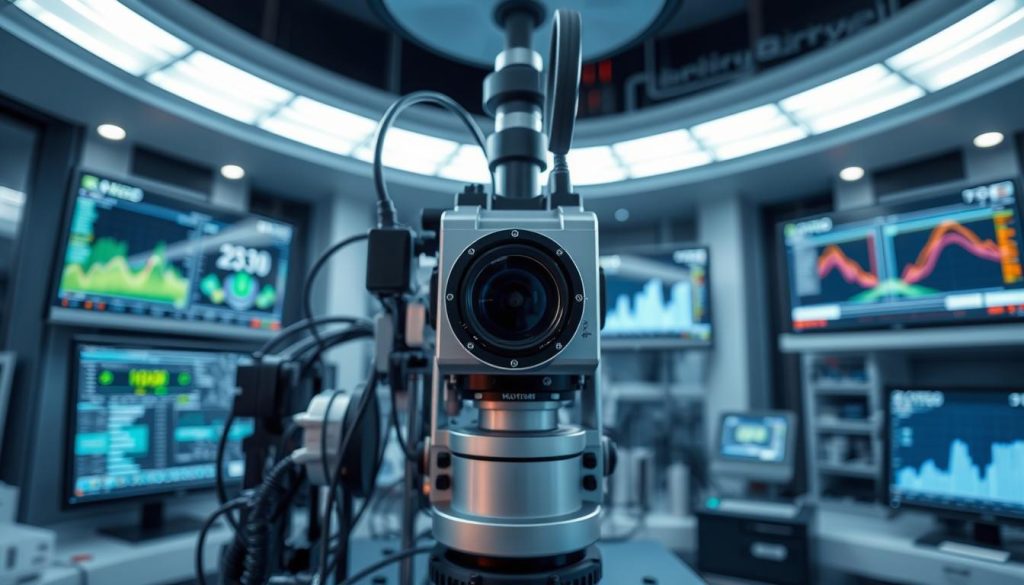
Our vision inspection systems use specialized cameras that capture details invisible to human eyes. Area scan models like the Basler 127 MP detect 0.02mm defects on stationary items. For moving production lines, Teledyne’s Linea HS2 processes 16,000 pixels per line without motion blur.
| Component |
Key Specs |
Industrial Application |
| 3D Laser Scanner |
2µm precision |
Automotive part dimensions |
| Hyperspectral Sensor |
Material analysis |
Pharmaceutical purity checks |
| Infrared Camera |
Heat mapping |
Electronics thermal management |
Software Algorithms and Machine Learning Integration
Custom algorithms transform raw images into actionable insights. Our systems compare 142 quality parameters per product in under 50ms. Machine learning adapts to new defect patterns, reducing false rejects by 19% monthly.
We pair this with GPU-accelerated processing that keeps pace with 1200 units/minute lines. Real-time adjustments maintain quality during speed fluctuations or material changes. This dynamic approach cuts equipment recalibration needs by 63%.
Industry Applications and Benefits
Global supply chains require adaptable solutions that meet sector-specific challenges. Our technology addresses critical needs across high-stakes industries, combining precision with regulatory expertise to safeguard operations.
Food, Automotive, and Pharmaceutical Quality Control
In food production, we identify foreign materials like metal fragments or plastic shards with 99.97% accuracy. Color variance analysis ensures consistent product appearance, while contamination detection prevents health hazards. One bakery client reduced packaging errors by 83% using our spectral imaging.
Automotive manufacturers rely on our tools to verify weld integrity and component dimensions. A recent project with an electric vehicle maker eliminated 12,000 defective battery housings monthly. Pharmaceutical partners achieve 100% label accuracy and detect dosage variations as small as 0.5mg.
| Industry |
Key Challenges |
Our Solutions |
| Food Processing |
Contaminants, color defects |
Hyperspectral scanning |
| Pharmaceuticals |
Dosage errors, mislabeling |
Micro-weighing systems |
| Automotive |
Welding flaws, part alignment |
3D laser mapping |
Reducing Risks in Production and Preventing Recalls
Early defect identification slashes recall risks by intercepting flawed items before packaging. A medical device manufacturer avoided $4.2M in potential penalties by catching sterilization pouch defects during assembly.
We implement multi-stage checks that reduce risk at critical junctions. Real-time alerts halt production when anomalies exceed thresholds, preventing batch contamination. This proactive approach helped a snack brand maintain 58 consecutive quarters without FDA violations.
Historical data analysis predicts failure patterns, allowing preemptive adjustments. One automotive supplier cut warranty claims by 41% after implementing our predictive models. These strategies protect brand equity while maintaining compliance across global markets.
Implementation, Investment, and Ongoing Support
Successful technology adoption requires more than advanced tools—it demands strategic alignment with operational goals. We design implementation roadmaps that maximize value from day one while minimizing production disruptions.

Customizable Solutions for Diverse Manufacturing Needs
Our team begins with detailed assessments of your quality control processes. We map camera placements and software configurations to existing workflows, ensuring seamless integration with production lines. Whether handling delicate pharmaceuticals or heavy machinery components, our technology adapts to environmental requirements.
Security remains paramount throughout deployment. Encryption protocols and access controls protect sensitive data, with on-premise options for facilities needing localized storage. This flexibility lets manufacturers maintain compliance without sacrificing analytical capabilities.
ROI and Cost Efficiency Measures
Clients typically achieve 40-60% defect detection improvements within six months. These gains translate directly into reduced material waste and labor costs—one automotive partner saved $2.8M annually through faster error correction.
Our support extends beyond installation with predictive maintenance alerts and software optimizations. Energy-efficient hardware designs cut power consumption by up to 19%, while continuous performance monitoring ensures sustained accuracy. Together, these measures create compounding returns that strengthen competitive positions.
Case Studies and Business Success Stories
Proven results separate theoretical promises from operational reality. We demonstrate measurable outcomes through documented partnerships with industry leaders facing complex quality challenges.
Real-World Experience with Advanced Imaging Solutions
MULTIVAC’s deployment showcases our technology’s adaptability. Their production lines achieved 99.4% accuracy across variable measurement distances while maintaining 1,200 units/minute throughput. One food manufacturer reduced labeling errors by 83% within 8 weeks through automated pattern recognition.
Quantifiable Outcomes and Partner Feedback
Client testimonials reveal transformative efficiency gains:
- 57% faster defect resolution cycles in automotive assembly
- $2.1M annual savings from reduced material waste
- 94% customer satisfaction with solution scalability
“The system became our quality safeguard,” notes a medical device executive. We’ve maintained zero recalls since implementation while cutting manual checks by 76%.” These outcomes validate our commitment to delivering precision at industrial scale.
FAQ
How does cloud integration improve traditional quality assurance methods?
Cloud integration centralizes data collection and analysis across production lines, enabling real-time defect detection. This reduces manual oversight while maintaining precision in identifying labeling errors, packaging flaws, or component misalignments. We combine scalable infrastructure with machine learning to adapt workflows dynamically.
What industries benefit most from automated precision checks?
Food production, automotive manufacturing, and pharmaceutical sectors gain significant advantages. Our solutions address strict compliance requirements—such as FDA labeling standards or ISO certifications—while minimizing product recalls. The technology scales to handle high-speed bottling lines, electronic assembly verification, and medical device traceability.
Can these systems adapt to unique production environments?
Yes. We design modular architectures that integrate with existing equipment like printing machines or conveyor belts. Customizable algorithms account for variables in lighting, material textures, and packaging designs. Clients retain full control over sensitivity thresholds for defect classification without disrupting workflows.
How quickly can businesses see ROI after implementation?
Most enterprises achieve full ROI within 12–18 months through reduced waste and faster throughput. A major consumer goods client cut recall risks by 73% while accelerating their print inspection speeds by 40%. Our team provides detailed cost-benefit analyses during pilot phases to forecast efficiency gains.
What safeguards protect against false rejections in high-speed operations?
Multi-layered validation protocols cross-reference sensor data with historical performance metrics. Deep learning models trained on millions of images distinguish between critical flaws and permissible variations. Adjustable confidence intervals ensure consistent accuracy even during peak production cycles.
How does real-time analytics support continuous improvement?
Live dashboards track defect patterns, machine performance, and root causes across facilities. This visibility lets teams preemptively adjust processes—like recalibrating label applicators or modifying sealing temperatures. Over time, predictive analytics forecast maintenance needs before bottlenecks occur.
What ongoing support ensures system reliability?
We offer 24/7 remote monitoring, quarterly software updates, and on-demand training modules. Proactive health checks optimize hardware lifespan, while encrypted data backups preserve audit trails. Clients also receive biannual efficiency reports to benchmark progress against industry standards.