In today’s fast-paced manufacturing landscape, maintaining flawless product standards is non-negotiable. We specialize in automated optical inspection technology, delivering tailored solutions that redefine quality control processes. Our approach bridges the gap between traditional manual methods and modern precision, ensuring manufacturers meet rigorous demands without compromising efficiency.
Advanced imaging systems and intelligent software algorithms form the backbone of our inspection tools. These innovations enable rapid defect detection across electronics assembly, automotive components, and other critical industries. By prioritizing accuracy and speed, we help businesses reduce waste, lower operational costs, and maintain competitive advantages.
Customization sits at the core of our strategy. We recognize that every production environment faces unique challenges, which is why our solutions adapt seamlessly to existing workflows. Whether optimizing high-volume lines or specialized applications, our technology scales to match evolving needs.
Continuous innovation drives our commitment to progress. Through artificial intelligence and machine learning integration, we push the boundaries of what automated inspection can achieve. This forward-thinking mindset ensures clients stay ahead in an era where quality defines market leadership.
Key Takeaways
- Advanced imaging and AI-driven software enhance defect detection accuracy
- Customizable solutions integrate smoothly with existing production workflows
- Reduces operational costs through minimized waste and improved efficiency
- Serves diverse industries including electronics and automotive manufacturing
- Continuous innovation keeps pace with evolving quality standards
Introduction to Automated Optical Inspection Solutions
Manufacturers once relied solely on human eyes for quality checks, a method fraught with limitations. This reality shaped early production lines, where teams compared components against reference samples using basic tools like microscopes. “Human vision can’t maintain peak performance through 8-hour shifts,” observes one industry veteran, highlighting why manual methods struggled to keep pace with growing demands.
Historical Overview: From Magnifiers to Machine Vision
The shift from manual verification to automated optical inspection began when production volumes outpaced human capabilities. Early electrical assembly lines used “golden boards” as visual benchmarks, requiring inspectors to memorize countless details. Fatigue and cognitive biases often led to missed defects, creating costly rework cycles.
Modern solutions employ coordinated camera arrays that map components with micrometer precision. Advanced lighting configurations reveal hidden flaws, while software algorithms compare thousands of data points against digital standards. This technological leap eliminated the variability inherent in human-dependent processes.
Meeting Modern Manufacturing’s Relentless Pace
Today’s production environments demand inspection speeds that manual methods can’t achieve. Our automated approach processes components 15x faster than traditional checks while maintaining 99.9% accuracy. Real-time defect detection allows immediate corrective action, preventing quality issues from cascading through production lines.
Reliability forms the cornerstone of effective quality control. By removing human subjectivity, we ensure identical evaluation standards across shifts and facilities. This consistency proves critical for industries like automotive manufacturing, where a single defective part can compromise entire vehicle systems.
Benefits of AOI System Solutions in Production
Modern manufacturing demands error-free outputs at speeds manual methods can’t match. Our solutions address this challenge through intelligent inspection technologies that deliver measurable improvements across two critical areas: product integrity and operational economics.
Enhanced Quality and Consistency
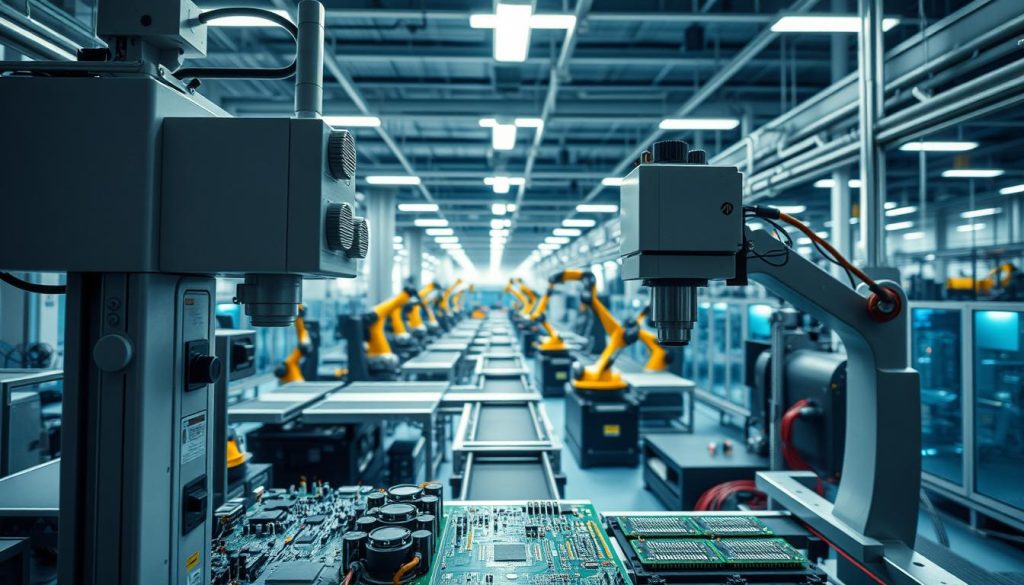
We empower manufacturers to maintain near-perfect quality standards through millimeter-level defect detection. Our technology identifies hairline cracks, micro-scratches, and component misalignments invisible to human inspectors. This eliminates the “Friday afternoon effect” – reduced alertness during long shifts that compromises manual checks.
Real-time analysis ensures identical evaluation criteria for every unit. One automotive client reduced warranty claims by 37% after implementing our solution. “Consistency became our new baseline,” their quality director noted.
Cost Reduction and Waste Minimization
Early defect detection prevents flawed products from consuming additional resources. Our data shows clients reduce material waste by 29% on average within six months. Immediate feedback loops help teams correct issues before they create downstream bottlenecks.
| Metric |
Manual Inspection |
Our Solution |
| Units/Hour |
120 |
1,850 |
| Defect Escape Rate |
8.2% |
0.3% |
| Cost/1000 Units |
$47 |
$12 |
Comprehensive reporting transforms quality data into actionable insights. Detailed defect maps help engineers pinpoint machine calibration issues or material flaws. This targeted approach reduces rework time by 41% compared to traditional troubleshooting methods.
Advanced Imaging and AI Technologies in AOI
Precision manufacturing demands inspection tools that see what human eyes cannot. Our solutions combine advanced imaging technologies with adaptive AI to create inspection ecosystems that learn as they operate. This synergy between hardware and software redefines quality assurance benchmarks.
High-Resolution Camera and Lighting Systems
We deploy three specialized imaging configurations to handle diverse production challenges. Contact Image Sensors (CIS) excel at scanning continuous surfaces like metal sheets, with modular designs adapting to any production line length. For large components, our machine vision cameras capture 25-micron details across surfaces up to 2 meters wide.
| Camera Type |
Resolution |
Key Applications |
| CIS Arrays |
6400 dpi |
Films, foils, textiles |
| Machine Vision |
45 MP |
Automotive panels, PCBs |
| Micro Cameras |
12 MP |
Tube interiors, tight spaces |
Angled lighting configurations reveal hidden flaws through shadow analysis. One client detected 0.02mm cracks in aerospace alloys using our orthogonal illumination setup. “The system sees defects we didn’t know existed,” their engineering lead remarked.
Real-Time Anomaly Detection with AI Software
Our Live Vision platform processes 850 frames/second using neural networks trained on 14 million defect samples. Customizable algorithms adapt to unique product features, reducing false positives by 63% compared to generic solutions. Real-time heat maps guide operators to irregularities during high-speed production.
The software learns from every inspection cycle, improving detection accuracy by 0.8% monthly. Instant reports detail defect locations, dimensions, and probable causes – transforming quality data into corrective actions. With 98.7% first-pass accuracy, manufacturers achieve new levels of operational confidence.
Custom Electromechanical Integration and Robotic Automation
Manufacturing success increasingly depends on seamless integration between inspection technologies and production infrastructure. We engineer solutions that merge precision control with adaptive automation, creating cohesive workflows where quality assurance becomes an organic part of manufacturing processes.
Precision Motion Control and Conveyor Systems
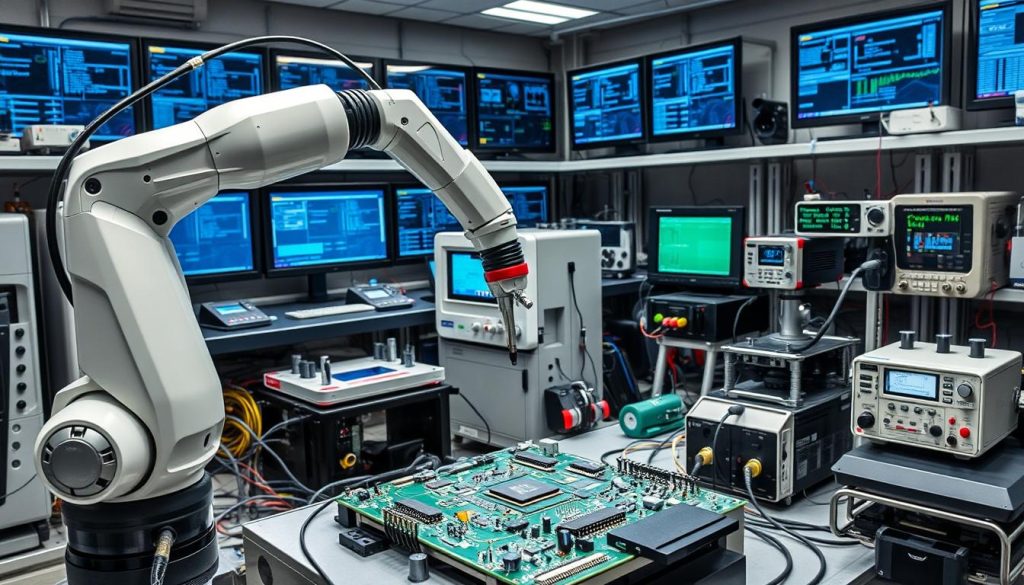
Our conveyor designs adapt to unique production demands through modular configurations. Variable-speed controls maintain consistent part movement under imaging devices, while anti-vibration platforms ensure measurement accuracy. Tailored mounting solutions position cameras and lighting at optimal angles, regardless of component size or shape.
| Conveyor Type |
Resolution |
Applications |
| Micro-Feeder |
±0.05mm |
Miniature electronics |
| Heavy-Duty |
±0.2mm |
Automotive parts |
| Flexible Belt |
±0.1mm |
Irregular shapes |
One medical device manufacturer achieved 99.4% alignment accuracy after implementing our curved-track conveyor. “The system handles our delicate components like surgical instruments,” their production manager noted.
Robotic Arms and Complex Assembly Handling
Six-axis robotic arms perform intricate maneuvers for multi-surface inspections. Vision-guided grippers adjust pressure based on component fragility, while synchronized camera arrays capture 360-degree views. This approach reduced handling damage by 68% for an aerospace client.
Integrated controllers manage real-time communication between robotic actuators and inspection software. Our solutions maintain 0.02-second synchronization between mechanical movements and image capture, ensuring critical defects never escape detection during high-speed operations.
Tailored AOI Solutions for Diverse Manufacturing Environments
Electronics manufacturers face varying production challenges across assembly lines. We address these demands through specialized inspection tools designed for specific technical requirements. Our approach ensures quality control adapts to each environment rather than forcing workflows to conform to rigid standards.
Precision for Modern Assembly Techniques
Surface Mount Technology (SMT) lines require microscopic accuracy. Our solutions verify component placement within 15 microns while analyzing solder joint quality across 12 parameters. This prevents defects in miniaturized circuits found in smartphones and IoT devices.
Through-Hole Technology (THT) applications demand different capabilities. We inspect pin insertion depth to ±0.1mm tolerances and assess solder fillet completeness. Advanced thermal imaging detects cold joints that could fail under stress, crucial for automotive power systems.
With over 10,000 installations globally, partners like Mek demonstrate our technology’s reliability. Their 24-bit imaging captures 16 million color variations, revealing subtle flux residues that 8-bit systems miss. This precision helps manufacturers reduce escapes by 83% compared to conventional methods.
We offer multiple configurations to match production needs:
- Full 3D scanning for complex aerospace assemblies
- Selective inspection zones for high-speed consumer electronics
- Inline station integration minimizing workflow disruptions
Our tools adapt to medical device cleanliness standards and military-grade durability tests. By aligning with existing equipment protocols, we help manufacturers upgrade quality processes without costly line overhauls.
Conclusion
Quality control now stands as the defining factor in manufacturing success. Our solutions combine advanced imaging technologies with intelligent processing to deliver unmatched defect detection capabilities. Through high-resolution cameras and adaptive algorithms, we help partners achieve 99.9% inspection accuracy while maintaining production line speed.
Every solution addresses critical needs – from microscopic solder joint analysis to large-scale component validation. This comprehensive approach ensures manufacturers meet evolving industry standards for product reliability. Real-time feedback loops transform quality data into actionable insights, reducing rework costs by up to 41%.
We continue refining our technologies through machine learning integration, ensuring detection capabilities stay ahead of emerging challenges. Our team provides customized implementation strategies that align with existing workflows, minimizing operational disruptions.
For businesses seeking to eliminate quality-related risks, our partnership delivers lasting value. “This isn’t just inspection – it’s operational transformation,” as one aerospace client noted. Let us help you build products that define excellence in your market.
FAQ
How do automated optical inspection solutions enhance manufacturing reliability?
Our solutions combine high-resolution imaging with adaptive algorithms to detect microscopic defects like solder joint irregularities or component misalignments. This precision minimizes human error while maintaining consistent output across high-volume production cycles.
What cost benefits can manufacturers expect from implementing these technologies?
By identifying defects early in assembly processes, we help reduce scrap rates and rework costs by up to 70%. Real-time analytics also optimize equipment utilization, creating measurable ROI within 6-12 months through yield improvements.
How does AI-powered anomaly detection improve inspection accuracy?
Machine learning models trained on millions of defect samples enable adaptive pattern recognition. Unlike rule-based systems, our software evolves with production line changes, detecting emerging issues like tombstoning or insufficient solder with 99.98% confidence levels.
Can your solutions integrate with existing SMT assembly lines?
Yes – we design modular interfaces compatible with Yamaha, Fuji, and ASM placement machines. Our conveyor synchronization maintains throughput speeds up to 45,000 components/hour while providing closed-loop feedback to upstream processes.
What makes your approach suitable for mixed-product manufacturing?
Multi-spectral lighting configurations and programmable inspection recipes allow rapid changeovers between PCB types. Combined with robotic part handling, this flexibility supports everything from automotive ECUs to medical device assemblies without throughput penalties.