Manufacturers lose billions annually to product defects that slip past traditional quality checks. This staggering financial impact underscores a critical challenge in modern production.
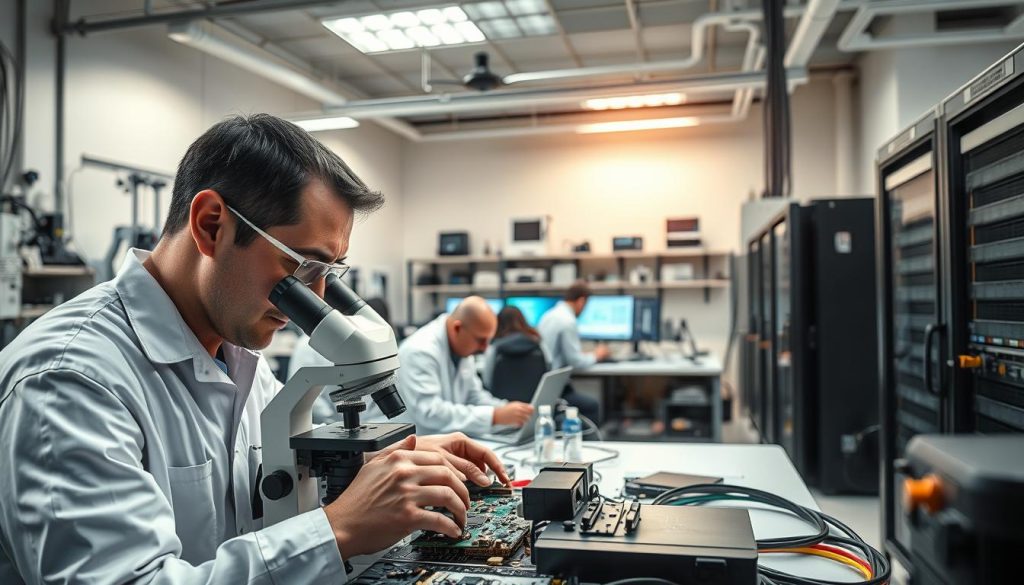
Manual inspection methods struggle to keep pace with today’s high-volume manufacturing. Human eyes grow tired, and subtle flaws can escape notice among millions of parts. The demand for near-perfect accuracy has never been greater.
We recognize these pressures facing American manufacturers. That’s why we’re transforming quality control through advanced technologies. Our approach moves beyond outdated systems to intelligent, automated solutions.
Cloud-based innovation lies at the heart of our methodology. This allows for scalable systems that can be deployed across multiple facilities. Manufacturers gain consistent, reliable oversight without massive infrastructure investments.
This article will guide you through practical implementation strategies. We’ll explore how these technologies reduce operational burdens while enhancing product quality. Our goal is to provide actionable insights for business growth.
Key Takeaways
- Traditional inspection methods are increasingly inadequate for modern manufacturing volumes
- Automated systems offer superior accuracy and consistency compared to manual processes
- Cloud-based solutions enable scalable deployment across distributed facilities
- Advanced technologies significantly reduce operational costs and defect rates
- Implementation requires careful planning but delivers substantial long-term benefits
- Quality control transformation supports business growth and competitive advantage
Introduction to Deep Learning for Electronic Component Defect Detection
With daily production volumes exceeding 10 million units in some component categories, traditional inspection methods face insurmountable challenges. The DIP switch market alone demonstrates this scale, projected to reach $554.35 million by 2031. This growth underscores the critical need for advanced quality control systems.
We recognize the fundamental shift from manual visual checks to automated systems. Conventional methods create significant burdens on inspection personnel due to their labor-intensive nature. Industry 4.0 trends emphasize converting toward continuous, consistent production systems.
| Inspection Method |
Accuracy Rate |
Processing Speed |
Scalability |
Labor Requirements |
| Manual Visual Inspection |
70-85% |
10-50 units/minute |
Limited |
High |
| Rule-Based Automated Systems |
85-92% |
100-500 units/minute |
Moderate |
Medium |
| Advanced AI Solutions |
95-99% |
1000+ units/minute |
High |
Low |
These technologies have demonstrated remarkable success across diverse applications. From medical imaging to material analysis, they establish a proven foundation for industrial applications. Modern systems learn complex patterns that traditional methods cannot effectively encode.
We position our cloud-enabled solutions as the bridge between cutting-edge research and practical implementation. Manufacturers gain access to advanced capabilities without requiring extensive in-house expertise. This approach ensures scalable, reliable oversight across distributed facilities.
Comparison: Traditional Methods vs Deep Learning Approaches
The transition from conventional inspection techniques to modern automated systems represents a fundamental shift in manufacturing quality assurance. We observe distinct advantages emerging from this technological evolution.
Challenges with Traditional Inspection Methods
Traditional approaches rely heavily on preset thresholds and rule-based algorithms. These systems perform binary classification using fixed parameters to identify flaws.
Conventional methods struggle with image contamination and lighting variations. They require extensive manual configuration for each specific defect type.
This creates significant maintenance burdens and limits adaptability across different production scenarios. The systems cannot effectively handle new or evolving defect patterns.
Advantages of Deep Learning-Based Systems
Modern approaches automatically learn discriminating features from training data. They adapt to subtle variations without manual rule reconfiguration.
These systems demonstrate superior performance in complex manufacturing environments. They handle changes in lighting, positioning, and surface characteristics effectively.
While traditional methods offer simplicity in setup, they create higher operational costs through false positives and missed defects. Our solutions provide fundamental advances in detection capability and long-term reliability.
Overview of Electronic Component Defect Detection Techniques
Manufacturers today have access to diverse analytical approaches for ensuring product quality across different operational contexts. We categorize these into three fundamental methodologies, each offering distinct advantages for specific manufacturing scenarios.
| Method |
Best Use Case |
Data Requirements |
Processing Speed |
| Part Image Classification |
Predetermined component locations |
Moderate training data |
High |
| Whole Image Understanding |
Multiple component analysis |
Extensive training data |
Medium |
| Direct Defect Detection |
Precise flaw localization |
Specialized training data |
Variable |
Part image classification focuses on analyzing cropped sections, predicting both component types and quality status. This approach works effectively when component positions and sizes are standardized.
Whole image examination provides comprehensive analysis of complete circuit boards in a single pass. It identifies multiple components and potential issues simultaneously across the entire field of view.
The most targeted methodology involves direct identification of flaw locations within images. This technique delivers precise spatial information about where quality problems occur.
Selection among these techniques depends on available training data volume, specific inspection objectives, and computational resources. Each approach presents unique trade-offs in accuracy, speed, and implementation complexity.
We guide manufacturers through evaluating their operational constraints against these methodological options. The choice significantly impacts both detection performance and long-term system maintenance requirements.
Role of Printed Circuit Boards in Modern Electronics
As electronic systems grow increasingly complex, printed circuit boards serve as the critical infrastructure enabling seamless component integration. These foundational elements connect various electronic parts through conductive pathways on insulating substrates.
Key Components and Quality Control
We recognize that printed circuit technology incorporates essential elements like capacitors, resistors, and semiconductors. These components work together through precisely designed conductive paths.
Quality assurance must address multiple defect categories throughout the manufacturing process. Surface imperfections and component placement errors represent common challenges requiring careful detection.
| Defect Category |
Common Examples |
Detection Priority |
| Surface Defects |
Contamination, scratches, solder overflow |
High |
| Component Issues |
Misaligned pins, missing parts, wrong orientation |
Critical |
| Circuit Problems |
Open circuits, short circuits, incorrect routing |
Medium-High |
| Assembly Errors |
Incorrect component values, reversed polarity |
High |
Importance of Inspection in PCB Manufacturing
We emphasize that comprehensive inspection systems have become indispensable for modern production. The miniaturization of circuit board components demands precise detection capabilities.
Automated optical inspection provides consistent quality assessment across high-volume manufacturing. This approach ensures reliable performance in diverse applications from consumer electronics to automotive systems.
Effective quality control protects brand reputation while reducing operational costs. It represents a strategic investment in long-term manufacturing excellence.
Deep Learning Algorithms Revolutionizing Defect Detection
Breakthroughs in computational vision are transforming how manufacturers approach quality assurance processes. We implement sophisticated algorithms that continuously improve their performance through exposure to diverse visual data.
Convolutional Neural Networks and Their Impact
We recognize that convolutional architectures represent the fundamental advancement enabling modern inspection systems. These networks process visual information through layered structures that build complexity progressively.
Simple edges and textures form the foundation for more sophisticated pattern recognition. This hierarchical approach allows the system to identify subtle imperfections that escape conventional methods.
The spatial hierarchy capture capability makes these networks particularly effective for localized quality issues. They excel at detecting variations that characterize manufacturing imperfections across diverse components.
Integration of Machine Learning and Image Processing
We emphasize the synergistic combination of adaptive intelligence with enhanced data quality techniques. Machine learning provides the framework for continuous improvement while image processing optimizes feature extraction.
This integration creates systems capable of recognizing both known flaw patterns and previously unseen anomalies. The technology learns complex relationships between visual features and quality categories that would be impractical to encode manually.
Our cloud-enabled approach makes these sophisticated architectures accessible without requiring extensive in-house expertise. Manufacturers benefit from advanced capabilities while avoiding substantial computational infrastructure investments.
In-Depth Analysis of YOLO Versions for DIP Inspection
Our investigation into automated visual inspection systems focused on identifying the most effective architecture for dual in-line package (DIP) quality control. We evaluated four distinct YOLO versions against stringent performance criteria.
This analysis provides manufacturers with practical guidance for selecting optimal systems based on specific operational constraints.
Differences Between YOLOv3, YOLOv4, YOLOv7, and YOLOv9
Each YOLO iteration introduces architectural refinements that impact real-world performance. These changes affect backbone networks, feature extraction, and detection head designs.
While YOLOv9 represents the latest advancement, our testing revealed that newer versions don’t automatically guarantee superior results for specific industrial applications.
Performance Metrics: Accuracy and Processing Time
Our evaluation demonstrated that YOLOv7 with ConSinGAN augmentation achieved superior performance with 95.50% accuracy. This model completed detection in 285 milliseconds per image.
This represents a substantial improvement over threshold-based methods. More importantly, it reduces production detection time by 909-948 milliseconds.
Detection speed is critical for maintaining synchronization with automated production lines. Our findings help manufacturers balance accuracy requirements with throughput demands.
Leveraging Data Augmentation for Improved Performance
A critical bottleneck in automated quality control systems involves the limited availability of flawed product samples for training purposes. We address this challenge through strategic data augmentation techniques that expand limited datasets effectively.
Role of ConSinGAN in Dataset Expansion
We leverage ConSinGAN, a specialized generative adversarial network, to overcome data scarcity. This model develops from single images, progressively increasing resolution through multi-stage training. Starting at 25×25 pixels, each stage adds complexity.
This approach effectively simulates authentic flaw characteristics in generated images. It requires fewer training samples than alternatives like DCGAN or WGAN architectures.
| Augmentation Technique |
Application |
Impact on Model |
| Flipping/Mirroring |
Orientation variations |
Improves rotation invariance |
| Brightness Adjustment |
Lighting simulation |
Enhances lighting robustness |
| Noise Injection |
Real-world conditions |
Increases noise tolerance |
| Gaussian Blur |
Focus variations |
Improves focus flexibility |
These data augmentation strategies serve dual purposes. They expand limited datasets while improving model robustness against production variations. Our approach bridges the gap between data requirements and manufacturing realities.
Real-World Implementation in Automated Manufacturing
Successful deployment of automated quality control requires careful integration with existing production infrastructure. We design comprehensive systems that bridge advanced technology with practical manufacturing constraints.
Our approach addresses both technical capabilities and operational realities. This ensures reliable performance in demanding industrial environments.
Integration with SCADA and Industrial Equipment
We establish supervisory control interfaces that enable seamless communication between analytical models and production equipment. This creates centralized monitoring capabilities across multiple facilities.
The control system combines personal computers with programmable logic controllers for robust operation. Ethernet connections link imaging equipment with analytical capabilities for real-time processing.
| System Component |
Function |
Integration Method |
Operational Benefit |
| Control System |
Coordinates detection processes |
PC-PLC communication |
Centralized management |
| Imaging Equipment |
Captures component images |
Ethernet connectivity |
High-quality data acquisition |
| Mechanical Interface |
Handles component positioning |
Pneumatic and electromagnetic controls |
Automated part handling |
Addressing Hardware Limitations in Production Lines
We develop lightweight analytical models that operate within industrial computational constraints. This practical approach avoids requiring unlimited resources while maintaining accuracy.
Our imaging architecture inspects all six sides of components using specialized camera configurations. Different depth-of-field settings ensure optimal coverage for various part geometries.
Multiple automated optical inspection stations minimize interference from production environment variables. This comprehensive approach delivers consistent results despite challenging conditions.
deep learning for electronic component defect detection
Forward-thinking manufacturers recognize that intelligent inspection technologies offer more than incremental improvements—they enable complete operational transformation. We consolidate our understanding that this represents a fundamental shift in quality control methodology.
| Implementation Factor |
Consideration |
Impact Level |
Timeline |
| Model Selection |
Architecture compatibility |
High |
Initial phase |
| Data Strategy |
Training sample acquisition |
Critical |
Ongoing |
| System Integration |
Existing infrastructure |
Medium-High |
Deployment phase |
| Business Alignment |
Operational objectives |
High |
Strategic planning |
Successful deployment requires comprehensive planning across multiple dimensions. We emphasize careful model selection, adequate training data preparation, and seamless integration with manufacturing workflows.
These approaches excel where flaw patterns demonstrate complexity and variability. High-volume production environments benefit most from automated inspection capabilities.
Our cloud innovation platform eliminates traditional barriers to advanced technology adoption. Manufacturers gain access to sophisticated analytical capabilities without substantial infrastructure investment.
We invite organizations seeking enhanced quality control to contact our team today. Visit https://opsiocloud.com/contact-us/ to begin your transformation journey with tailored solutions that deliver measurable business value.
Impact of Image Quality and Contamination on Detection
Image contamination presents one of the most persistent challenges in maintaining consistent detection performance across manufacturing environments. We recognize that visual data integrity directly influences system reliability, requiring careful attention to environmental factors.
Industrial settings generate multiple contamination sources that affect detection accuracy. These include close-up imaging challenges and illumination variations that obscure critical details.
Effects of Lighting Changes and Image Noise
Lighting variations and image noise significantly impact detection reliability. Internal lighting systems create reflections and shadows that mask flaw characteristics.
Electronic sensors introduce noise that can generate false positives or obscure genuine defects. We address these challenges through robust preprocessing techniques.
Strategies for Mitigating Contamination Issues
We implement comprehensive strategies to maintain detection quality despite environmental challenges. Regular optical system maintenance prevents lens contamination issues.
Our approach includes training models on augmented datasets containing realistic contamination patterns. This ensures stable performance across varying manufacturing conditions.
Manufacturing applications demand near-perfect accuracy, making contamination resistance essential. Our cloud platform enables ongoing monitoring and rapid model adjustments.
Industrial Deployment in the United States
The United States manufacturing sector faces distinct operational challenges that shape technology adoption patterns. We observe that domestic production facilities must navigate high labor costs, stringent quality requirements, and competitive global pressures.
American manufacturers confront skilled labor shortages in quality inspection roles. These workforce gaps create significant bottlenecks in production lines. Regulatory compliance demands documented inspection processes across critical sectors.
We emphasize that successful implementation requires careful integration with existing enterprise platforms. This includes ERP and MES systems that manage operational workflows. Alignment with workforce development initiatives helps transition personnel to analytical roles.
Key sectors benefiting from automated oversight include aerospace, medical devices, and automotive parts. These industries maintain rigorous quality standards where flaw costs are substantial. The reshoring trend creates opportunities for domestic competitive advantages.
Our cloud-enabled solutions support distributed operations across multiple facilities. This approach enables centralized model management while maintaining local oversight. We help manufacturers navigate adoption complexities from planning through full deployment.
Integrating Cloud Innovation with Automation Systems
Cloud-based innovation is reshaping how automated systems manage quality control across distributed production networks. We combine cloud infrastructure with industrial automation to create comprehensive oversight solutions. This integration enables centralized management while maintaining local operational flexibility.
Benefits of Cloud Computing in Defect Detection
Cloud computing delivers significant advantages for automated oversight. We eliminate substantial upfront hardware investments. Our approach provides access to scalable computational resources for demanding analytical tasks.
Centralized data storage enables comprehensive analysis across multiple facilities. This creates a unified view of quality performance. Software updates and model improvements deploy seamlessly across the entire network.
Our cloud architecture facilitates rapid deployment of proven detection models. This ensures consistent quality standards while accommodating local variations. The system adapts to changing production requirements without extensive technical expertise.
Future Trends in IoT and Cloud-Enabled Manufacturing
Emerging technologies will further enhance cloud-enabled manufacturing capabilities. Edge computing provides ultra-low-latency detection at the source. This complements cloud-based analytics for comprehensive oversight.
Federated learning enables privacy-preserving model improvement across sites. This approach maintains data security while leveraging collective intelligence. Integration with broader Industry 4.0 ecosystems creates synergistic benefits.
Cloud platforms support sophisticated analytics beyond individual detection events. We enable trend analysis and predictive quality modeling. This facilitates root cause investigation and continuous process optimization.
Our cloud innovation approach provides the foundation for manufacturing agility. It enables rapid response to new product introductions and evolving quality standards. We invite you to explore how cloud-enabled oversight can transform your operations.
Contact us today to discuss your specific manufacturing context. Visit https://opsiocloud.com/contact-us/ for tailored solutions that deliver immediate value.
Academic and Industry Perspectives on Defect Detection
Academic research provides crucial foundations that bridge theoretical advancements with practical manufacturing applications. We analyze how scholarly insights translate into operational improvements.
Research studies demonstrate extensive investigation into automated detection methodologies. These investigations span multiple architectures including YOLO variants and convolutional networks.
Insights from Research Studies and Papers
We reference significant findings from peer-reviewed publications. Studies in IEEE CVPR proceedings (pp. 4510-4520) establish performance benchmarks.
Public datasets like those on Kaggle facilitate standardized testing. However, these often lack manufacturing-specific challenges.
| Research Focus |
Academic Emphasis |
Industry Requirements |
| Model Architecture |
Theoretical performance |
Computational efficiency |
| Data Requirements |
Standardized datasets |
Real-world variability |
| Performance Metrics |
Accuracy percentages |
Production line integration |
Practical Implications in Real-World Applications
We recognize the gap between laboratory results and factory floor implementation. Newer models don’t automatically guarantee superior performance.
Practical applications demand balancing accuracy with speed and resource constraints. Our approach synthesizes research insights with operational realities.
Manufacturers benefit from understanding that data quality often outweighs model complexity. This perspective guides effective implementation strategies.
Strategic Insights from Web Sources and Research
Research collaborations across leading academic institutions reveal critical patterns in automated quality assurance methodologies. We analyze findings from comprehensive studies that bridge theoretical advancements with practical manufacturing applications.
These investigations provide validated frameworks for industrial implementation success. The methodologies demonstrate measurable improvements in detection accuracy across diverse manufacturing contexts.
Analysis of Source Data and Case Studies
Our examination of institutional research identifies three primary approaches for quality assessment. Each method offers distinct advantages based on specific operational requirements and available resources.
The balance of training data emerges as a critical success factor. Industrial applications face unique challenges in dataset creation compared to standard image collections.
| Research Methodology |
Detection Accuracy |
Data Requirements |
Industrial Applicability |
| Part Image Classification |
92-96% |
Moderate dataset |
High for standardized components |
| Whole Image Understanding |
88-94% |
Extensive training images |
Medium for complex assemblies |
| Direct Defect Identification |
95-99% |
Specialized defect data |
Variable by application |
Case studies consistently highlight the importance of comprehensive system integration. Successful implementations combine accurate model performance with robust mechanical handling and control interfaces.
We position these strategic insights as foundations for our cloud-enabled solutions. They incorporate proven methodologies and lessons from research to deliver reliable detection systems.
Technology Trends and Future Opportunities
Future-oriented inspection systems are transitioning from isolated detection functions to integrated quality management ecosystems that leverage multiple data sources. We observe increasing miniaturization and complexity driving corresponding advances in inspection technologies.
Emerging architectures like vision transformers and EfficientNet promise improved performance with reduced computational requirements. These models enhance capability to learn from limited training data through sophisticated attention mechanisms.

Edge computing enables ultra-low-latency detection by performing inference directly on industrial devices. This approach reduces network dependence while supporting real-time decision-making at production speeds.
Federated learning represents a breakthrough for collaborative model improvement across multiple sites. This methodology preserves data privacy while enabling industry-wide performance advances.
We emphasize the evolution toward comprehensive quality management systems that integrate inspection data with process monitoring. Our cloud innovation platform provides the architectural flexibility required to incorporate emerging technologies as they mature.
Opportunities extend beyond traditional manufacturing to encompass electronic waste recycling and circular economy applications. We commit to ongoing investment ensuring our solutions evolve with technological advances.
Conclusion
Advanced analytical technologies have fundamentally reshaped quality control paradigms in modern production environments. We have demonstrated how these systems deliver superior accuracy and operational efficiency compared to traditional methods.
Successful implementation requires careful planning across multiple dimensions. This includes selecting appropriate analytical models, preparing adequate training data, and ensuring seamless integration with manufacturing workflows.
Cloud innovation serves as the essential enabler, making sophisticated capabilities accessible to manufacturers of all sizes. Our approach eliminates barriers related to expertise and infrastructure while providing scalability and continuous improvement.
The future extends beyond standalone inspection toward comprehensive quality management systems. These integrated approaches will incorporate emerging technologies and enable predictive rather than reactive oversight.
We invite manufacturers seeking to transform their quality control capabilities to contact us today. Visit https://opsiocloud.com/contact-us/ to discuss tailored solutions that deliver immediate value.
FAQ
How does deep learning improve defect detection compared to traditional methods?
Our approach leverages convolutional neural networks to automatically learn intricate patterns from images, significantly enhancing accuracy over manual inspection. These systems analyze visual data with superior consistency, reducing human error and increasing throughput in quality control processes.
What types of electronic component defects can be identified using this technology?
Our advanced models are trained to recognize various anomalies, including soldering defects, misaligned parts, cracks, and missing components on printed circuit boards. The system’s neural networks adapt to identify both common and rare flaw types across different manufacturing stages.
How does data augmentation enhance the performance of defect detection systems?
We employ sophisticated techniques like ConSinGAN to artificially expand training datasets, creating diverse examples that improve model robustness. This methodology helps neural networks generalize better to real-world variations in lighting, angle, and component types without requiring extensive manual data collection.
What role do printed circuit boards play in modern defect detection applications?
As foundational elements in electronics, printed circuit boards require meticulous inspection to ensure proper functionality. Our solutions provide comprehensive analysis of these boards, examining solder joints, component placement, and structural integrity through high-resolution imaging and machine learning algorithms.
How do different YOLO versions compare in electronic inspection applications?
Each YOLO iteration brings distinct advantages in speed and precision for real-time detection. Our implementation carefully selects versions based on specific operational requirements, balancing processing time against accuracy metrics to optimize performance for automated manufacturing environments.
Can these systems integrate with existing industrial manufacturing equipment?
A>Absolutely. Our solutions are designed for seamless integration with SCADA systems and production line machinery. We ensure compatibility with various industrial protocols, enabling real-time monitoring and immediate feedback without disrupting established manufacturing workflows.
What measures are taken to address image quality issues in industrial settings?
We implement advanced preprocessing techniques and noise reduction algorithms to compensate for challenging conditions. Our models are trained on diverse datasets that account for variable lighting, surface reflections, and common contaminants, ensuring reliable performance across different production environments.
How does cloud innovation enhance automated defect detection systems?
Cloud computing enables scalable processing power for complex neural network operations, facilitating continuous model improvement through aggregated data. This infrastructure supports real-time analytics across multiple production facilities, creating a unified quality management ecosystem that evolves with emerging trends.